Butler James R A, Davila Federico, Alders Robyn, Bourke R Michael, Crimp Steve, McCarthy John, McWilliam Andrew, Palo Anton S M, Robins Lisa, Webb Michael J, van Wensveen Monica, Sanderson Todd, Walker Daniel
CSIRO Land and Water, Brisbane, Australia.
Institute for Sustainable Futures, University of Technology, Sydney, Australia.
Environ Sci Policy. 2021 Mar;117:34-45. doi: 10.1016/j.envsci.2020.12.011. Epub 2020 Dec 23.
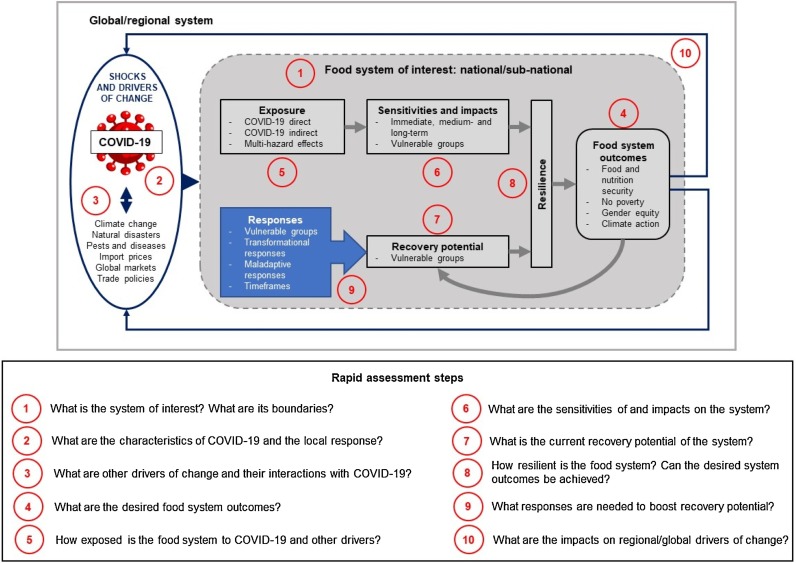
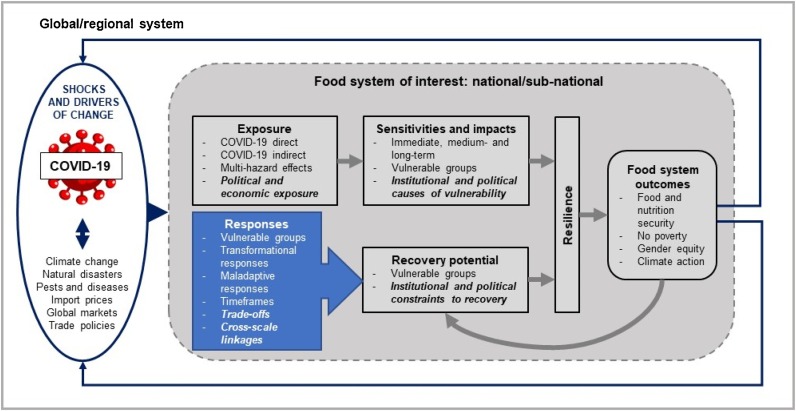
The frequency and severity of shocks to food systems is accelerating globally, exemplified by the current COVID-19 outbreak. In low- and middle-income countries, the impacts have exacerbated existing food system vulnerabilities and poverty. Governments and donors must respond quickly, but few tools are available that identify interventions to build food system resilience, or emerging opportunities for transformation. In this paper we reflect on the application of a systems-based rapid assessment which we applied across 11 Indo-Pacific countries in May-July 2020. Our approach was shaped by three design parameters: the integration of key informants' perspectives engaged remotely within the countries, applicability to diverse food systems and COVID-19 experiences across the region, and the consideration of food systems as complex systems. For the rapid assessment we adopted an analytical framework proposed by Allen and Prosperi (2016). To include a development lens, we added the analysis of vulnerable groups and their exposure, impacts, recovery potential and resilience, and pro-poor interventions. We concluded that the framework and approach facilitated integration and triangulation of disparate knowledge types and data to identify priority interventions and was sufficiently flexible to be applied across food systems, at both national, sub-national and commodity scales. The step-wise method was simple and enabled structured inquiry and reporting. Although the systems concepts appeared more easily transferrable to key informants in some countries than others, potentially transformational interventions were identified, and also some risks of maladaptation. We present a refined framework that emphasises analysis of political, economic and institutional drivers of exposure and vulnerability, the constraints that they pose for building recovery potential and resilience, and trade-offs amongst winners and losers inherent in proposed interventions.
全球范围内,粮食系统受到冲击的频率和严重程度正在加速上升,当前的新冠疫情就是例证。在低收入和中等收入国家,这些冲击加剧了粮食系统现有的脆弱性和贫困状况。政府和捐助方必须迅速做出回应,但几乎没有工具可用于确定增强粮食系统复原力的干预措施或转型的新机遇。在本文中,我们反思了一种基于系统的快速评估方法的应用情况,该方法于2020年5月至7月在11个印太国家进行了应用。我们的方法受三个设计参数影响:将各国远程参与的关键信息提供者的观点纳入其中、适用于该地区多样化的粮食系统和新冠疫情经历,以及将粮食系统视为复杂系统。对于快速评估,我们采用了艾伦和普罗斯佩里(2016年)提出的分析框架。为纳入发展视角,我们增加了对弱势群体及其暴露情况、影响、恢复潜力和复原力以及扶贫干预措施的分析。我们得出的结论是,该框架和方法有助于整合不同类型的知识和数据并进行三角测量,以确定优先干预措施,并且足够灵活,可在国家、次国家和商品层面应用于各种粮食系统。逐步方法简单易行,能够进行结构化调查和报告。尽管系统概念在某些国家似乎比其他国家更容易传达给关键信息提供者,但我们识别出了潜在的变革性干预措施,也发现了一些适应不良的风险。我们提出了一个完善的框架,该框架强调对暴露和脆弱性的政治、经济和制度驱动因素进行分析,它们对建立恢复潜力和复原力所构成的制约,以及拟议干预措施中固有的赢家和输家之间的权衡。