Suppr超能文献

基于个性化气象触发因素预测哮喘发作的优化深度神经网络模型。

Optimised deep neural network model to predict asthma exacerbation based on personalised weather triggers.

机构信息

Faculty of Computing and Informatics, Multimedia University, Cyberjaya, 63100, Malaysia.

Faculty of Medicine, University of Malaya, Kuala Lumpur, 50603, Malaysia.

出版信息

F1000Res. 2021 Sep 10;10:911. doi: 10.12688/f1000research.73026.1. eCollection 2021.

Abstract
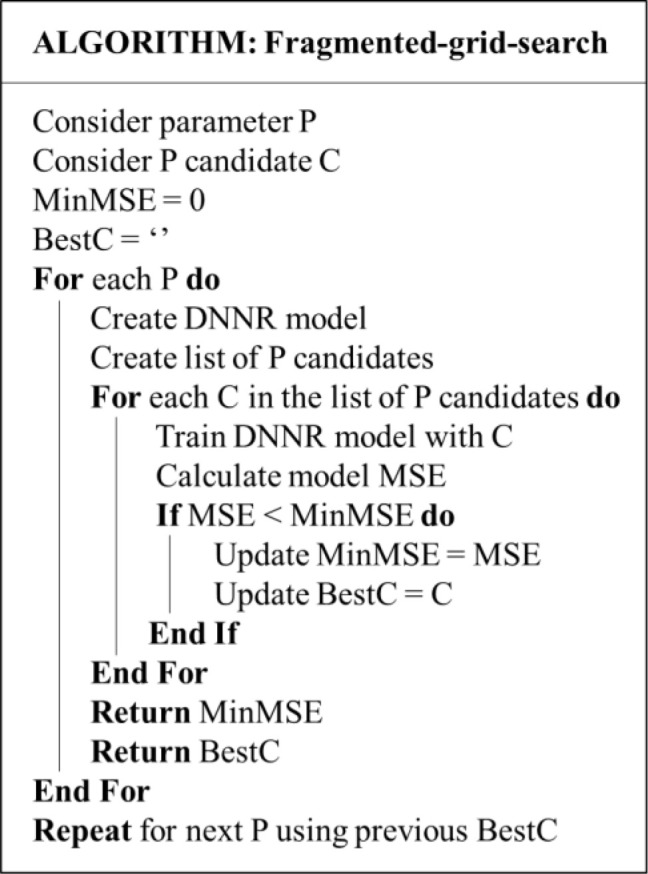
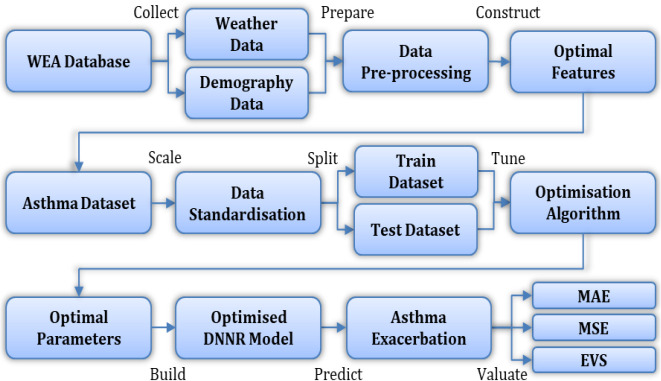
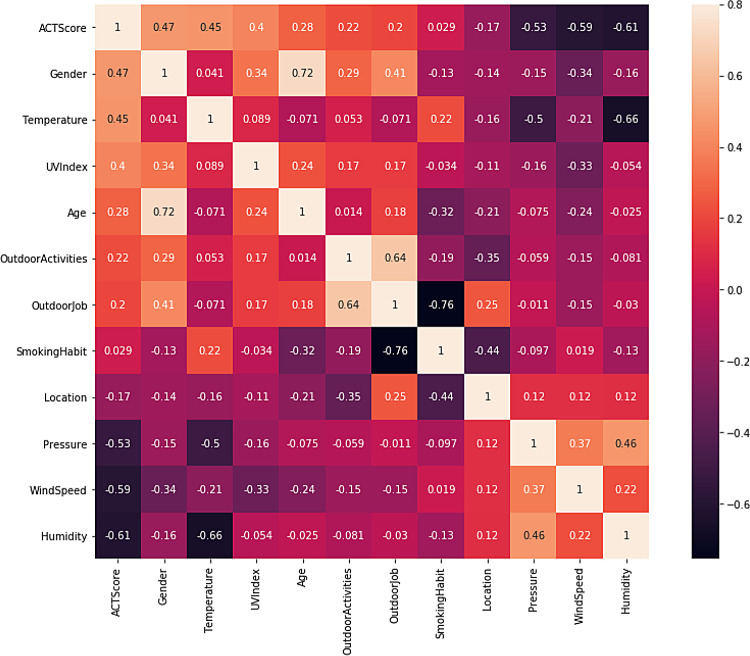
  • Recently, there have been attempts to develop mHealth applications for asthma self-management. However, there is a lack of applications that can offer accurate predictions of asthma exacerbation using the weather triggers and demographic characteristics to give tailored response to users. This paper proposes an optimised Deep Neural Network Regression (DNNR) model to predict asthma exacerbation based on personalised weather triggers. - With the aim of integrating weather, demography, and asthma tracking, an mHealth application was developed where users conduct the Asthma Control Test (ACT) to identify the chances of their asthma exacerbation. The asthma dataset consists of panel data from 10 users that includes 1010 ACT scores as the target output. Moreover, the dataset contains 10 input features which include five weather features (temperature, humidity, air-pressure, UV-index, wind-speed) and five demography features (age, gender, outdoor-job, outdoor-activities, location). - Using the DNNR model on the asthma dataset, a score of 0.83 was achieved with Mean Absolute Error (MAE)=1.44 and Mean Squared Error (MSE)=3.62. It was recognised that, for effective asthma self-management, the prediction errors must be in the acceptable loss range (error<0.5). Therefore, an optimisation process was proposed to reduce the error rates and increase the accuracy by applying standardisation and fragmented-grid-search. Consequently, the optimised-DNNR model (with 2 hidden-layers and 50 hidden-nodes) using the Adam optimiser achieved a 94% accuracy with MAE=0.20 and MSE=0.09. - This study is the first of its kind that recognises the potentials of DNNR to identify the correlation patterns among asthma, weather, and demographic variables. The optimised-DNNR model provides predictions with a significantly higher accuracy rate than the existing predictive models and using less computing time. Thus, the optimisation process is useful to build an enhanced model that can be integrated into the asthma self-management for mHealth application.
摘要
  • 最近,人们试图开发用于哮喘自我管理的移动医疗应用程序。然而,缺乏能够利用天气触发因素和人口统计学特征来准确预测哮喘恶化的应用程序,从而为用户提供个性化的响应。本文提出了一种优化的深度神经网络回归(DNNR)模型,该模型基于个性化的天气触发因素预测哮喘恶化。

  • 为了整合天气、人口统计学和哮喘跟踪数据,开发了一个移动医疗应用程序,用户可以通过该程序进行哮喘控制测试(ACT),以确定哮喘恶化的可能性。哮喘数据集包含来自 10 位用户的面板数据,其中包含 1010 个 ACT 分数作为目标输出。此外,该数据集还包含 10 个输入特征,包括 5 个天气特征(温度、湿度、气压、紫外线指数、风速)和 5 个人口统计学特征(年龄、性别、户外工作、户外活动、位置)。

  • 在哮喘数据集上使用 DNNR 模型,平均绝对误差(MAE)为 1.44,均方误差(MSE)为 3.62,模型得分为 0.83。研究发现,为了进行有效的哮喘自我管理,预测误差必须在可接受的损失范围内(误差<0.5)。因此,提出了一种优化过程,通过应用标准化和分段网格搜索来降低误差率并提高准确性。因此,使用 Adam 优化器的优化-DNNR 模型(具有 2 个隐藏层和 50 个隐藏节点)达到了 94%的准确率,平均绝对误差(MAE)为 0.20,均方误差(MSE)为 0.09。

  • 本研究首次认识到 DNNR 识别哮喘、天气和人口统计学变量之间相关模式的潜力。优化的 DNNR 模型提供的预测准确率明显高于现有预测模型,且计算时间更少。因此,优化过程对于构建可集成到移动医疗应用程序中的增强型模型非常有用。
https://cdn.ncbi.nlm.nih.gov/pmc/blobs/5d7e/8543171/9626eda971c4/f1000research-10-76644-g0000.jpg

文献AI研究员

20分钟写一篇综述,助力文献阅读效率提升50倍。

立即体验

用中文搜PubMed

大模型驱动的PubMed中文搜索引擎

马上搜索

文档翻译

学术文献翻译模型,支持多种主流文档格式。

立即体验