Yasmin Farah, Zeeshan Muhammad Hamayl, Ullah Irfan
Department of Internal Medicine, Dow Medical College, Dow University of Health Sciences, Karachi, Pakistan.
Department of Community Medicine, Kabir Medical College (Gandhara University), Peshawar, Pakistan.
Ann Med Surg (Lond). 2022 Feb;74:102974. doi: 10.1016/j.amsu.2021.102974. Epub 2021 Nov 3.
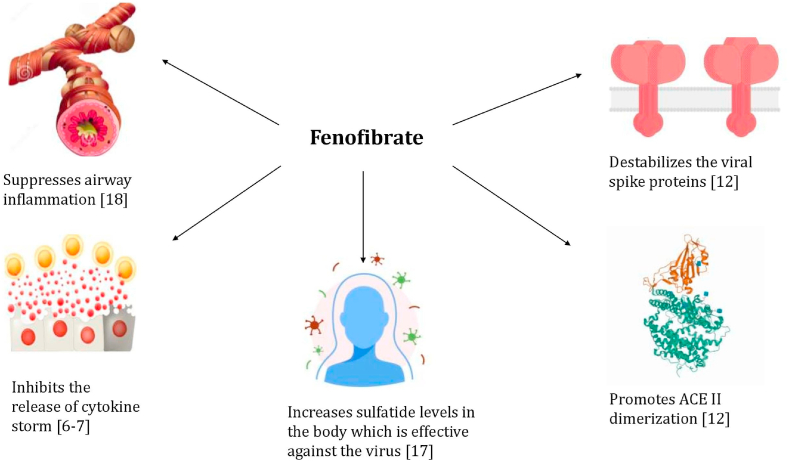
In December 2019, a severe pneumonia-like illness emerged in the city of Wuhan, China which inevitably led to the Coronavirus disease-19 (COVID-19) pandemic caused by the SARS-CoV-2 virus. Due to the increase in infectivity and mortality caused by the virus, multiple therapeutic regimens are being suggested in order to help tackle this problem. The infectivity of SARS-CoV2 virus is due to its ability to attach itself to the ACE II receptors on the host cells via its viral spike protein (S protein) and inducing its entry into the target cell. The effects of the drug, Fenofibrate on the ACE II receptors and also, how the pharmaceutical properties of this drug can help prevent viral entry and eventually, reduce severity in COVID-19 patients. Since this drug has a good profile and is relatively safe to use, the risk-to-benefit analysis is positive and can be beneficial for patients infected with severe SARS-CoV2 infection.
2019年12月,中国武汉市出现了一种严重的类似肺炎的疾病,不可避免地导致了由严重急性呼吸综合征冠状病毒2(SARS-CoV-2)病毒引起的2019冠状病毒病(COVID-19)大流行。由于该病毒导致的传染性和死亡率增加,人们提出了多种治疗方案以帮助解决这一问题。SARS-CoV-2病毒的传染性源于其通过病毒刺突蛋白(S蛋白)附着于宿主细胞上的血管紧张素转换酶2(ACE II)受体并诱导其进入靶细胞的能力。非诺贝特药物对ACE II受体的作用,以及该药物的药学特性如何有助于防止病毒进入并最终降低COVID-19患者的病情严重程度。由于该药物具有良好的特性且使用相对安全,风险效益分析是积极的,对感染严重SARS-CoV-2感染的患者可能有益。