Berry Craig W, Wolf S Tony, Cottle Rachel M, Kenney W Larry
Noll Laboratory, Department of Kinesiology, The Pennsylvania State University, University Park, PA, United States.
Graduate Program in Physiology, The Pennsylvania State University, University Park, PA, United States.
Front Sports Act Living. 2021 Oct 21;3:742710. doi: 10.3389/fspor.2021.742710. eCollection 2021.
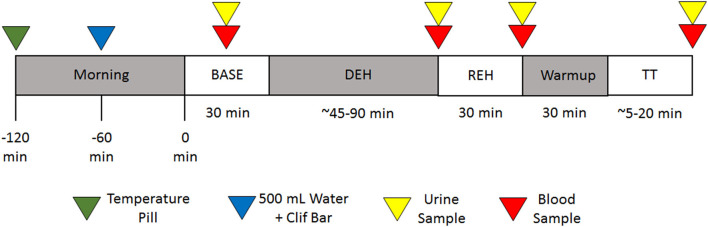
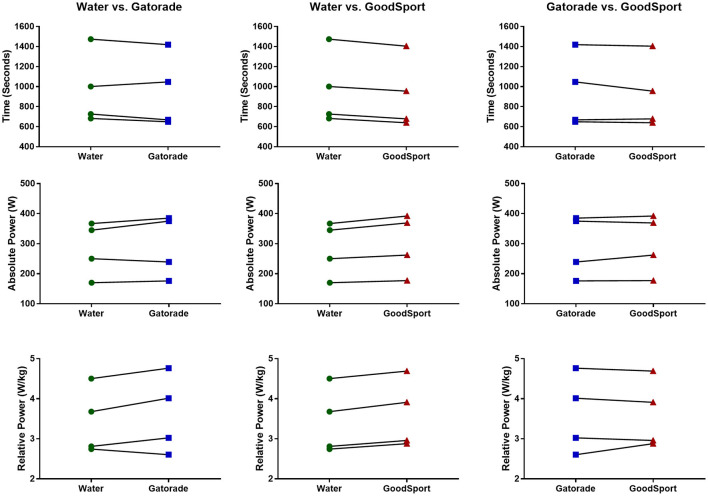
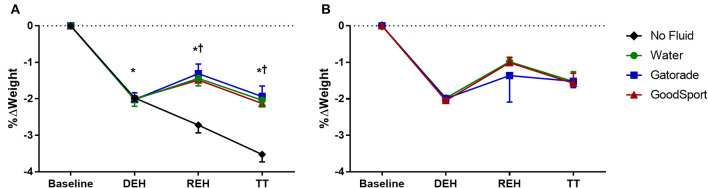
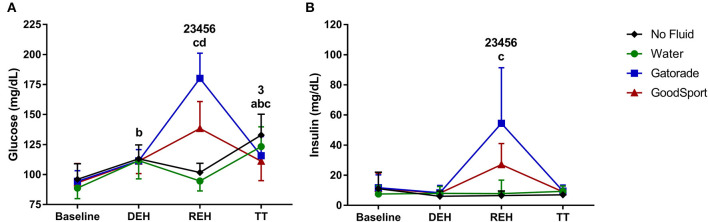
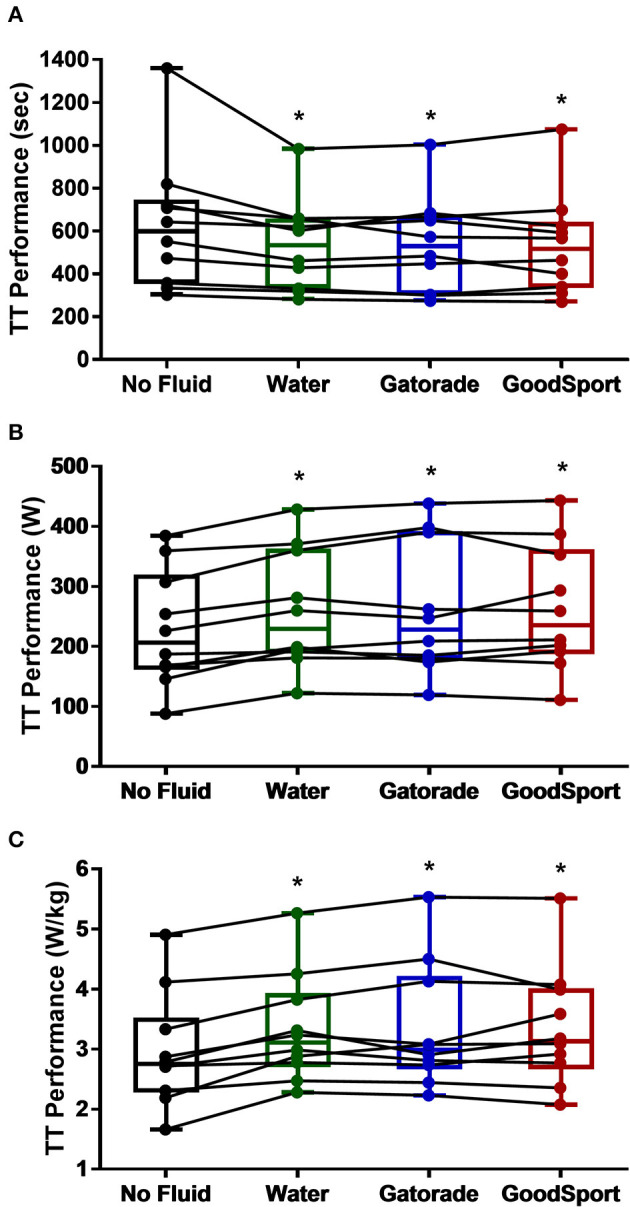
Dehydration ≥2% loss of body mass is associated with reductions in performance capacity, and carbohydrate (CHO)-electrolyte solutions (CES) are often recommended to prevent dehydration and provide a source of exogenous carbohydrate during exercise. It is also well established that performance capacity in the heat is diminished compared to cooler conditions, a response attributable to greater cardiovascular strain caused by high skin and core temperatures. Because hydration status, environmental conditions, and carbohydrate availability interact to influence performance capacity, we sought to determine how these factors affect push-to-the-finish cycling performance. Ten young trained cyclists exercised at a moderate intensity (2.5 W·kg) in a hot-dry condition [40°C, 20% relative humidity (RH)] until dehydration of ~2% body mass. Subjects then consumed either no fluid (NF) or enough fluid (water, WAT; Gatorade®, GAT; or GoodSport™, GS) to replace 75% of lost body mass over 30 min. After a 30-min light-intensity warm-up (1.5 W·kg) in a 35°C, 20% RH environment, subjects then completed a 120-kJ time trial (TT). TT time-to-completion, absolute power, and relative power were significantly improved in WAT (535 ± 214 s, 259 ± 99 W, 3.3 ± 0.9 W·kg), GAT (539 ± 226 s, 260 ± 110 W, 3.3 ± 1.0 W·kg), and GS (534 ± 238 s, 262 ± 105 W, 3.4 ± 1.0 W·kg) compared to NF (631 ± 310 s, 229 ± 96 W, 3.0 ± 0.9 W·kg) all ( < 0.01) with no differences between WAT, GAT, and GS, suggesting that hydration is more important than carbohydrate availability during exercise in the heat. A subset of four subjects returned to the laboratory to repeat the WAT, GAT, and GS treatments to determine if between-beverage differences in time-trial performance were evident with a longer TT in thermoneutral conditions. Following dehydration, the ambient conditions in the environmental chamber were reduced to 21°C and 20% RH and subjects completed a 250-kJ TT. All four subjects improved TT performance in the GS trial (919 ± 353 s, 300 ± 100 W, 3.61 ± 0.86 W·kg) compared to WAT (960 ± 376 s, 283 ± 91 W, 3.43 ± 0.83 W·kg), while three subjects improved TT performance in the GAT trial (946 ± 365 s, 293 ± 103 W, 3.60 ± 0.97 W·kg) compared to WAT, highlighting the importance of carbohydrate availability in cooler conditions as the length of a push-to-the-finish cycling task increases.
体重减轻≥2%的脱水与运动能力下降有关,碳水化合物(CHO)-电解质溶液(CES)常被推荐用于预防脱水,并在运动期间提供外源碳水化合物来源。与较凉爽的条件相比,热环境下的运动能力也会明显下降,这种反应归因于皮肤和核心温度升高导致的更大心血管压力。由于水合状态、环境条件和碳水化合物供应相互作用会影响运动能力,我们试图确定这些因素如何影响冲刺阶段的自行车骑行表现。十名年轻的受过训练的自行车运动员在炎热干燥的条件下(40°C,20%相对湿度(RH))以中等强度(2.5 W·kg)运动,直到体重减轻约2%。然后,受试者要么不补充液体(NF),要么补充足够的液体(水,WAT;佳得乐,GAT;或GoodSport™,GS),在30分钟内补充75%的体重减轻量。在35°C、20%RH的环境中进行30分钟的低强度热身(1.5 W·kg)后,受试者接着完成了一项120千焦的计时赛(TT)。与NF组(631±310秒,229±96瓦,3.0±0.9 W·kg)相比,WAT组(535±214秒,259±99瓦,3.3±0.9 W·kg)、GAT组(539±226秒,260±110瓦,3.3±1.0 W·kg)和GS组(534±238秒,262±105瓦,3.4±1.0 W·kg)的TT完成时间、绝对功率和相对功率均显著改善(均P<0.01),且WAT、GAT和GS组之间无差异,这表明在炎热环境下运动时,水合作用比碳水化合物供应更重要。四名受试者回到实验室重复WAT、GAT和GS处理,以确定在热中性条件下进行更长时间的TT时,饮料间在计时赛表现上的差异是否明显。脱水后,环境舱内的环境条件降至21°C和20%RH,受试者完成了一项250千焦的TT。与WAT组(960±376秒,283±91瓦,3.43±0.83 W·kg)相比,所有四名受试者在GS试验中的TT表现均有所改善(919±353秒,300±100瓦,3.61±0.86 W·kg),而与WAT组相比,三名受试者在GAT试验中的TT表现有所改善(946±365秒,293±103瓦,3.60±0.97 W·kg),这突出了在较凉爽条件下随着冲刺阶段自行车骑行任务时长增加,碳水化合物供应的重要性。