Aiello Marco, Esposito Giuseppina, Pagliari Giulio, Borrelli Pasquale, Brancato Valentina, Salvatore Marco
IRCCS SDN, Via Emanuele Gianturco 113, 80143, Naples, Italy.
Bio Check Up S.R.L, Naples, Italy.
Insights Imaging. 2021 Nov 8;12(1):164. doi: 10.1186/s13244-021-01081-8.
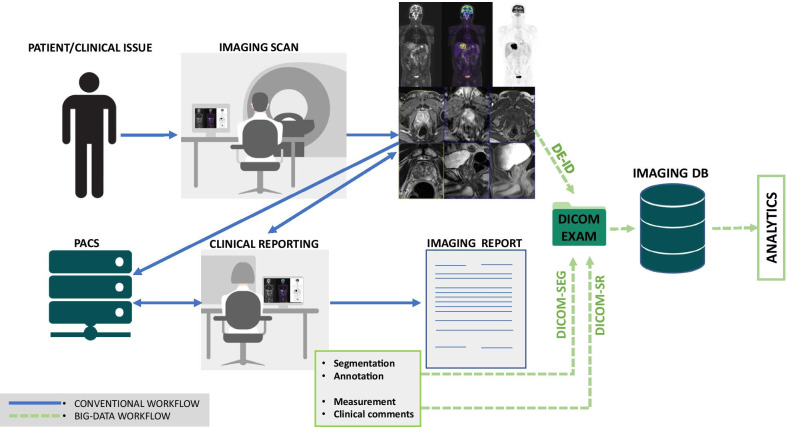
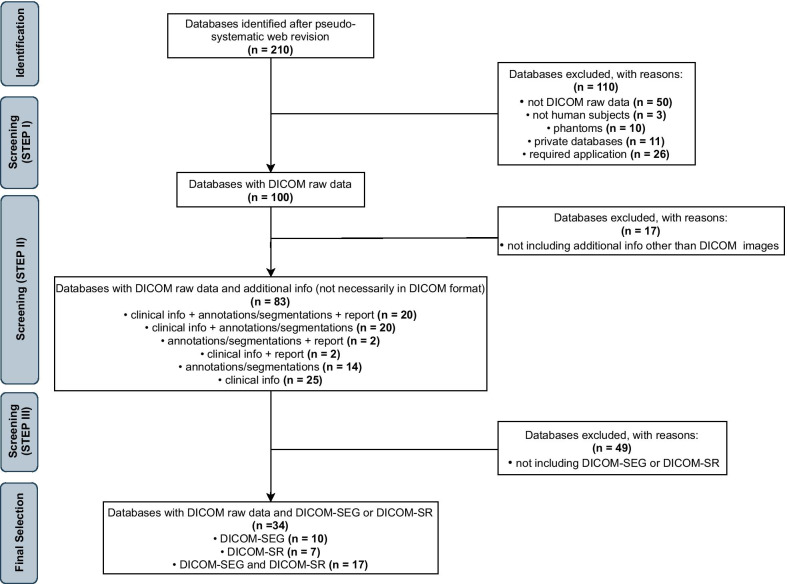
The diagnostic imaging field is experiencing considerable growth, followed by increasing production of massive amounts of data. The lack of standardization and privacy concerns are considered the main barriers to big data capitalization. This work aims to verify whether the advanced features of the DICOM standard, beyond imaging data storage, are effectively used in research practice. This issue will be analyzed by investigating the publicly shared medical imaging databases and assessing how much the most common medical imaging software tools support DICOM in all its potential. Therefore, 100 public databases and ten medical imaging software tools were selected and examined using a systematic approach. In particular, the DICOM fields related to privacy, segmentation and reporting have been assessed in the selected database; software tools have been evaluated for reading and writing the same DICOM fields. From our analysis, less than a third of the databases examined use the DICOM format to record meaningful information to manage the images. Regarding software, the vast majority does not allow the management, reading and writing of some or all the DICOM fields. Surprisingly, if we observe chest computed tomography data sharing to address the COVID-19 emergency, there are only two datasets out of 12 released in DICOM format. Our work shows how the DICOM can potentially fully support big data management; however, further efforts are still needed from the scientific and technological community to promote the use of the existing standard, encouraging data sharing and interoperability for a concrete development of big data analytics.
诊断成像领域正在经历显著增长,随之而来的是大量数据的不断产生。缺乏标准化和隐私问题被认为是大数据资本化的主要障碍。这项工作旨在验证DICOM标准的先进功能(除了成像数据存储之外)在研究实践中是否得到有效应用。将通过调查公开共享的医学影像数据库并评估最常见的医学影像软件工具在其所有潜在功能方面对DICOM的支持程度来分析这个问题。因此,使用系统方法选择并检查了100个公共数据库和10个医学影像软件工具。具体而言,在选定的数据库中评估了与隐私、分割和报告相关的DICOM字段;对软件工具进行了评估,以确定其对相同DICOM字段的读写能力。从我们的分析来看,在所检查的数据库中,不到三分之一使用DICOM格式记录有意义的信息来管理图像。在软件方面,绝大多数软件不允许对部分或所有DICOM字段进行管理、读取和写入。令人惊讶的是,如果我们观察用于应对新冠疫情紧急情况的胸部计算机断层扫描数据共享情况,在以DICOM格式发布的12个数据集中,只有两个数据集。我们的工作表明DICOM有潜力全面支持大数据管理;然而,科技界仍需进一步努力,以促进现有标准的使用,鼓励数据共享和互操作性,以推动大数据分析的具体发展。