School of Earth, Atmospheric and Life Sciences, Faculty of Science, Medicine and Health, University of Wollongong, Wollongong, New South Wales, Australia.
Department of Evolutionary Paleobiology, Institute of Paleobiology, Polish Academy of Sciences, Warsaw, Poland.
PLoS One. 2021 Nov 8;16(11):e0259004. doi: 10.1371/journal.pone.0259004. eCollection 2021.
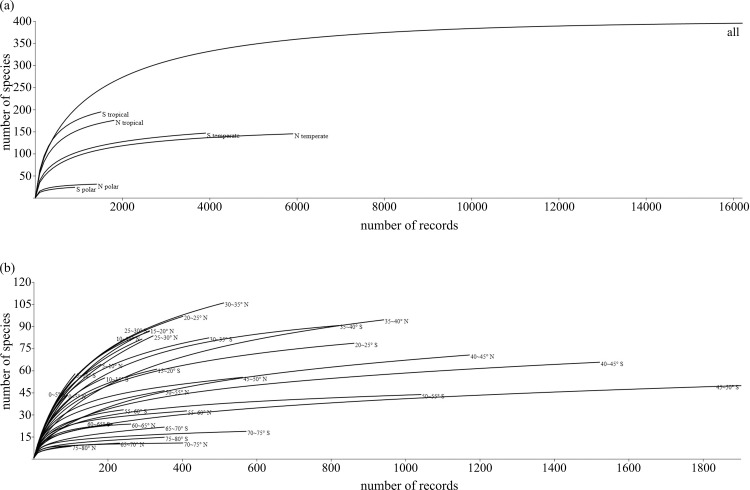
The global distribution patterns of 14918 geo-referenced occurrences from 394 living brachiopod species were mapped in 5° grid cells, which enabled the visualization and delineation of distinct bioregions and biodiversity hotspots. Further investigation using cluster and network analyses allowed us to propose the first systematically and quantitatively recognized global bioregionalization framework for living brachiopods, consisting of five bioregions and thirteen bioprovinces. No single environmental or ecological variable is accountable for the newly proposed global bioregionalization patterns of living brachiopods. Instead, the combined effects of large-scale ocean gyres, climatic zonation as well as some geohistorical factors (e.g., formation of land bridges and geological recent closure of ancient seaways) are considered as the main drivers at the global scale. At the regional scale, however, the faunal composition, diversity and biogeographical differentiation appear to be mainly controlled by seawater temperature variation, regional ocean currents and coastal upwelling systems.
全球 394 种活腕足动物的 14918 个地理参考点的分布模式被绘制在 5°的网格单元中,这使得不同的生物区系和生物多样性热点能够可视化和划定。进一步使用聚类和网络分析的研究使我们能够提出第一个系统地和定量地识别的活腕足动物的全球生物区系框架,包括五个生物区系和十三个生物省。没有一个单一的环境或生态变量可以解释新提出的活腕足动物的全球生物区系模式。相反,大规模海洋回旋、气候分带以及一些地质历史因素(如大陆桥的形成和古代海道的最近关闭)的综合影响被认为是全球范围内的主要驱动因素。然而,在区域尺度上,动物群组成、多样性和生物地理分化似乎主要受到海水温度变化、区域海流和沿海上升流系统的控制。