Wiebe Keith, Sulser Timothy B, Dunston Shahnila, Rosegrant Mark W, Fuglie Keith, Willenbockel Dirk, Nelson Gerald C
International Food Policy Research Institute, Washington, DC, United States of America.
United States Department of Agriculture, Economic Research Service, Washington, DC, United States of America.
PLoS One. 2021 Apr 15;16(4):e0249994. doi: 10.1371/journal.pone.0249994. eCollection 2021.
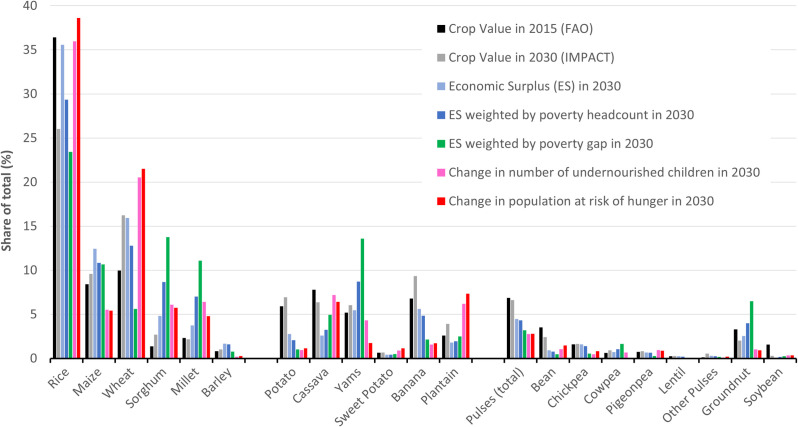
In 2017-2018, a group of international development funding agencies launched the Crops to End Hunger initiative to modernize public plant breeding in lower-income countries. To inform that initiative, USAID asked the International Food Policy Research Institute and the United States Department of Agriculture's Economic Research Service to estimate the impacts of faster productivity growth for 20 food crops on income and other indicators in 106 countries in developing regions in 2030. We first estimated the value of production in 2015 for each crop using data from FAO. We then used the IMPACT and GLOBE economic models to estimate changes in the value of production and changes in economy-wide income under scenarios of faster crop productivity growth, assuming that increased investment will raise annual rates of yield growth by 25% above baseline growth rates over the period 2015-2030. We found that faster productivity growth in rice, wheat and maize increased economy-wide income in the selected countries in 2030 by 59 billion USD, 27 billion USD and 21 billion USD respectively, followed by banana and yams with increases of 9 billion USD each. While these amounts represent small shares of total GDP, they are 2-15 times current public R&D spending on food crops in developing countries. Income increased most in South Asia and Sub-Saharan Africa. Faster productivity growth in rice and wheat reduced the population at risk of hunger by 11 million people and 6 million people respectively, followed by plantain and cassava with reductions of about 2 million people each. Changes in adequacy ratios were relatively large for carbohydrates (already in surplus) and relatively small for micronutrients. In general, we found that impacts of faster productivity growth vary widely across crops, regions and outcome indicators, highlighting the importance of identifying the potentially diverse objectives of different decision makers and recognizing possible tradeoffs between objectives.
2017年至2018年期间,一批国际发展资助机构发起了“作物促消饥”倡议,旨在使低收入国家的公共植物育种实现现代化。为了给该倡议提供参考依据,美国国际开发署要求国际粮食政策研究所和美国农业部经济研究局估算到2030年20种粮食作物生产率更快增长对发展中地区106个国家的收入及其他指标的影响。我们首先利用联合国粮食及农业组织(FAO)的数据估算了2015年每种作物的产值。然后,我们使用了“影响”(IMPACT)和“全球”(GLOBE)经济模型,在作物生产率更快增长的情景下估算产值变化和全经济范围的收入变化,假设在2015年至2030年期间增加投资将使年单产增长率比基线增长率提高25%。我们发现,水稻、小麦和玉米生产率更快增长分别使选定国家在2030年的全经济范围收入增加了590亿美元、270亿美元和210亿美元,其次是香蕉和山药,各增加了90亿美元。虽然这些金额在国内生产总值总额中所占份额较小,但却是发展中国家目前用于粮食作物公共研发支出的2至15倍。南亚和撒哈拉以南非洲的收入增长最多。水稻和小麦生产率更快增长分别使面临饥饿风险的人口减少了1100万和600万,其次是大蕉和木薯,各减少了约200万。碳水化合物(已供过于求)的充足率变化相对较大,而微量营养素的充足率变化相对较小。总体而言,我们发现作物生产率更快增长的影响在作物、地区和结果指标之间差异很大,这凸显了明确不同决策者潜在的多样化目标以及认识目标之间可能的权衡取舍的重要性。