Microelectronics & Nanotechnology-Shamsuddin Research Centre (MiNT-SRC), Institute of Integrated Engineering (IIE), Universiti Tun Hussein Onn Malaysia, Parit Raja, Batu Pahat Johor, Malaysia.
Faculty of Electronic and Electrical Engineering (FKEE), Universiti Tun Hussein Onn Malaysia, Parit Raja, Batu Pahat Johor, Malaysia.
PLoS One. 2021 Nov 8;16(11):e0259730. doi: 10.1371/journal.pone.0259730. eCollection 2021.
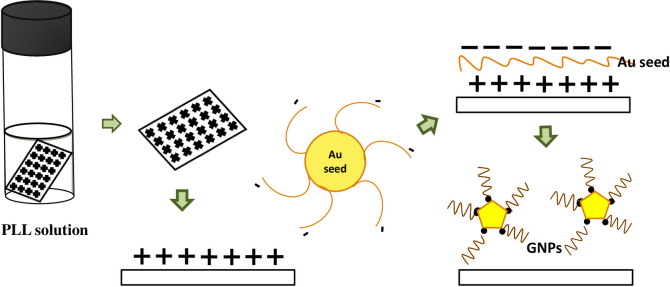
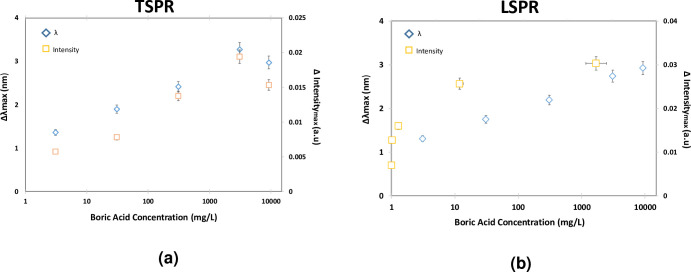
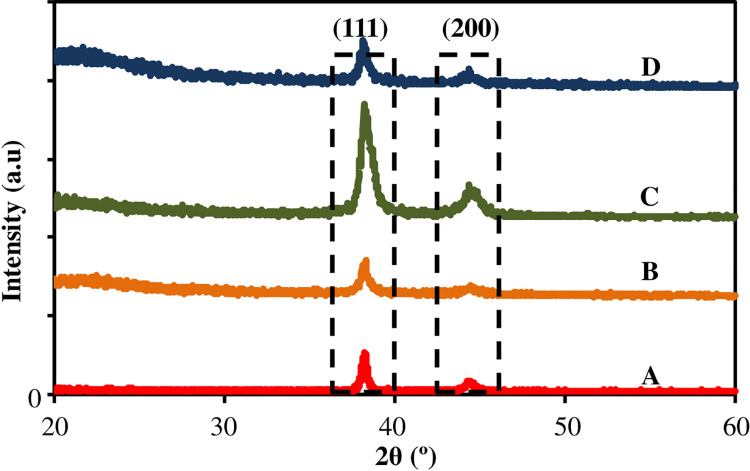
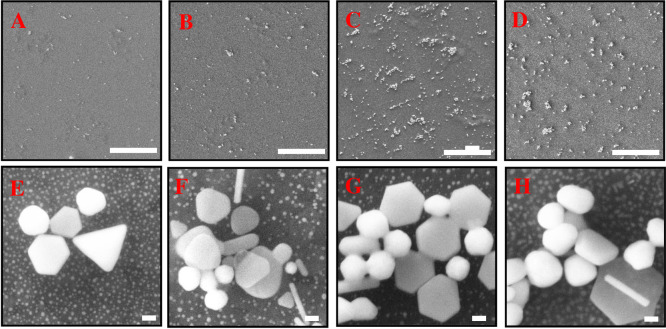
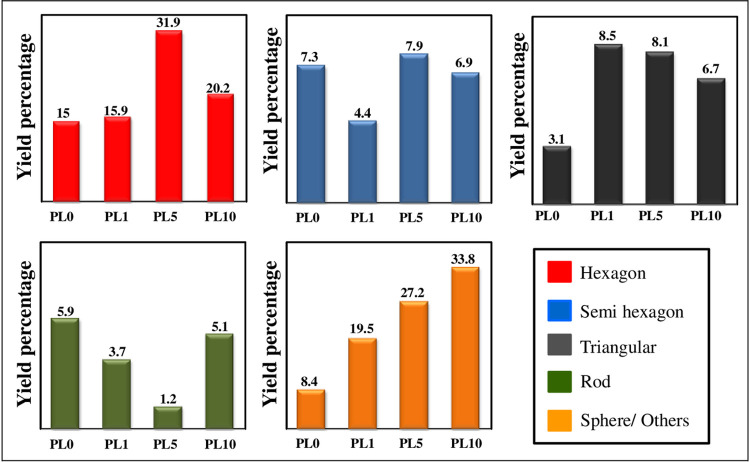
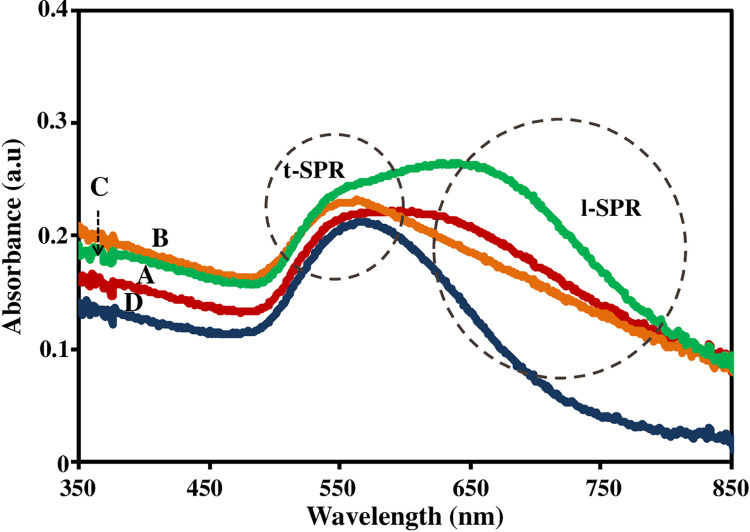
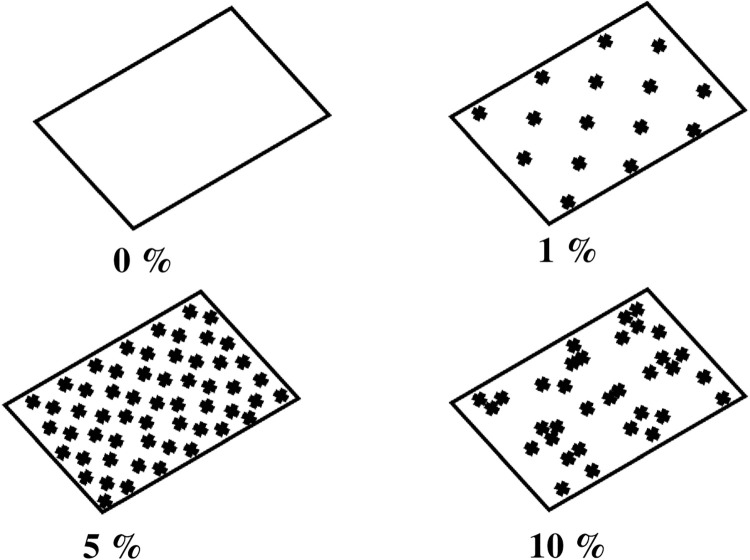
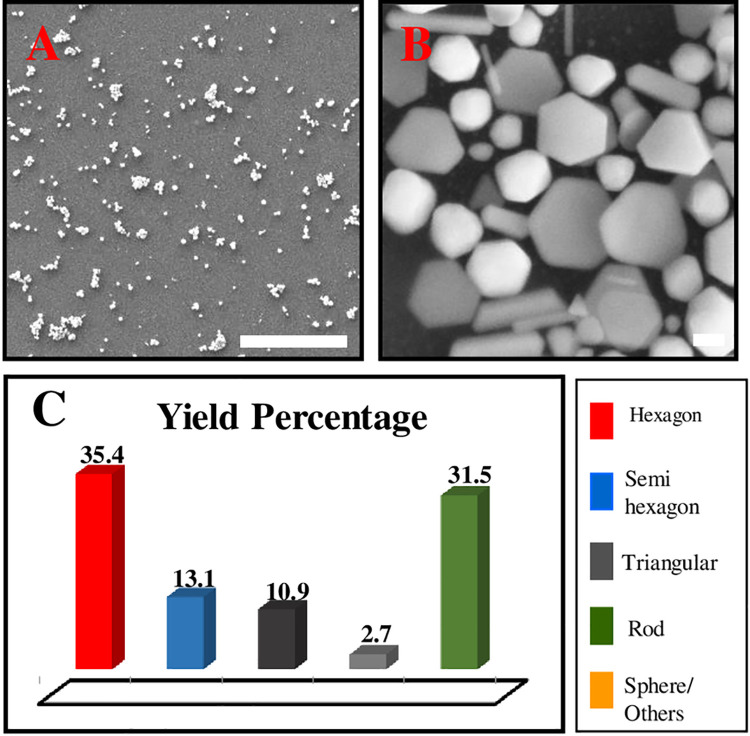
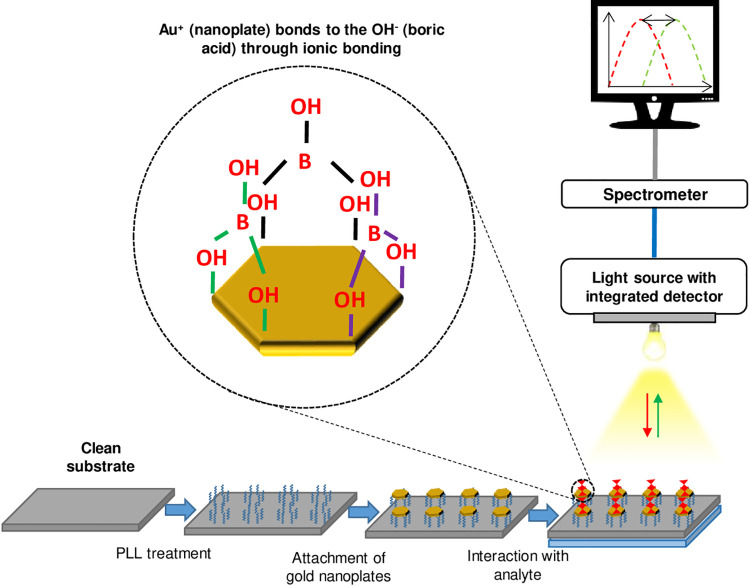
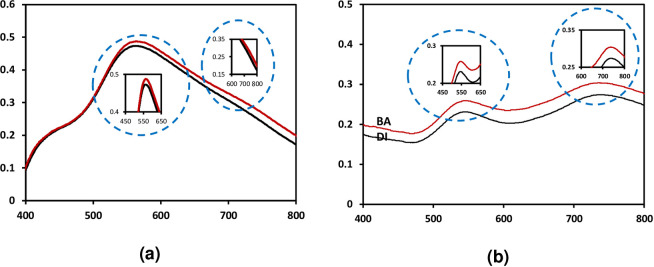
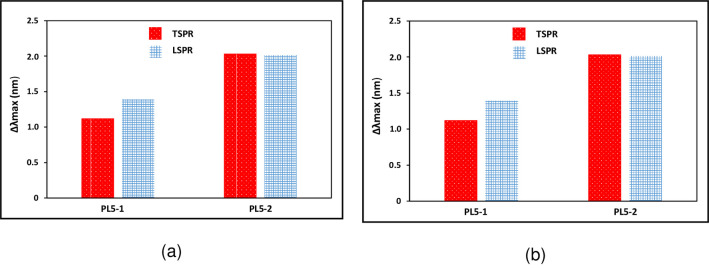
An anisotropic structure, gold (Au) nanoplates was synthesized using a two-step wet chemical seed mediated growth method (SMGM) directly on the substrate surface. Prior to the synthesis process, poly-l-lysine (PLL) as a cation polymer was used to enhance the yield of grown Au nanoplates. The electrostatic interaction of positive charged by PLL with negative charges from citrate-capped gold nanoseeds contributes to the yield increment. The percentage of PLL was varied from 0% to 10% to study the morphology of Au nanoplates in term of shape, size and surface density. 5% PLL with single layer treatment produce a variety of plate shapes such as hexagonal, flat rod and triangular obtained over the whole substrate surface with the estimated maximum yield up to ca. 48%. The high yield of Au nanoplates exhibit dual plasmonic peaks response that are associated with transverse and longitudinal localized surface plasmon resonance (TSPR and LSPR). Then, the PLL treatment process was repeated twice resulting the increment of Au nanoplates products to ca. 60%. The thin film Au nanoplates was further used as sensing materials in plasmonic sensor for detection of boric acid. The anisotropic Au nanoplates have four sensing parameters being monitored when the medium changes, which are peak position (wavelength shift), intensity of TSPR and LSPR, and the changes on sensing responses. The sensor responses are based on the interaction of light with dielectric properties from surrounding medium. The resonance effect produces by a collection of electron vibration on the Au nanoparticles surface after hit by light are captured as the responses. As a conclusion, it was found that the PLL treatment is capable to promote high yield of Au nanoplates. Moreover, the high yield of the Au nanoplates is an indication as excellent candidate for sensing material in plasmonic sensor.
采用两步湿化学种子介导生长法(SMGM)直接在基底表面合成各向异性结构的金(Au)纳米板。在合成过程之前,聚-l-赖氨酸(PLL)作为阳离子聚合物用于提高生长的 Au 纳米板的产率。带正电荷的 PLL 与带负电荷的柠檬酸金纳米种子之间的静电相互作用有助于提高产率。PLL 的百分比从 0%变化到 10%,以研究 Au 纳米板的形貌,包括形状、尺寸和表面密度。5%的 PLL 单层处理在整个基底表面上产生了各种形状的纳米板,如六边形、扁平棒和三角形,估计最大产率高达约 48%。高产率的 Au 纳米板表现出双等离子体激元峰响应,这与横向和纵向局域表面等离子体共振(TSPR 和 LSPR)有关。然后,重复进行 PLL 处理两次,导致 Au 纳米板产物的增加约为 60%。薄膜 Au 纳米板进一步用作等离子体传感器中的传感材料,用于检测硼酸。各向异性 Au 纳米板在介质变化时会监测四个传感参数,即峰位置(波长移动)、TSPR 和 LSPR 的强度,以及传感响应的变化。传感器响应基于光与周围介质的介电性质的相互作用。共振效应是由光撞击后 Au 纳米颗粒表面的电子振动产生的。总之,发现 PLL 处理能够促进 Au 纳米板的高产率。此外,Au 纳米板的高产率表明其是等离子体传感器中传感材料的优秀候选者。