Singh Mandeep, Nara Usha, Kumar Antul, Choudhary Anuj, Singh Hardeep, Thapa Sittal
Department of Plant Breeding and Genetics, Punjab Agricultural University, Ludhiana, Punjab, 141004, India.
Department of Botany, Punjab Agricultural University, Ludhiana, Punjab, 141004, India.
J Genet Eng Biotechnol. 2021 Nov 9;19(1):173. doi: 10.1186/s43141-021-00274-4.
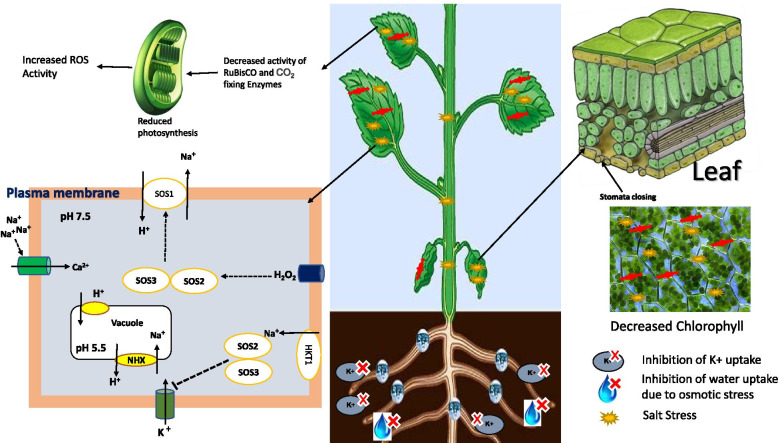
The era of first green revolution brought about by the application of chemical fertilizers surely led to the explosion of food grains, but left behind the notable problem of salinity. Continuous application of these fertilizers coupled with fertilizer-responsive crops make the country self-reliant, but continuous deposition of these led to altered the water potential and thus negatively affecting the proper plant functioning from germination to seed setting.
Increased concentration of anion and cations and their accumulation and distribution cause cellular toxicity and ionic imbalance. Plants respond to salinity stress by any one of two mechanisms, viz., escape or tolerate, by either limiting their entry via root system or controlling their distribution and storage. However, the understanding of tolerance mechanism at the physiological, biochemical, and molecular levels will provide an insight for the identification of related genes and their introgression to make the crop more resilient against salinity stress.
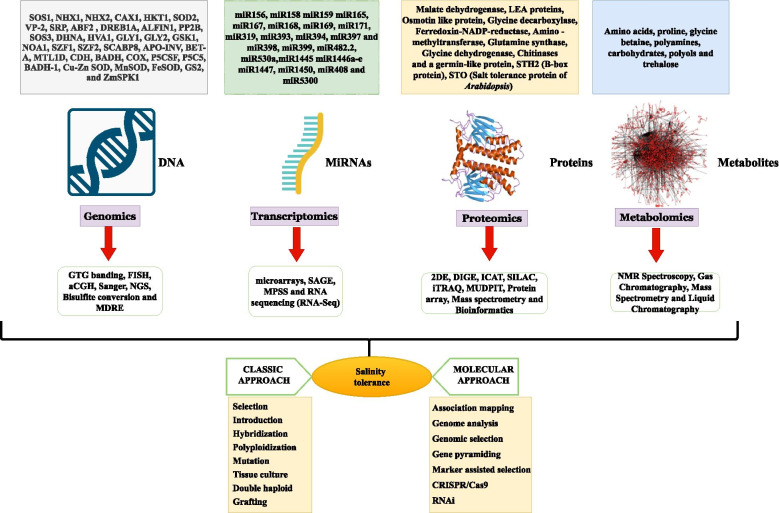
Novel emerging approaches of plant breeding and biotechnologies such as genome-wide association studies, mutational breeding, marker-assisted breeding, double haploid production, hyperspectral imaging, and CRISPR/Cas serve as engineering tools for dissecting the in-depth physiological mechanisms. These techniques have well-established implications to understand plants' adaptions to develop more tolerant varieties and lower the energy expenditure in response to stress and, constitutively fulfill the void that would have led to growth resistance and yield penalty.
化肥的应用带来了第一次绿色革命,这无疑导致了粮食产量的激增,但也留下了显著的盐碱化问题。这些化肥的持续使用以及对化肥有反应的作物使国家实现了自给自足,但这些化肥的持续沉积改变了水势,从而对植物从发芽到结实的正常功能产生了负面影响。
阴离子和阳离子浓度的增加及其积累和分布会导致细胞毒性和离子失衡。植物通过两种机制之一应对盐胁迫,即逃避或耐受,要么通过根系限制它们的进入,要么控制它们的分布和储存。然而,在生理、生化和分子水平上对耐受机制的理解将为鉴定相关基因及其导入提供思路,以使作物对盐胁迫更具抗性。
植物育种和生物技术的新兴方法,如全基因组关联研究、诱变育种、标记辅助育种、双单倍体生产、高光谱成像和CRISPR/Cas,可作为剖析深入生理机制的工程工具。这些技术对于理解植物的适应性具有既定的意义,有助于培育更耐受的品种,降低应对胁迫时的能量消耗,并从根本上填补可能导致生长抗性和产量损失的空白。