Department of Epidemiology and Biostatistics, Institute of Public Health, College of Medicine and Health Sciences, University of Gondar, Gondar, Ethiopia.
School of Nursing, College of Medicine and Health Sciences and Comprehensive specialized hospital, University of Gondar, Gondar, Ethiopia.
BMC Pediatr. 2021 Nov 9;21(1):497. doi: 10.1186/s12887-021-02901-y.
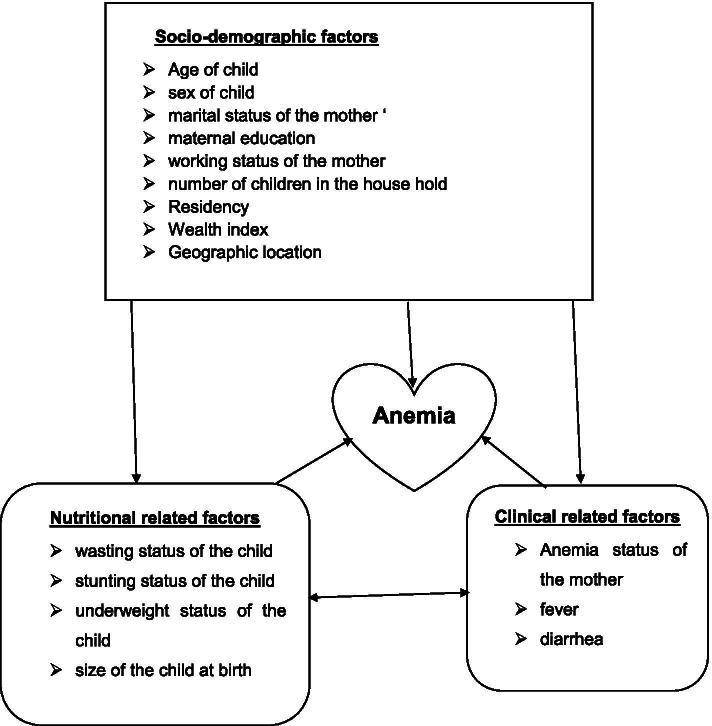
The magnitude of childhood anemia was increased from time to time. Thus, Even if the Ethiopian government applied tremendous efforts, anemia in children continues as a major public health problem. There is limited evidence on the spatial variation of and determinant factors of childhood anemia at the national level. Therefore, this study aimed to explore spatial distribution and determinants of anemia among children aged 6 to 59 months in Ethiopia.
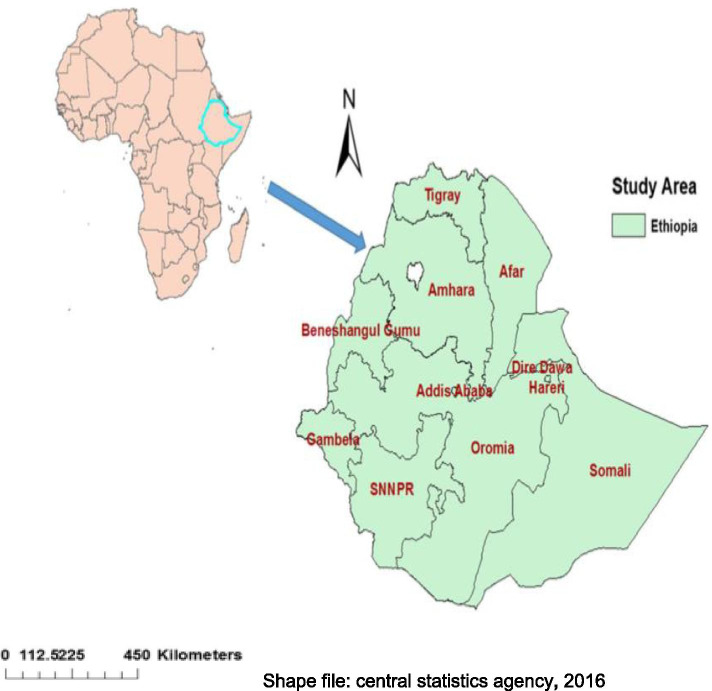
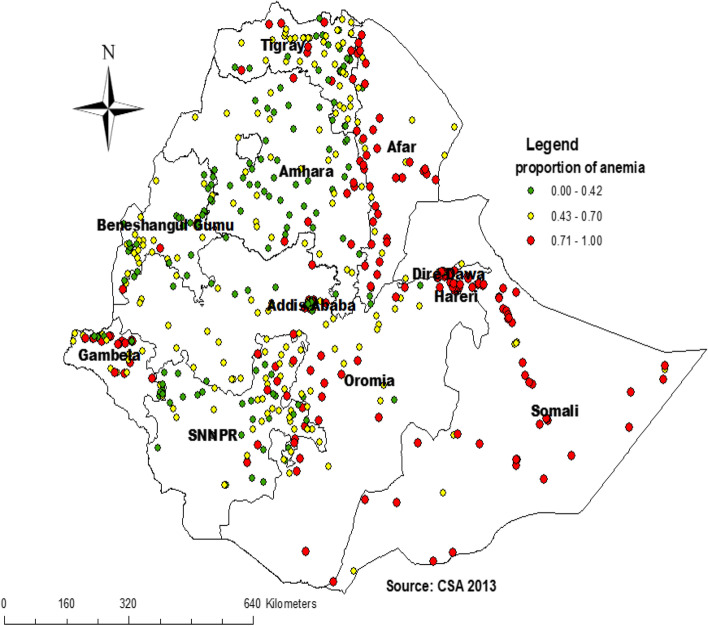
A stratified two-stage cluster sampling technique was used in Ethiopian Demographic Health Survey 2016 data. In this study 8602 children aged 6-59 months were included. Bernoulli model was used to explore the presence of purely spatial clusters of Anemia in children in age 6-59 months using Sat scan. ArcGIS version 10.3 was used to know the distribution of anemia cases across the country. A mixed-effects Logistic regression model was used to identify determinant factors of anemia.
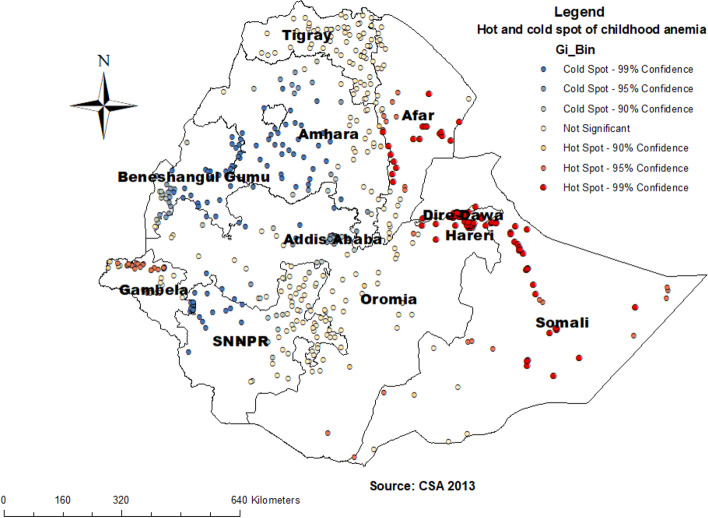
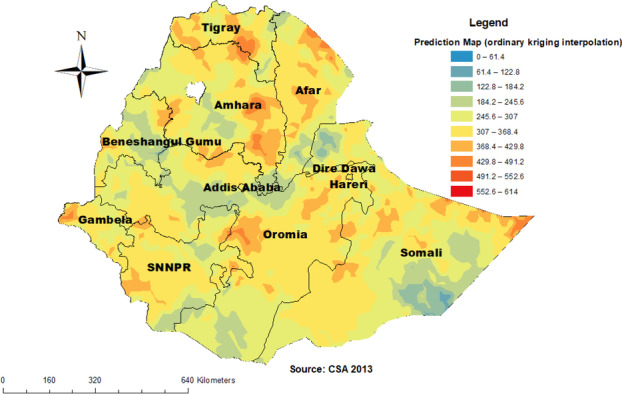
The finding indicates that the spatial distribution of childhood anemia was non-random in the country with Moran's I: 0.65, p < 0.001. The SaT scan analysis identified a total of 180 significant primary clusters located in the Somali and Afar regions (LLR = 14.47, P-value< 0.001, RR = 1.47). Age of child 12-23 months (AOR = 0, 68, 95%CI: 0.55, 0.85), 24-35 months (AOR = 0.38, 95%CI: 0.31, 0.47), and36-47 months (AOR = 0.25, 95%CI, 0.20, 0.31), working mother (AOR = 0.87, 95%CI: 0.76, 0.99), anemic mother (AOR = 1.53, 95%CI, 1.35, 1.73), had fever in the last 2 weeks (AOR = 1.36,95%CI:1.13, 1.65), moderate stunting (AOR = 1.31,95%CI: 1.13, 1.50),Severely stunting (AOR = 1.82,95%CI: 1.54, 2.16), religion, wealth index, and number of under-five children in the household were statistically significant associated with childhood anemia.
Spatial variation of childhood anemia across the country was non-random. Age of the child, wealth index, stunting, religion, number of under-five children in the household, fever in the last 2 weeks, anemic mother, and working status of the mother were determinants of childhood anemia. Therefore, interventions should be a priority concern for high-risk (hot spot) areas regarding allocation of resources and improved access to health facilities, and to reduce the consequence of anemia among the generation policymakers and concerned bodies should be implemented these specific determinant factors.
儿童贫血的程度时有增加。因此,尽管埃塞俄比亚政府付出了巨大努力,但儿童贫血仍然是一个主要的公共卫生问题。关于全国儿童贫血的空间变化和决定因素,证据有限。因此,本研究旨在探讨埃塞俄比亚 6-59 个月儿童贫血的空间分布和决定因素。
采用分层两阶段整群抽样技术对 2016 年埃塞俄比亚人口与健康调查数据进行分析。本研究共纳入 8602 名 6-59 个月龄儿童。使用 Bernoulli 模型,使用 Satscan 探索 6-59 个月儿童贫血的纯空间聚类。使用 ArcGIS 版本 10.3 了解全国贫血病例的分布情况。采用混合效应 Logistic 回归模型确定贫血的决定因素。
研究结果表明,该国儿童贫血的空间分布呈非随机分布,莫兰指数为 0.65,p<0.001。SaT 扫描分析共确定了 180 个位于索马里和阿法尔地区的显著原发性集群(LLR=14.47,P 值<0.001,RR=1.47)。儿童年龄 12-23 个月(AOR=0.68,95%CI:0.55,0.85)、24-35 个月(AOR=0.38,95%CI:0.31,0.47)和 36-47 个月(AOR=0.25,95%CI:0.20,0.31)、母亲工作(AOR=0.87,95%CI:0.76,0.99)、母亲贫血(AOR=1.53,95%CI:1.35,1.73)、过去 2 周发热(AOR=1.36,95%CI:1.13,1.65)、中度发育迟缓(AOR=1.31,95%CI:1.13,1.50)、重度发育迟缓(AOR=1.82,95%CI:1.54,2.16)、宗教信仰、财富指数以及家庭中五岁以下儿童人数与儿童贫血呈统计学相关。
全国儿童贫血的空间变化呈非随机分布。儿童年龄、财富指数、发育迟缓、宗教信仰、家庭中五岁以下儿童人数、过去 2 周发热、母亲贫血和母亲工作状态是儿童贫血的决定因素。因此,应优先关注高风险(热点)地区的干预措施,分配资源并改善获得卫生设施的机会,以减少政策制定者和相关机构这一代人中贫血的后果,应实施这些具体的决定因素。