Dyksik Mateusz, Duim Herman, Maude Duncan K, Baranowski Michal, Loi Maria Antonietta, Plochocka Paulina
Laboratoire National des Champs Magnétiques Intenses, EMFL, CNRS UPR 3228, University Grenoble Alpes, University Toulouse, University Toulouse 3, INSA-T, Grenoble and Toulouse, France.
Department of Experimental Physics, Faculty of Fundamental Problems of Technology, Wroclaw University of Science and Technology, Wroclaw, Poland.
Sci Adv. 2021 Nov 12;7(46):eabk0904. doi: 10.1126/sciadv.abk0904. Epub 2021 Nov 10.
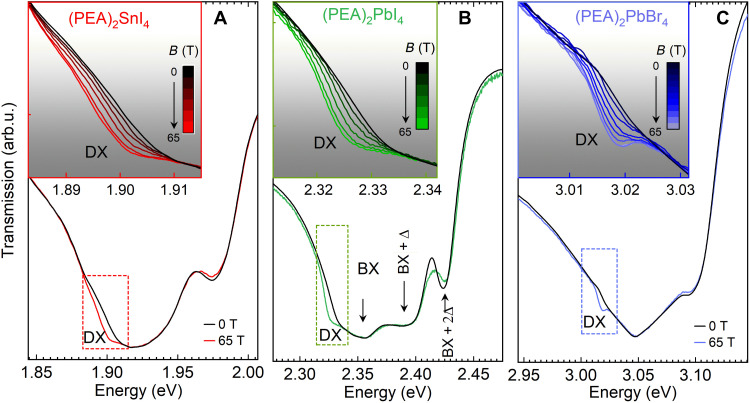
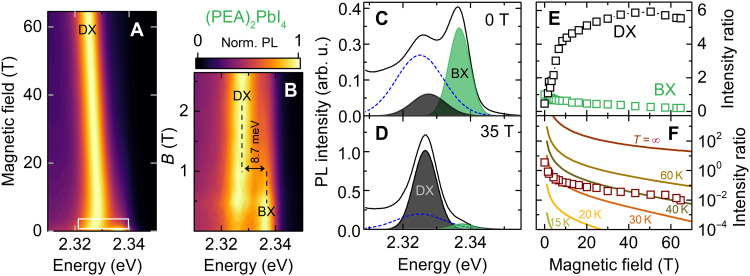
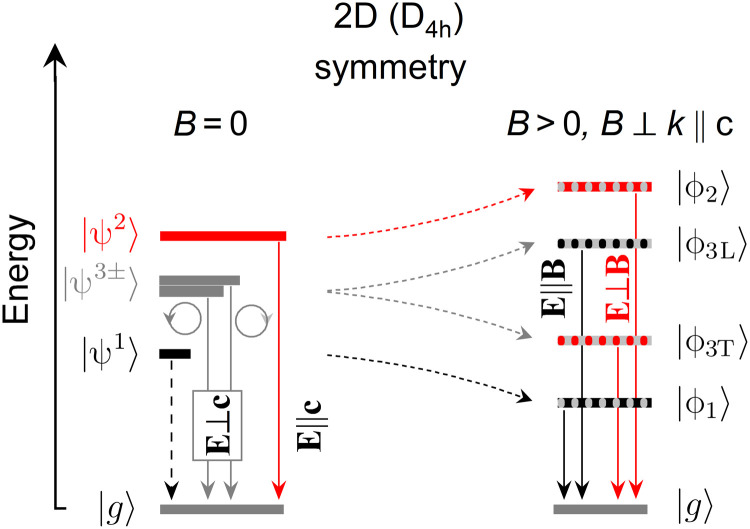
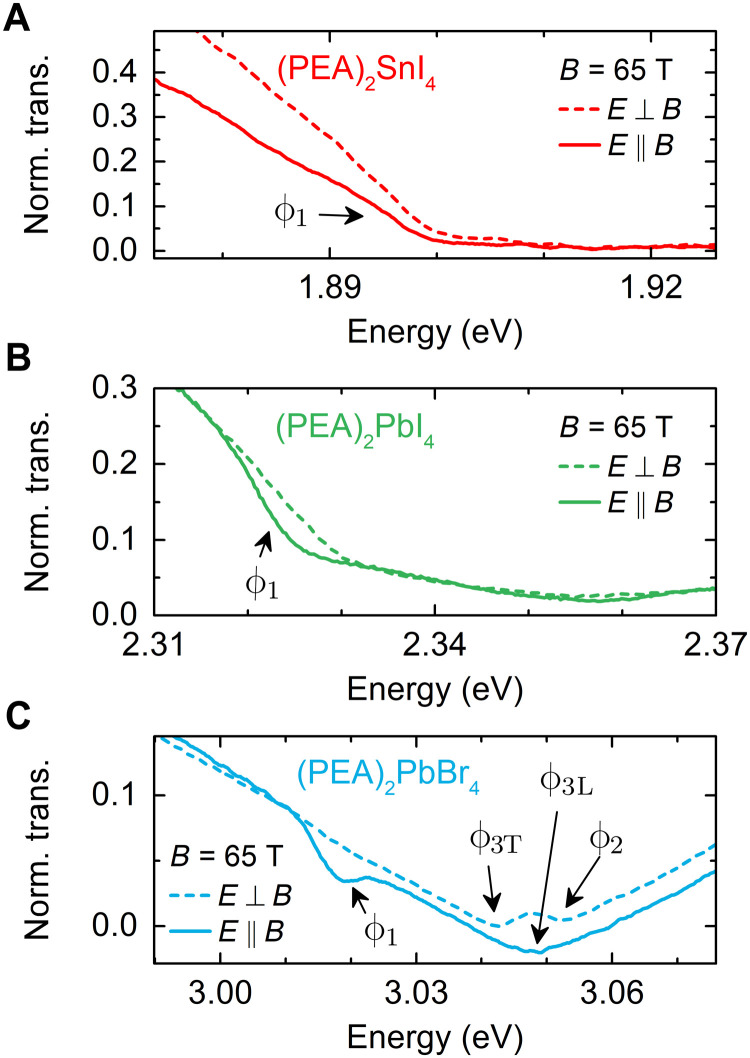
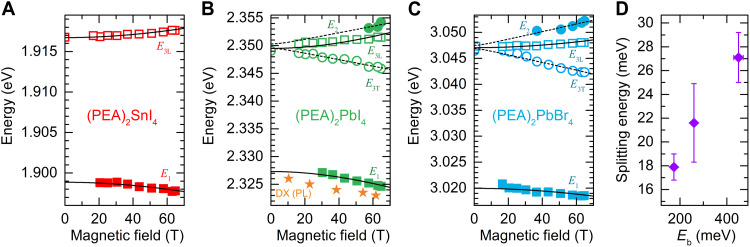
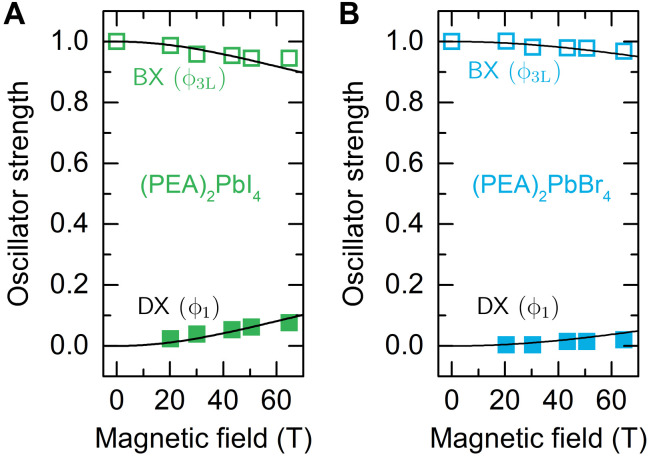
Optically inactive dark exciton states play an important role in light emission processes in semiconductors because they provide an efficient nonradiative recombination channel. Understanding the exciton fine structure in materials with potential applications in light-emitting devices is therefore critical. Here, we investigate the exciton fine structure in the family of two-dimensional (2D) perovskites (PEA)SnI, (PEA)PbI, and (PEA)PbBr. In-plane magnetic field mixes the bright and dark exciton states, brightening the otherwise optically inactive dark exciton. The bright-dark splitting increases with increasing exciton binding energy. Hot photoluminescence is observed, indicative of a non-Boltzmann distribution of the bright-dark exciton populations. We attribute this to the phonon bottleneck, which results from the weak exciton–acoustic phonon coupling in soft 2D perovskites. Hot photoluminescence is responsible for the strong emission observed in these materials, despite the substantial bright-dark exciton splitting.
光学非活性暗激子态在半导体的发光过程中起着重要作用,因为它们提供了一个有效的非辐射复合通道。因此,了解在发光器件中具有潜在应用的材料中的激子精细结构至关重要。在这里,我们研究了二维(2D)钙钛矿(PEA)SnI、(PEA)PbI和(PEA)PbBr家族中的激子精细结构。面内磁场混合了明亮和暗激子态,使原本光学非活性的暗激子变亮。亮-暗分裂随着激子结合能的增加而增大。观察到热光致发光,这表明亮-暗激子种群存在非玻尔兹曼分布。我们将此归因于声子瓶颈,它是由软二维钙钛矿中激子-声学声子的弱耦合导致的。尽管亮-暗激子有很大的分裂,但热光致发光是这些材料中观察到的强发射的原因。