Merck Center for Catalysis at Princeton University, Princeton, NJ 08544, USA.
Discovery Chemistry, Janssen Research and Development, Janssen-Cilag S.A., C/Jarama 75A, Toledo 45007, Spain.
Science. 2021 Dec 3;374(6572):1258-1263. doi: 10.1126/science.abl4322. Epub 2021 Nov 11.
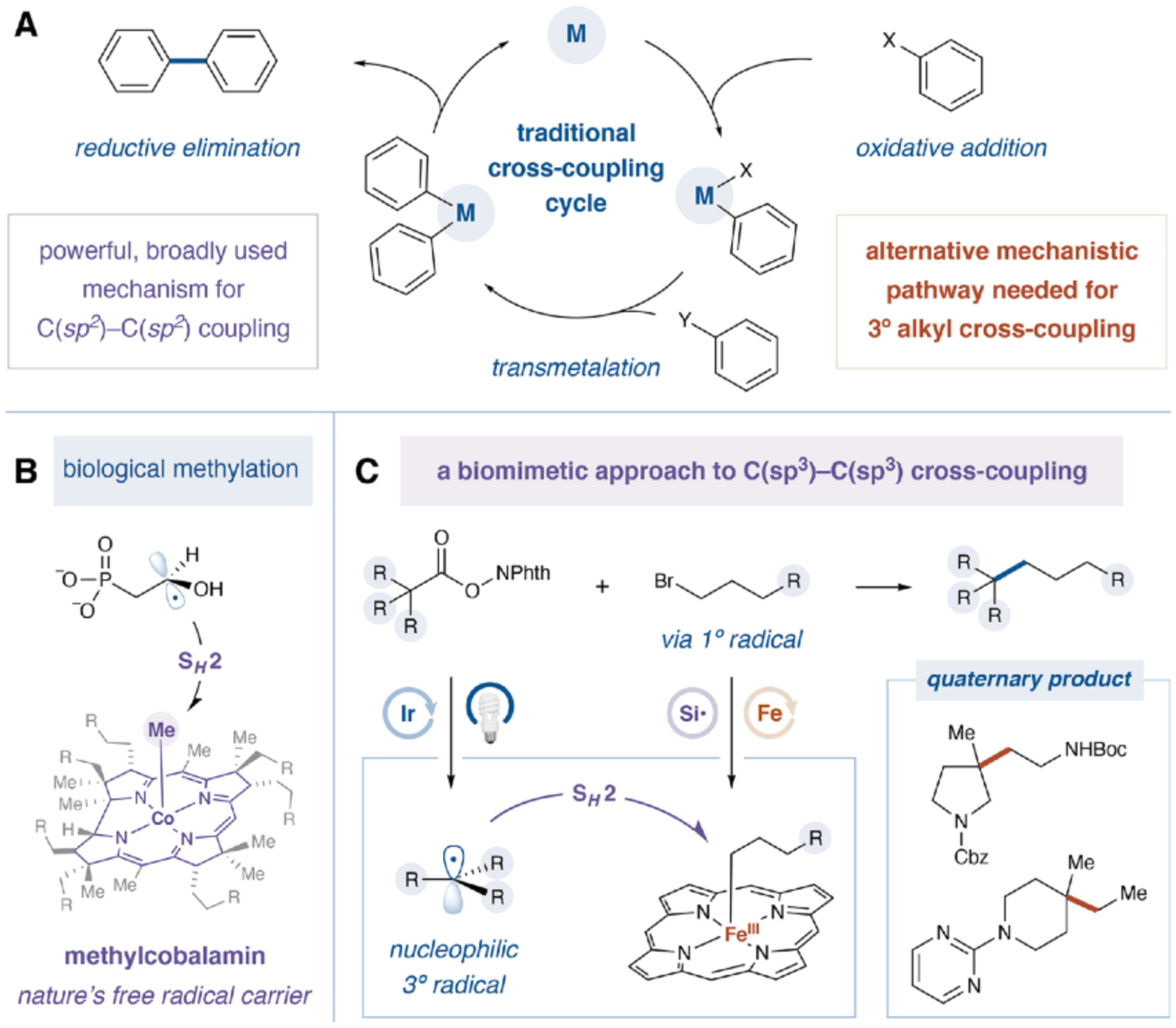
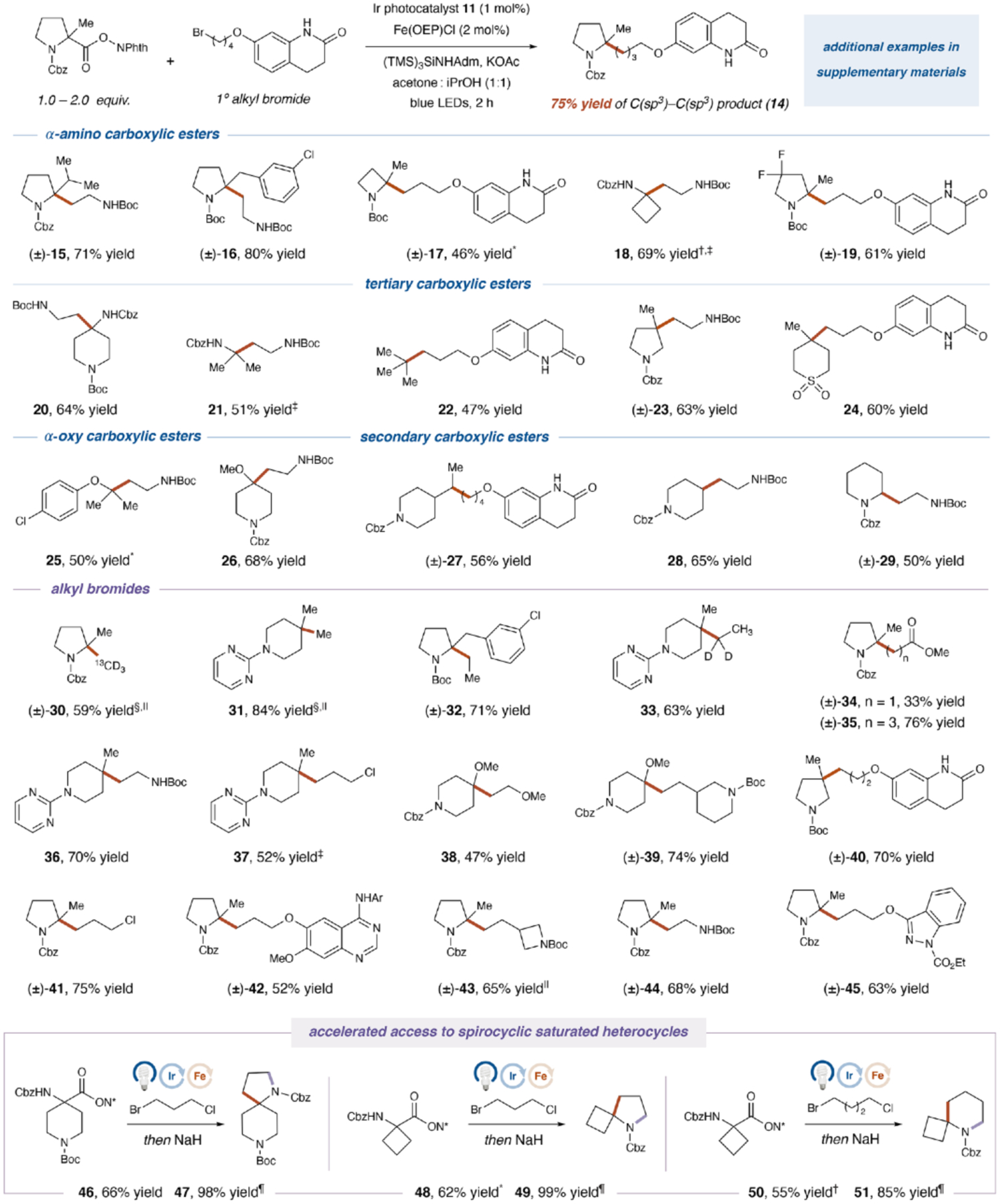
Bimolecular homolytic substitution (S2) is an open-shell mechanism that is implicated across a host of biochemical alkylation pathways. Surprisingly, however, this radical substitution manifold has not been generally deployed as a design element in synthetic C–C bond formation. We found that the S2 mechanism can be leveraged to enable a biomimetic sp-sp cross-coupling platform that furnishes quaternary sp-carbon centers, a long-standing challenge in organic molecule construction. This heteroselective radical-radical coupling uses the capacity of iron porphyrin to readily distinguish between the S2 bond-forming roles of open-shell primary and tertiary carbons, combined with photocatalysis to generate both radical classes simultaneously from widely abundant functional groups. Mechanistic studies confirm the intermediacy of a primary alkyl–Fe(III) species prior to coupling and provide evidence for the S2 displacement pathway in the critical quaternary sp-carbon bond formation step.
双分子均裂取代(S2)是一种涉及多种生物化学烷基化途径的开壳机制。然而,令人惊讶的是,这种自由基取代机理并没有被普遍用作合成 C-C 键形成的设计元素。我们发现,S2 机制可以被利用来实现仿生 sp-sp 交叉偶联平台,提供季 sp 碳原子,这是有机分子构建中的一个长期挑战。这种杂选择性自由基-自由基偶联利用铁卟啉的能力,很容易区分开壳的伯碳和叔碳的 S2 键形成作用,再结合光催化,从广泛丰富的官能团中同时生成两种自由基。机理研究证实了在偶联之前存在伯烷基-Fe(III)物种的中间体,并为关键的季 sp 碳原子键形成步骤中的 S2 取代途径提供了证据。