From the Danish Pain Research Center (S.S.G., T.S.J., N.B.F., P.K.), Department of Clinical Medicine, Aarhus University; Research Unit for Neurology (M.I., S.H.S.), Odense University Hospital, Odense, Denmark, University of Southern Denmark, Odense; Department of Clinical Neurophysiology (A.G.K., H.T.), Aarhus University Hospital; Department of Neurology (S.S.G., T.S.J., N.B.F.), Aarhus University Hospital, Denmark; Nuffield Department of Clinical Neurosciences (D.B.), University of Oxford, United Kingdom; Core Center for Molecular Morphology (J.R.N., P.K.), Section for Stereology and Microscopy, Department of Clinical Medicine, Aarhus University; and Department of Pathology (J.R.N.), Aarhus University Hospital, Denmark.
Neurol Neuroimmunol Neuroinflamm. 2021 Nov 11;9(1). doi: 10.1212/NXI.0000000000001111. Print 2022 Jan.
The mechanisms of pain in patients with diabetic polyneuropathy are unknown. Studies have suggested a role of inflammation and increased neuropeptides peripherally in pain generation. This study examined the possible skin markers of painful diabetic polyneuropathy (P-DPN): macrophages, substance P (SP), and calcitonin gene-related peptide (CGRP).
The participants were included from a large Danish cross-sectional clinical study of type 2 diabetes. We diagnosed definite diabetic polyneuropathy using the Toronto criteria and used the Neuropathic Pain Special Interest Group classification for defining P-DPN. We included 60 skin biopsies from patients with diabetic polyneuropathy-30 with P-DPN and 30 with nonpainful diabetic polyneuropathy (NP-DPN)-and 30 biopsies from healthy controls of similar age and sex. The biopsies were stained using PGP 9.5, IbA1, and SP and CGRP primary markers.
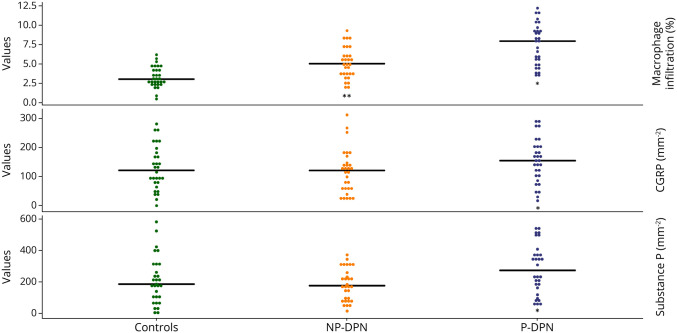
There was increased macrophage density in patients with P-DPN (8.0%) compared with that in patients with NP-DPN (5.1%, < 0.001), and there was increased macrophage density in patients with NP-DPN (5.1%) compared with that in healthy controls (3.1%, < 0.001). When controlling for neuropathy severity, body mass index, age, and sex, there was still a difference in macrophage density between patients with P-DPN and patients with NP-DPN. Patients with P-DPN had higher median nerve fiber length density (274.5 and 155 mm for SP and CGRP, respectively) compared with patients with NP-DPN (176 and 121 mm for SP and CGRP, respectively, = 0.009 and 0.04) and healthy controls (185.5 and 121.5 mm for SP and CGRP, respectively), whereas there was no difference between patients with NP-DPN and controls without diabetes ( = 0.64 and 0.49, respectively). The difference between P-DPN and NP-DPN for SP and CGRP was significant only in female patients, although a trend was seen in male patients.
The findings point to a possible involvement of the innate immune system in the pathogenesis of neuropathic pain in patients with DPN, although markers of activated macrophages were not measured in this study.
糖尿病多发性神经病患者的疼痛机制尚不清楚。研究表明,炎症和外周神经肽的增加可能与疼痛的产生有关。本研究探讨了痛性糖尿病多发性神经病(P-DPN)的可能皮肤标志物:巨噬细胞、P 物质(SP)和降钙素基因相关肽(CGRP)。
参与者来自丹麦一项大型 2 型糖尿病横断面临床研究。我们根据多伦多标准诊断明确的糖尿病多发性神经病,并使用神经病理性疼痛特殊兴趣小组分类来定义 P-DPN。我们纳入了 60 例糖尿病多发性神经病患者的皮肤活检,其中 30 例为 P-DPN,30 例为无痛性糖尿病多发性神经病(NP-DPN),30 例为年龄和性别相似的健康对照。活检采用 PGP 9.5、IbA1 和 SP 和 CGRP 进行染色。
与 NP-DPN 患者(5.1%,<0.001)相比,P-DPN 患者的巨噬细胞密度增加(8.0%),与健康对照组(3.1%,<0.001)相比,NP-DPN 患者的巨噬细胞密度增加。在控制神经病变严重程度、体重指数、年龄和性别后,P-DPN 患者和 NP-DPN 患者的巨噬细胞密度仍存在差异。与 NP-DPN 患者相比,P-DPN 患者的正中神经纤维长度密度(SP 和 CGRP 分别为 274.5 和 155mm)更高(SP 和 CGRP 分别为 176 和 121mm,=0.009 和 0.04),与健康对照组(SP 和 CGRP 分别为 185.5 和 121.5mm)相比,差异有统计学意义(=0.64 和 0.49)。SP 和 CGRP 在 P-DPN 和 NP-DPN 之间的差异仅在女性患者中具有统计学意义,尽管在男性患者中也有趋势。
研究结果表明,固有免疫系统可能参与了 DPN 患者神经病理性疼痛的发病机制,尽管本研究并未测量活化巨噬细胞的标志物。