Neuroscience and Mental Health Research Institute, School of Medicine, Cardiff University, Cardiff, UK.
Cardiff University Brain Research Imaging Centre, School of Psychology, Cardiff University, Maindy Road, Cardiff, CF24 4HQ, UK.
Sci Rep. 2021 Nov 11;11(1):22061. doi: 10.1038/s41598-021-01630-7.
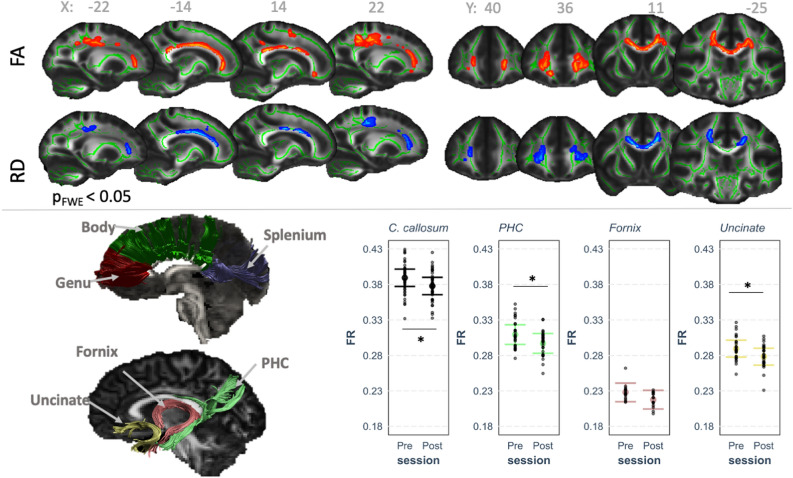
Exercise is beneficial for brain health, inducing neuroplasticity and vascular plasticity in the hippocampus, which is possibly mediated by brain-derived neurotrophic factor (BDNF) levels. Here we investigated the short-term effects of exercise, to determine if a 1-week intervention is sufficient to induce brain changes. Fifteen healthy young males completed five supervised exercise training sessions over seven days. This was preceded and followed by a multi-modal magnetic resonance imaging (MRI) scan (diffusion-weighted MRI, perfusion-weighted MRI, dual-calibrated functional MRI) acquired 1 week apart, and blood sampling for BDNF. A diffusion tractography analysis showed, after exercise, a significant reduction relative to baseline in restricted fraction-an axon-specific metric-in the corpus callosum, uncinate fasciculus, and parahippocampal cingulum. A voxel-based approach found an increase in fractional anisotropy and reduction in radial diffusivity symmetrically, in voxels predominantly localised in the corpus callosum. A selective increase in hippocampal blood flow was found following exercise, with no change in vascular reactivity. BDNF levels were not altered. Thus, we demonstrate that 1 week of exercise is sufficient to induce microstructural and vascular brain changes on a group level, independent of BDNF, providing new insight into the temporal dynamics of plasticity, necessary to exploit the therapeutic potential of exercise.
锻炼有益于大脑健康,可在海马体中诱导神经可塑性和血管可塑性,这可能是由脑源性神经营养因子 (BDNF) 水平介导的。在这里,我们研究了锻炼的短期效果,以确定为期一周的干预是否足以引起大脑变化。十五名健康的年轻男性在七天内完成了五次监督下的锻炼训练。在此之前和之后,相隔一周进行了多模态磁共振成像 (MRI) 扫描(扩散加权 MRI、灌注加权 MRI、双校准功能 MRI)和血液采样以检测 BDNF。弥散张量分析显示,与基线相比,在胼胝体、钩束和海马旁扣带回中的限制分数(一种轴突特异性指标)在锻炼后显著降低。基于体素的方法发现,在体素中,以胼胝体为主的体素中,各向异性分数增加,径向弥散度降低对称。锻炼后发现海马血流选择性增加,血管反应性没有变化。BDNF 水平没有改变。因此,我们证明了 1 周的锻炼足以引起大脑微观结构和血管的变化,这种变化在群体水平上是独立于 BDNF 的,为了解大脑可塑性的时间动态提供了新的见解,这对于发挥锻炼的治疗潜力是必要的。