Huang Zhenxing, Liu Xinfeng, Wang Rongpin, Zhang Mudan, Zeng Xianchun, Liu Jun, Yang Yongfeng, Liu Xin, Zheng Hairong, Liang Dong, Hu Zhanli
Lauterbur Research Center for Biomedical Imaging, Shenzhen Institutes of Advanced Technology, Chinese Academy of Sciences, Shenzhen, 518055 China.
Chinese Academy of Sciences Key Laboratory of Health Informatics, Shenzhen, 518055 China.
Appl Intell (Dordr). 2021;51(5):2838-2849. doi: 10.1007/s10489-020-01965-0. Epub 2020 Nov 14.
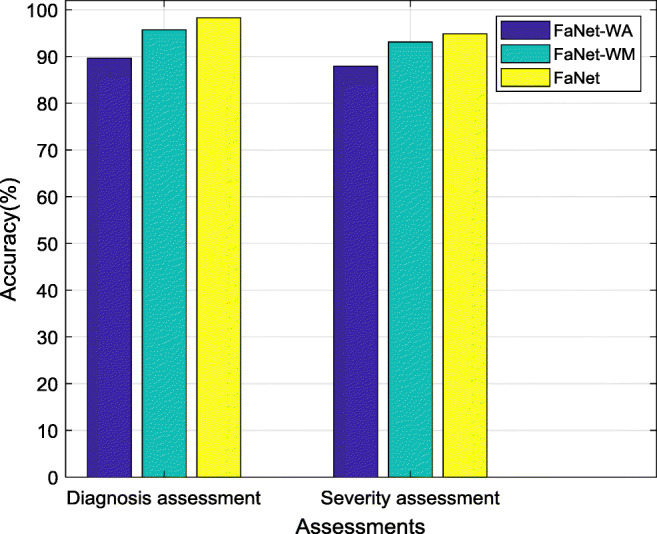
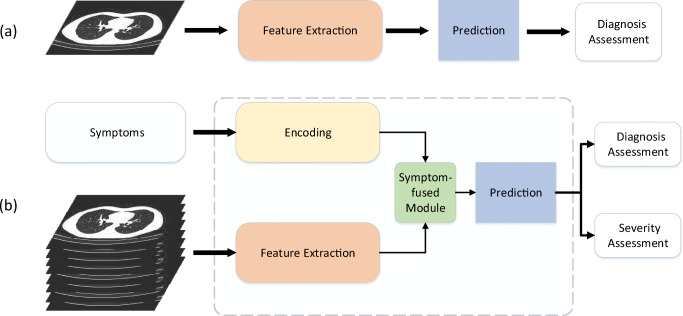
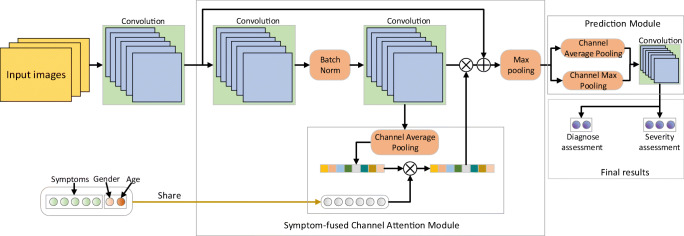
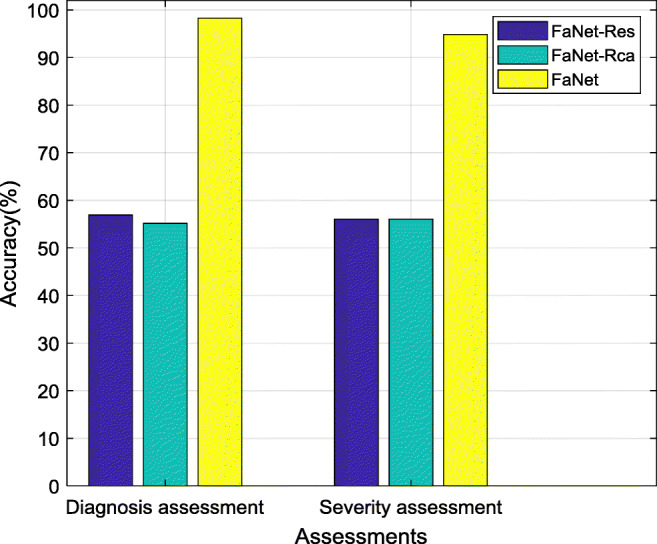
The novel coronavirus (COVID-19) pneumonia has become a serious health challenge in countries worldwide. Many radiological findings have shown that X-ray and CT imaging scans are an effective solution to assess disease severity during the early stage of COVID-19. Many artificial intelligence (AI)-assisted diagnosis works have rapidly been proposed to focus on solving this classification problem and determine whether a patient is infected with COVID-19. Most of these works have designed networks and applied a single CT image to perform classification; however, this approach ignores prior information such as the patient's clinical symptoms. Second, making a more specific diagnosis of clinical severity, such as slight or severe, is worthy of attention and is conducive to determining better follow-up treatments. In this paper, we propose a deep learning (DL) based dual-tasks network, named FaNet, that can perform rapid both diagnosis and severity assessments for COVID-19 based on the combination of 3D CT imaging and clinical symptoms. Generally, 3D CT image sequences provide more spatial information than do single CT images. In addition, the clinical symptoms can be considered as prior information to improve the assessment accuracy; these symptoms are typically quickly and easily accessible to radiologists. Therefore, we designed a network that considers both CT image information and existing clinical symptom information and conducted experiments on 416 patient data, including 207 normal chest CT cases and 209 COVID-19 confirmed ones. The experimental results demonstrate the effectiveness of the additional symptom prior information as well as the network architecture designing. The proposed FaNet achieved an accuracy of 98.28% on diagnosis assessment and 94.83% on severity assessment for test datasets. In the future, we will collect more covid-CT patient data and seek further improvement.
新型冠状病毒(COVID-19)肺炎已成为全球各国面临的严峻健康挑战。许多放射学研究结果表明,X射线和CT成像扫描是评估COVID-19早期疾病严重程度的有效方法。许多人工智能(AI)辅助诊断工作迅速被提出,专注于解决这一分类问题并确定患者是否感染了COVID-19。这些工作大多设计了网络并应用单张CT图像进行分类;然而,这种方法忽略了患者临床症状等先验信息。其次,对临床严重程度进行更具体的诊断,如轻微或严重,值得关注,且有助于确定更好的后续治疗方案。在本文中,我们提出了一种基于深度学习(DL)的双任务网络,名为FaNet,它可以基于3D CT成像和临床症状的组合,对COVID-19进行快速诊断和严重程度评估。一般来说,3D CT图像序列比单张CT图像提供更多的空间信息。此外,临床症状可被视为提高评估准确性的先验信息;放射科医生通常能快速且容易地获取这些症状。因此,我们设计了一个同时考虑CT图像信息和现有临床症状信息的网络,并对416例患者数据进行了实验,其中包括207例正常胸部CT病例和209例COVID-19确诊病例。实验结果证明了额外症状先验信息以及网络架构设计的有效性。所提出的FaNet在测试数据集的诊断评估中准确率达到98.28%,在严重程度评估中准确率达到94.83%。未来,我们将收集更多的covid-CT患者数据并寻求进一步改进。