• 文献检索
  • 文档翻译
  • 深度研究
  • 学术资讯
  • Suppr Zotero 插件Zotero 插件
  • 邀请有礼
  • 套餐&价格
  • 历史记录
应用&插件
Suppr Zotero 插件Zotero 插件浏览器插件Mac 客户端Windows 客户端微信小程序
定价
高级版会员购买积分包购买API积分包
服务
文献检索文档翻译深度研究API 文档MCP 服务
关于我们
关于 Suppr公司介绍联系我们用户协议隐私条款
关注我们

Suppr 超能文献

核心技术专利:CN118964589B侵权必究
粤ICP备2023148730 号-1Suppr @ 2026

文献检索

告别复杂PubMed语法,用中文像聊天一样搜索,搜遍4000万医学文献。AI智能推荐,让科研检索更轻松。

立即免费搜索

文件翻译

保留排版,准确专业,支持PDF/Word/PPT等文件格式,支持 12+语言互译。

免费翻译文档

深度研究

AI帮你快速写综述,25分钟生成高质量综述,智能提取关键信息,辅助科研写作。

立即免费体验

冠状病毒诊断仪:用于基于胸部X光的COVID-19感染检测的轻量级深度卷积神经网络。

Corona-Nidaan: lightweight deep convolutional neural network for chest X-Ray based COVID-19 infection detection.

作者信息

Chakraborty Mainak, Dhavale Sunita Vikrant, Ingole Jitendra

机构信息

Defence Institute of Advanced Technology (DIAT), Girinagar Pune, 411025 India.

Smt. Kashibai Navale Medical College and General Hospital, Narhe Pune, 411041 India.

出版信息

Appl Intell (Dordr). 2021;51(5):3026-3043. doi: 10.1007/s10489-020-01978-9. Epub 2021 Feb 2.

DOI:10.1007/s10489-020-01978-9
PMID:34764582
原文链接:https://pmc.ncbi.nlm.nih.gov/articles/PMC7851642/
Abstract

The coronavirus COVID-19 pandemic is today's major public health crisis, we have faced since the Second World War. The pandemic is spreading around the globe like a wave, and according to the World Health Organization's recent report, the number of confirmed cases and deaths are rising rapidly. COVID-19 pandemic has created severe social, economic, and political crises, which in turn will leave long-lasting scars. One of the countermeasures against controlling coronavirus outbreak is specific, accurate, reliable, and rapid detection technique to identify infected patients. The availability and affordability of RT-PCR kits remains a major bottleneck in many countries, while handling COVID-19 outbreak effectively. Recent findings indicate that chest radiography anomalies can characterize patients with COVID-19 infection. In this study, Corona-Nidaan, a lightweight deep convolutional neural network (DCNN), is proposed to detect COVID-19, Pneumonia, and Normal cases from chest X-ray image analysis; without any human intervention. We introduce a simple minority class oversampling method for dealing with imbalanced dataset problem. The impact of transfer learning with pre-trained CNNs on chest X-ray based COVID-19 infection detection is also investigated. Experimental analysis shows that Corona-Nidaan model outperforms prior works and other pre-trained CNN based models. The model achieved 95% accuracy for three-class classification with 94% precision and recall for COVID-19 cases. While studying the performance of various pre-trained models, it is also found that VGG19 outperforms other pre-trained CNN models by achieving 93% accuracy with 87% recall and 93% precision for COVID-19 infection detection. The model is evaluated by screening the COVID-19 infected Indian Patient chest X-ray dataset with good accuracy.

摘要

新型冠状病毒COVID-19大流行是自第二次世界大战以来我们面临的当今主要公共卫生危机。这场大流行正像波浪一样在全球蔓延,根据世界卫生组织最近的报告,确诊病例数和死亡人数正在迅速上升。COVID-19大流行引发了严重的社会、经济和政治危机,反过来也将留下持久的创伤。控制冠状病毒爆发的对策之一是采用特定、准确、可靠和快速的检测技术来识别感染患者。在有效应对COVID-19爆发的同时,逆转录聚合酶链反应(RT-PCR)试剂盒的可获得性和可承受性在许多国家仍然是一个主要瓶颈。最近的研究结果表明,胸部X光检查异常可作为COVID-19感染患者的特征。在本研究中,提出了一种轻量级深度卷积神经网络(DCNN)“Corona-Nidaan”,用于从胸部X光图像分析中检测COVID-19、肺炎和正常病例;无需任何人工干预。我们引入了一种简单的少数类过采样方法来处理不平衡数据集问题。还研究了使用预训练的卷积神经网络(CNN)进行迁移学习对基于胸部X光的COVID-19感染检测的影响。实验分析表明,“Corona-Nidaan”模型优于先前的工作和其他基于预训练CNN的模型。该模型在三类分类中达到了95%的准确率,对COVID-19病例的精确率和召回率为94%。在研究各种预训练模型的性能时,还发现VGG19在COVID-19感染检测中表现优于其他预训练的CNN模型,准确率达到93%,召回率为87%,精确率为93%。该模型通过筛查COVID-19感染的印度患者胸部X光数据集进行评估,准确率良好。
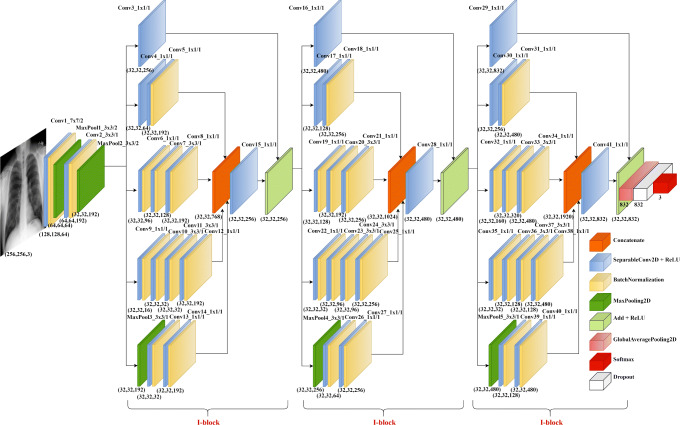
https://cdn.ncbi.nlm.nih.gov/pmc/blobs/8f34/7851642/e0608300d69c/10489_2020_1978_Fig18_HTML.jpg
https://cdn.ncbi.nlm.nih.gov/pmc/blobs/8f34/7851642/74dde7ebdbc4/10489_2020_1978_Fig1_HTML.jpg
https://cdn.ncbi.nlm.nih.gov/pmc/blobs/8f34/7851642/e4d0ba2a3f39/10489_2020_1978_Fig2_HTML.jpg
https://cdn.ncbi.nlm.nih.gov/pmc/blobs/8f34/7851642/b7730ee0c6b6/10489_2020_1978_Fig3_HTML.jpg
https://cdn.ncbi.nlm.nih.gov/pmc/blobs/8f34/7851642/b6df61a8f644/10489_2020_1978_Fig4_HTML.jpg
https://cdn.ncbi.nlm.nih.gov/pmc/blobs/8f34/7851642/81644ee99184/10489_2020_1978_Fig5_HTML.jpg
https://cdn.ncbi.nlm.nih.gov/pmc/blobs/8f34/7851642/f83d1709d89b/10489_2020_1978_Fig6_HTML.jpg
https://cdn.ncbi.nlm.nih.gov/pmc/blobs/8f34/7851642/c5ff43cbb27f/10489_2020_1978_Fig7_HTML.jpg
https://cdn.ncbi.nlm.nih.gov/pmc/blobs/8f34/7851642/1b8033509127/10489_2020_1978_Fig8_HTML.jpg
https://cdn.ncbi.nlm.nih.gov/pmc/blobs/8f34/7851642/1610f6bd6f1f/10489_2020_1978_Fig9_HTML.jpg
https://cdn.ncbi.nlm.nih.gov/pmc/blobs/8f34/7851642/9614d3d279b3/10489_2020_1978_Fig10_HTML.jpg
https://cdn.ncbi.nlm.nih.gov/pmc/blobs/8f34/7851642/fa4054e9cbb8/10489_2020_1978_Fig11_HTML.jpg
https://cdn.ncbi.nlm.nih.gov/pmc/blobs/8f34/7851642/d83ec7b7435f/10489_2020_1978_Fig12_HTML.jpg
https://cdn.ncbi.nlm.nih.gov/pmc/blobs/8f34/7851642/5917a1c681a8/10489_2020_1978_Fig13_HTML.jpg
https://cdn.ncbi.nlm.nih.gov/pmc/blobs/8f34/7851642/1cb801cd9e75/10489_2020_1978_Fig14_HTML.jpg
https://cdn.ncbi.nlm.nih.gov/pmc/blobs/8f34/7851642/761b00b3e407/10489_2020_1978_Fig15_HTML.jpg
https://cdn.ncbi.nlm.nih.gov/pmc/blobs/8f34/7851642/ad7d2312a310/10489_2020_1978_Fig16_HTML.jpg
https://cdn.ncbi.nlm.nih.gov/pmc/blobs/8f34/7851642/253070eabbd6/10489_2020_1978_Fig17_HTML.jpg
https://cdn.ncbi.nlm.nih.gov/pmc/blobs/8f34/7851642/e0608300d69c/10489_2020_1978_Fig18_HTML.jpg
https://cdn.ncbi.nlm.nih.gov/pmc/blobs/8f34/7851642/74dde7ebdbc4/10489_2020_1978_Fig1_HTML.jpg
https://cdn.ncbi.nlm.nih.gov/pmc/blobs/8f34/7851642/e4d0ba2a3f39/10489_2020_1978_Fig2_HTML.jpg
https://cdn.ncbi.nlm.nih.gov/pmc/blobs/8f34/7851642/b7730ee0c6b6/10489_2020_1978_Fig3_HTML.jpg
https://cdn.ncbi.nlm.nih.gov/pmc/blobs/8f34/7851642/b6df61a8f644/10489_2020_1978_Fig4_HTML.jpg
https://cdn.ncbi.nlm.nih.gov/pmc/blobs/8f34/7851642/81644ee99184/10489_2020_1978_Fig5_HTML.jpg
https://cdn.ncbi.nlm.nih.gov/pmc/blobs/8f34/7851642/f83d1709d89b/10489_2020_1978_Fig6_HTML.jpg
https://cdn.ncbi.nlm.nih.gov/pmc/blobs/8f34/7851642/c5ff43cbb27f/10489_2020_1978_Fig7_HTML.jpg
https://cdn.ncbi.nlm.nih.gov/pmc/blobs/8f34/7851642/1b8033509127/10489_2020_1978_Fig8_HTML.jpg
https://cdn.ncbi.nlm.nih.gov/pmc/blobs/8f34/7851642/1610f6bd6f1f/10489_2020_1978_Fig9_HTML.jpg
https://cdn.ncbi.nlm.nih.gov/pmc/blobs/8f34/7851642/9614d3d279b3/10489_2020_1978_Fig10_HTML.jpg
https://cdn.ncbi.nlm.nih.gov/pmc/blobs/8f34/7851642/fa4054e9cbb8/10489_2020_1978_Fig11_HTML.jpg
https://cdn.ncbi.nlm.nih.gov/pmc/blobs/8f34/7851642/d83ec7b7435f/10489_2020_1978_Fig12_HTML.jpg
https://cdn.ncbi.nlm.nih.gov/pmc/blobs/8f34/7851642/5917a1c681a8/10489_2020_1978_Fig13_HTML.jpg
https://cdn.ncbi.nlm.nih.gov/pmc/blobs/8f34/7851642/1cb801cd9e75/10489_2020_1978_Fig14_HTML.jpg
https://cdn.ncbi.nlm.nih.gov/pmc/blobs/8f34/7851642/761b00b3e407/10489_2020_1978_Fig15_HTML.jpg
https://cdn.ncbi.nlm.nih.gov/pmc/blobs/8f34/7851642/ad7d2312a310/10489_2020_1978_Fig16_HTML.jpg
https://cdn.ncbi.nlm.nih.gov/pmc/blobs/8f34/7851642/253070eabbd6/10489_2020_1978_Fig17_HTML.jpg
https://cdn.ncbi.nlm.nih.gov/pmc/blobs/8f34/7851642/e0608300d69c/10489_2020_1978_Fig18_HTML.jpg

相似文献

1
Corona-Nidaan: lightweight deep convolutional neural network for chest X-Ray based COVID-19 infection detection.冠状病毒诊断仪:用于基于胸部X光的COVID-19感染检测的轻量级深度卷积神经网络。
Appl Intell (Dordr). 2021;51(5):3026-3043. doi: 10.1007/s10489-020-01978-9. Epub 2021 Feb 2.
2
COVID-19 detection in CT and CXR images using deep learning models.使用深度学习模型进行 CT 和 CXR 图像中的 COVID-19 检测。
Biogerontology. 2022 Feb;23(1):65-84. doi: 10.1007/s10522-021-09946-7. Epub 2022 Jan 22.
3
Deep Learning Algorithm for COVID-19 Classification Using Chest X-Ray Images.基于胸部 X 光图像的 COVID-19 分类深度学习算法。
Comput Math Methods Med. 2021 Nov 9;2021:9269173. doi: 10.1155/2021/9269173. eCollection 2021.
4
CoroDet: A deep learning based classification for COVID-19 detection using chest X-ray images.CoroDet:一种基于深度学习的、利用胸部X光图像进行新冠肺炎检测的分类方法。
Chaos Solitons Fractals. 2021 Jan;142:110495. doi: 10.1016/j.chaos.2020.110495. Epub 2020 Nov 23.
5
Chest X-ray image phase features for improved diagnosis of COVID-19 using convolutional neural network.基于卷积神经网络的胸部 X 射线图像相位特征提高 COVID-19 诊断性能
Int J Comput Assist Radiol Surg. 2021 Feb;16(2):197-206. doi: 10.1007/s11548-020-02305-w. Epub 2021 Jan 9.
6
CNN-RNN Network Integration for the Diagnosis of COVID-19 Using Chest X-ray and CT Images.基于胸部 X 射线和 CT 图像的 COVID-19 诊断的 CNN-RNN 网络集成。
Sensors (Basel). 2023 Jan 25;23(3):1356. doi: 10.3390/s23031356.
7
Exploring the effect of image enhancement techniques on COVID-19 detection using chest X-ray images.探讨使用胸部 X 光图像的图像增强技术对 COVID-19 检测的影响。
Comput Biol Med. 2021 May;132:104319. doi: 10.1016/j.compbiomed.2021.104319. Epub 2021 Mar 11.
8
Automatic coronavirus disease 2019 diagnosis based on chest radiography and deep learning - Success story or dataset bias?基于胸部 X 光和深度学习的新型冠状病毒病 2019 自动诊断——成功案例还是数据集偏差?
Med Phys. 2022 Feb;49(2):978-987. doi: 10.1002/mp.15419. Epub 2022 Jan 12.
9
Deep-chest: Multi-classification deep learning model for diagnosing COVID-19, pneumonia, and lung cancer chest diseases.深胸部:用于诊断 COVID-19、肺炎和肺癌胸部疾病的多分类深度学习模型。
Comput Biol Med. 2021 May;132:104348. doi: 10.1016/j.compbiomed.2021.104348. Epub 2021 Mar 19.
10
COVID-ConvNet: A Convolutional Neural Network Classifier for Diagnosing COVID-19 Infection.COVID-ConvNet:用于诊断新冠病毒感染的卷积神经网络分类器
Diagnostics (Basel). 2023 May 9;13(10):1675. doi: 10.3390/diagnostics13101675.

引用本文的文献

1
Automated classification of chest X-rays: a deep learning approach with attention mechanisms.胸部X光片的自动分类:一种具有注意力机制的深度学习方法。
BMC Med Imaging. 2025 Mar 4;25(1):71. doi: 10.1186/s12880-025-01604-5.
2
An evaluation of lightweight deep learning techniques in medical imaging for high precision COVID-19 diagnostics.用于高精度COVID-19诊断的医学成像中的轻量级深度学习技术评估。
Healthc Anal (N Y). 2022 Nov;2:100096. doi: 10.1016/j.health.2022.100096. Epub 2022 Aug 23.
3
Feature selection of pre-trained shallow CNN using the QLESCA optimizer: COVID-19 detection as a case study.

本文引用的文献

1
Detection of COVID-19 using CXR and CT images using Transfer Learning and Haralick features.利用迁移学习和哈拉里克特征通过胸部X光和CT图像检测新型冠状病毒肺炎
Appl Intell (Dordr). 2021;51(1):341-358. doi: 10.1007/s10489-020-01831-z. Epub 2020 Aug 12.
2
COVID-Net: a tailored deep convolutional neural network design for detection of COVID-19 cases from chest X-ray images.COVID-Net:一种针对胸部 X 光图像中 COVID-19 病例检测的定制化深度卷积神经网络设计。
Sci Rep. 2020 Nov 11;10(1):19549. doi: 10.1038/s41598-020-76550-z.
3
Automated detection of COVID-19 cases using deep neural networks with X-ray images.
使用QLESCA优化器对预训练浅层卷积神经网络进行特征选择:以新冠病毒疾病检测为例
Appl Intell (Dordr). 2023 Feb 6:1-23. doi: 10.1007/s10489-022-04446-8.
4
COVID-19-The Role of Artificial Intelligence, Machine Learning, and Deep Learning: A Newfangled.新冠病毒-人工智能、机器学习和深度学习的作用:一种新奇事物
Arch Comput Methods Eng. 2023;30(4):2667-2682. doi: 10.1007/s11831-023-09882-4. Epub 2023 Jan 17.
5
MTSS-AAE: Multi-task semi-supervised adversarial autoencoding for COVID-19 detection based on chest X-ray images.MTSS-AAE:基于胸部X光图像的用于COVID-19检测的多任务半监督对抗自动编码
Expert Syst Appl. 2023 Apr 15;216:119475. doi: 10.1016/j.eswa.2022.119475. Epub 2023 Jan 4.
6
Detection of Covid-19 and other pneumonia cases from CT and X-ray chest images using deep learning based on feature reuse residual block and depthwise dilated convolutions neural network.基于特征重用残差块和深度扩张卷积神经网络的深度学习从胸部CT和X光图像中检测新冠病毒肺炎及其他肺炎病例
Appl Soft Comput. 2023 Jan;133:109906. doi: 10.1016/j.asoc.2022.109906. Epub 2022 Dec 7.
7
COVID-19 Diagnosis on Chest Radiographs with Enhanced Deep Neural Networks.利用增强深度神经网络进行胸部X光片上的COVID-19诊断。
Diagnostics (Basel). 2022 Jul 29;12(8):1828. doi: 10.3390/diagnostics12081828.
8
Multiclass Classification for Detection of COVID-19 Infection in Chest X-Rays Using CNN.基于卷积神经网络的胸部 X 光片 COVID-19 感染多分类检测
Comput Intell Neurosci. 2022 Aug 11;2022:3289809. doi: 10.1155/2022/3289809. eCollection 2022.
9
Image enhancement techniques on deep learning approaches for automated diagnosis of COVID-19 features using CXR images.基于深度学习方法的图像增强技术在使用胸部X光图像自动诊断新冠病毒特征中的应用
Multimed Tools Appl. 2022;81(29):42649-42690. doi: 10.1007/s11042-022-13486-8. Epub 2022 Aug 1.
10
Study of Different Deep Learning Methods for Coronavirus (COVID-19) Pandemic: Taxonomy, Survey and Insights.深度学习方法在冠状病毒(COVID-19)大流行中的研究:分类、调查与洞察。
Sensors (Basel). 2022 Feb 28;22(5):1890. doi: 10.3390/s22051890.
使用 X 射线图像的深度学习神经网络自动检测 COVID-19 病例。
Comput Biol Med. 2020 Jun;121:103792. doi: 10.1016/j.compbiomed.2020.103792. Epub 2020 Apr 28.
4
CoroNet: A deep neural network for detection and diagnosis of COVID-19 from chest x-ray images.CoroNet:一种用于从胸部 X 光图像中检测和诊断 COVID-19 的深度神经网络。
Comput Methods Programs Biomed. 2020 Nov;196:105581. doi: 10.1016/j.cmpb.2020.105581. Epub 2020 Jun 5.
5
Covid-19: automatic detection from X-ray images utilizing transfer learning with convolutional neural networks.新冠病毒(Covid-19):利用卷积神经网络的迁移学习从 X 光图像中自动检测。
Phys Eng Sci Med. 2020 Jun;43(2):635-640. doi: 10.1007/s13246-020-00865-4. Epub 2020 Apr 3.
6
Deep Learning COVID-19 Features on CXR Using Limited Training Data Sets.基于有限训练数据集的 X 光胸片深度学习 COVID-19 特征
IEEE Trans Med Imaging. 2020 Aug;39(8):2688-2700. doi: 10.1109/TMI.2020.2993291. Epub 2020 May 8.
7
The Role of Chest Imaging in Patient Management During the COVID-19 Pandemic: A Multinational Consensus Statement From the Fleischner Society.COVID-19 大流行期间患者管理中的胸部影像学作用: Fleischner 学会的一项多国家共识声明。
Chest. 2020 Jul;158(1):106-116. doi: 10.1016/j.chest.2020.04.003. Epub 2020 Apr 7.
8
Diagnosing COVID-19: The Disease and Tools for Detection.诊断 COVID-19:疾病与检测工具。
ACS Nano. 2020 Apr 28;14(4):3822-3835. doi: 10.1021/acsnano.0c02624. Epub 2020 Mar 30.
9
COVID-19: Impact on health of people & wealth of nations.新冠疫情:对民众健康和国家财富的影响。
Indian J Med Res. 2020;151(2 & 3):121-123. doi: 10.4103/ijmr.IJMR_664_20.
10
A Review of Coronavirus Disease-2019 (COVID-19).新型冠状病毒肺炎(COVID-19)概述。
Indian J Pediatr. 2020 Apr;87(4):281-286. doi: 10.1007/s12098-020-03263-6. Epub 2020 Mar 13.