Ashraf Sehrish, Parveen Asia, Asif Muhammad, Alanazi Abdullah D, Alouffi Abdulaziz, Muhammad Awais Mian, Khan Adil, Aktas Munir, Ozubek Sezayi, Iqbal Furhan
Institute of Pure and Applied biology, Zoology Division, Bahauddin Zakariya University Multan 60800, Pakistan.
Department of Biological Sciences, Faculty of Science and Humanities, Shaqra University, P.O. Box 1040, Ad-Dawadimi 11911, Saudi Arabia.
Saudi J Biol Sci. 2021 Nov;28(11):6488-6494. doi: 10.1016/j.sjbs.2021.07.026. Epub 2021 Jul 10.
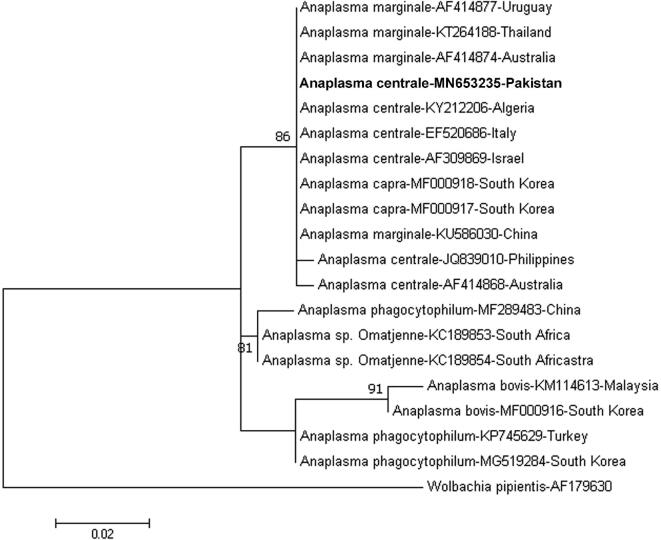
() is an obligate red blood cell residing tick transmitted rickettsiae that has not been studied extensively for its prevalence in cattle along with its epidemiology. Aim of this investigation was to report the seasonal prevalence, phylogeny and epidemiological parameters associated with the prevalence of in cattle breeds enrolled from District Layyah in Punjab, Pakistan. A total of 844 blood samples [Cross breed = 300, Holstein Friesian = 244, Sahiwal breed = 300)] were collected from apparently healthy cattle along with epidemiological data during 2017-18. PCR amplified 426 base pair fragment from 16S rRNA gene of in 14.4% (122/844) of cattle. Amplified 16S rRNA partial gene sequence of were confirmed by DNA sequencing and deposited to GenBank. Highest A. centrale prevalence was observed in spring (24%) followed by autumn (12.4%) summer (10%) and winter (7.1%) seasons. Sahiwal breed (18.3%) was most susceptible to infection followed by cross (12.3%) and Holstein Friesian breed (12.3%). 69/844 (8.2%) of Giemsa stained cattle blood smears were also found positive for spp. Farms where animal use to drink pool water and farms where dogs and other dairy animals were living with cattle had higher prevalence. Female cattle and dogs having tick burden were found associated with infection. Hematological profile was severely disturbed in positive cattle. It is recommended that should be screened in cattle, in addition to , for the effective control of tick born diseases in Pakistan.
()是一种专性寄生于红细胞内、通过蜱传播的立克次氏体,关于其在牛群中的流行情况及其流行病学尚未进行广泛研究。本调查的目的是报告与巴基斯坦旁遮普省莱雅县登记的牛品种中()的流行相关的季节性流行情况、系统发育和流行病学参数。在2017 - 2018年期间,从表面健康的牛身上采集了总共844份血样[杂交品种 = 300份,荷斯坦弗里生牛 = 244份,萨希瓦尔品种 = 300份]以及流行病学数据。通过聚合酶链反应(PCR)从14.4%(122/844)的牛的()16S rRNA基因中扩增出426个碱基对的片段。扩增出的()16S rRNA部分基因序列经DNA测序确认后存入基因库。观察到中央无浆体(A. centrale)的最高流行率出现在春季(24%),其次是秋季(12.4%)、夏季(10%)和冬季(7.1%)。萨希瓦尔品种(18.3%)最易感染(),其次是杂交品种(12.3%)和荷斯坦弗里生品种(12.3%)。在844份吉姆萨染色的牛血涂片样本中,也有69份(8.2%)被发现()属呈阳性。动物饮用池塘水的农场以及有狗和其他奶牛与牛一起生活的农场,()的流行率较高。发现有蜱寄生的母牛和狗与()感染有关。()呈阳性的牛的血液学指标受到严重干扰。建议在巴基斯坦,除了(另一种蜱传病原体,原文未提及具体名称)外,还应对牛群进行()筛查,以有效控制蜱传疾病。