Liu Hengchen, Zhang Mingzhao, Zhang Tingting, Shi Manyu, Lu Wenjun, Yang Shulong, Cui Qingbo, Li Zhaozhu
Department of Pediatric Surgery, The Second Hospital Affiliated to Harbin Medical University, Harbin, China.
Transl Pediatr. 2021 Oct;10(10):2418-2431. doi: 10.21037/tp-21-211.
Wilms tumor (WT) is a widespread urologic tumor in children. Ferroptosis, on the other hand, is a novel form of cell death associated with tumor development. In this study, we aim to explore the predictability of ferroptosis-related biomarkers in estimating prognosis in WT patients.
To determine a link between ferroptosis-related gene expression and WT prognosis, we first collected RNA sequencing data and clinical information, involving 124 WT and 6 healthy tissue samples, from the TARGET database. Next, we screened the collected information for ferroptosis-related long non-coding RNA using Cox regression analysis, and constructed a signature model, as well as a nomogram, related to prognosis. Finally, we explored a potential link between ferroptosis-related lncRNA and tumor immunity and screened for possible immune checkpoints.
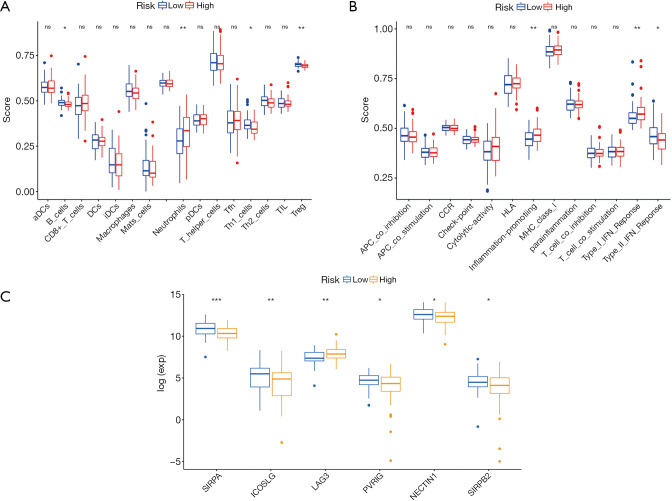
We constructed a WT prognosis prediction signature containing 12 ferroptosis-related lncRNAs. The area under the curves values, from the ROC curves, predicting overall survival rates at the 1, 3-, and 5-year timepoints were 0.775, 0.867, and 0.891 respectively. Moreover, we generated a nomogram, using clinical features and risk scores, carrying a C-index value of 0.836, which suggested a high predictive value. We also demonstrated significant differences in tumor immunity between low- and high-risk WT patients, particularly in the presence of B cells, NK cells, Th1 cells, Treg cells, inflammation promoting, and type I and II IFN responses. In addition, we showed that immune checkpoints like , , , , , and can serve as potential therapeutic targets for WT.
Based on our analyses, we generated a ferroptosis-related lncRNA signature that can both estimate prognosis of WT patients and may provide basis for future WT therapy.
肾母细胞瘤(WT)是儿童中一种常见的泌尿系统肿瘤。另一方面,铁死亡是一种与肿瘤发展相关的新型细胞死亡形式。在本研究中,我们旨在探讨铁死亡相关生物标志物在评估WT患者预后方面的预测能力。
为了确定铁死亡相关基因表达与WT预后之间的联系,我们首先从TARGET数据库收集了124例WT和6例健康组织样本的RNA测序数据及临床信息。接下来,我们使用Cox回归分析筛选收集到的与铁死亡相关的长链非编码RNA信息,并构建了一个与预后相关的特征模型和列线图。最后,我们探索了铁死亡相关lncRNA与肿瘤免疫之间的潜在联系,并筛选了可能的免疫检查点。
我们构建了一个包含12个铁死亡相关lncRNA的WT预后预测特征模型。ROC曲线预测1年、3年和5年总生存率的曲线下面积值分别为0.775、0.867和0.891。此外,我们利用临床特征和风险评分生成了一个列线图,其C指数值为0.836,表明具有较高的预测价值。我们还证明了低风险和高风险WT患者之间在肿瘤免疫方面存在显著差异,特别是在B细胞、NK细胞、Th1细胞、Treg细胞、炎症促进以及I型和II型干扰素反应方面。此外,我们表明诸如 、 、 、 、 和 等免疫检查点可作为WT潜在的治疗靶点。
基于我们的分析,我们生成了一个与铁死亡相关的lncRNA特征模型,该模型既能估计WT患者的预后,又可为未来WT治疗提供依据。