Pihán Philippe, Lisbona Fernanda, Borgonovo Janina, Edwards-Jorquera Sandra, Nunes-Hasler Paula, Castillo Karen, Kepp Oliver, Urra Hery, Saarnio Suvi, Vihinen Helena, Carreras-Sureda Amado, Forveille Sabrina, Sauvat Allan, De Giorgis Daniela, Pupo Amaury, Rodríguez Diego A, Quarato Giovanni, Sagredo Alfredo, Lourido Fernanda, Letai Anthony, Latorre Ramon, Kroemer Guido, Demaurex Nicolas, Jokitalo Eija, Concha Miguel L, Glavic Álvaro, Green Douglas R, Hetz Claudio
Biomedical Neuroscience Institute, Faculty of Medicine, University of Chile, Santiago, Chile.
Center for Geroscience, Brain Health and Metabolism (GERO), Santiago, Chile.
Sci Adv. 2021 Nov 12;7(46):eabe5469. doi: 10.1126/sciadv.abe5469.
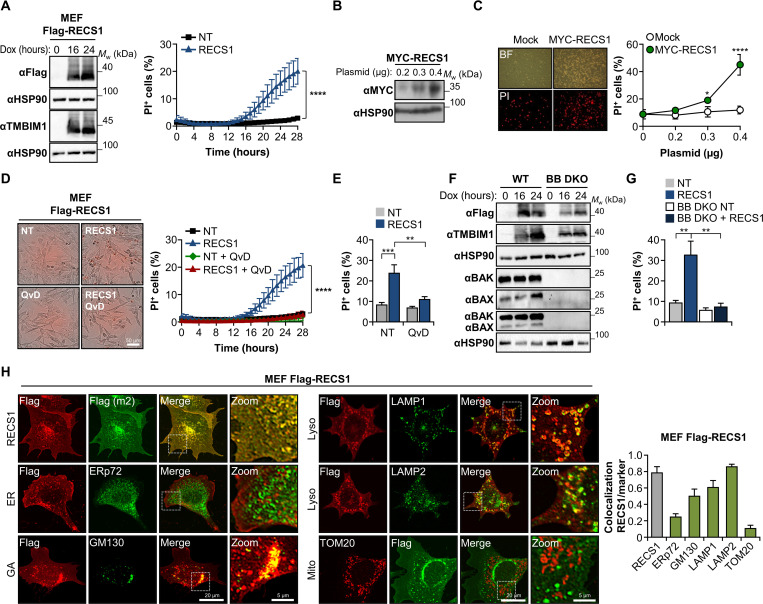
Programmed cell death is regulated by the balance between activating and inhibitory signals. Here, we have identified RECS1 (responsive to centrifugal force and shear stress 1) [also known as TMBIM1 (transmembrane BAX inhibitor motif containing 1)] as a proapoptotic member of the TMBIM family. In contrast to other proteins of the TMBIM family, RECS1 expression induces cell death through the canonical mitochondrial apoptosis pathway. Unbiased screening indicated that RECS1 sensitizes cells to lysosomal perturbations. RECS1 localizes to lysosomes, where it regulates their acidification and calcium content, triggering lysosomal membrane permeabilization. Structural modeling and electrophysiological studies indicated that RECS1 is a pH-regulated calcium channel, an activity that is essential to trigger cell death. RECS1 also sensitizes whole animals to stress in vivo in and zebrafish models. Our results unveil an unanticipated function for RECS1 as a proapoptotic component of the TMBIM family that ignites cell death programs at lysosomes.
程序性细胞死亡由激活信号和抑制信号之间的平衡所调控。在此,我们鉴定出RECS1(对离心力和剪切应力有反应1)[也称为TMBIM1(含跨膜BAX抑制基序1)]是TMBIM家族的促凋亡成员。与TMBIM家族的其他蛋白不同,RECS1的表达通过经典的线粒体凋亡途径诱导细胞死亡。无偏向性筛选表明,RECS1使细胞对溶酶体扰动敏感。RECS1定位于溶酶体,在那里它调节溶酶体的酸化和钙含量,触发溶酶体膜通透性增加。结构建模和电生理研究表明,RECS1是一种pH调节的钙通道,该活性对于触发细胞死亡至关重要。在小鼠和斑马鱼模型中,RECS1还使整个动物在体内对压力敏感。我们的结果揭示了RECS1作为TMBIM家族的促凋亡成分具有意想不到的功能,即它能在溶酶体处启动细胞死亡程序。