Department of Clinical Neurosciences, Colentina Clinical Hospital, Neurology Division, Carol Davila University of Medicine and Pharmacy, 020021 Bucharest, Romania.
Department of Clinical Neurosciences, Carol Davila University of Medicine and Pharmacy, 030167 Bucharest, Romania.
Int J Mol Sci. 2021 Oct 28;22(21):11663. doi: 10.3390/ijms222111663.
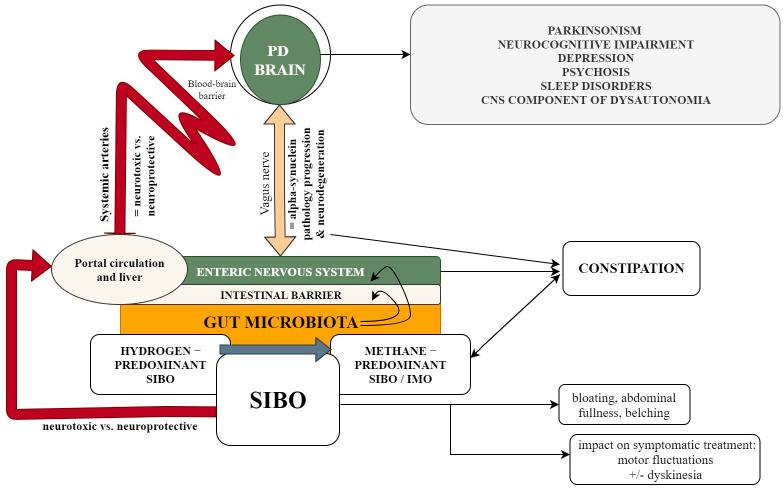
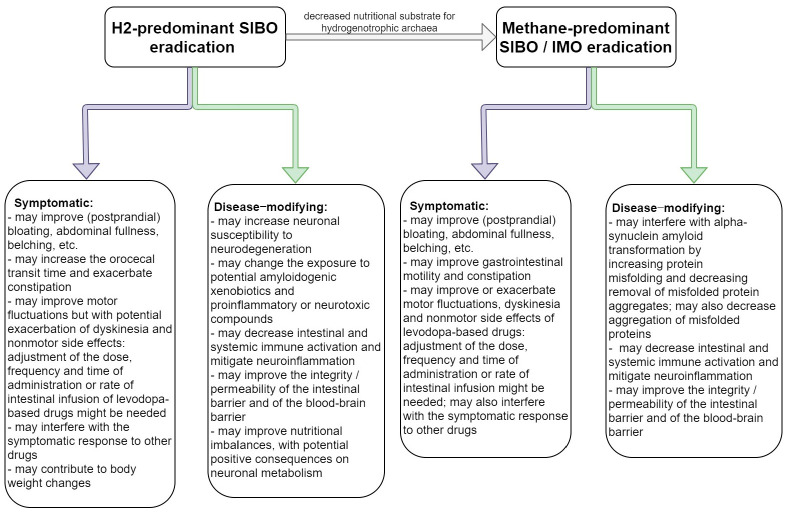
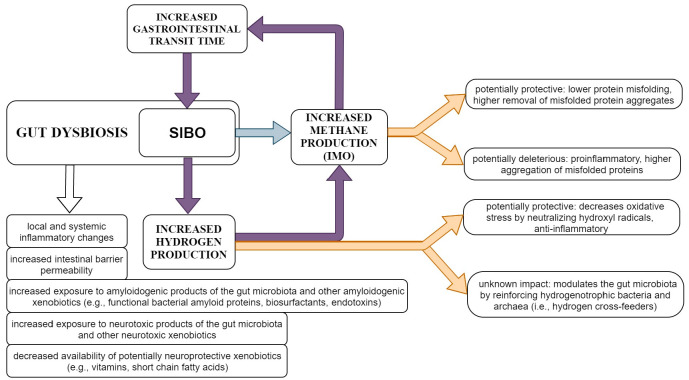
Increasing evidence suggests that the gut microbiota and the brain are closely connected via the so-called gut-brain axis. Small intestinal bacterial overgrowth (SIBO) is a gut dysbiosis in which the small intestine is abundantly colonized by bacteria that are typically found in the colon. Though not a disease, it may result in intestinal symptoms caused by the accumulation of microbial gases in the intestine. Intestinal inflammation, malabsorption and vitamin imbalances may also develop. SIBO can be eradicated by one or several courses of antibiotics but reappears if the predisposing condition persists. Parkinson's disease (PD) is a common neurodegenerative proteinopathy for which disease modifying interventions are not available. Sporadic forms may start in the gut years before the development of clinical features. Increased gastrointestinal transit time is present in most people with PD early during the course of the disease, predisposing to gut dysbiosis, including SIBO. The role that gut dysbiosis may play in the etiopathogenesis of PD is not fully understood yet. Here, we discuss the possibility that SIBO could contribute to the progression of PD, by promoting or preventing neurodegeneration, thus being a potential target for treatments aiming at slowing down the progression of PD. The direct symptomatic impact of SIBO and its impact on symptomatic medication are also briefly discussed.
越来越多的证据表明,肠道微生物群和大脑通过所谓的“肠脑轴”紧密相连。小肠细菌过度生长(SIBO)是一种肠道菌群失调,小肠被通常存在于结肠中的细菌大量定植。虽然它不是一种疾病,但它可能会导致肠道症状,这些症状是由肠道中微生物气体的积累引起的。肠道炎症、吸收不良和维生素失衡也可能发展。SIBO 可以通过一到几轮抗生素治疗来消除,但如果潜在的致病条件持续存在,它会再次出现。帕金森病(PD)是一种常见的神经退行性蛋白病,目前尚无有效的疾病修正干预措施。散发性病例可能在临床特征出现前数年就从肠道开始。在疾病早期,大多数 PD 患者的胃肠道通过时间增加,易发生肠道菌群失调,包括 SIBO。肠道菌群失调在 PD 的发病机制中的作用尚未完全清楚。在这里,我们讨论了 SIBO 可能通过促进或阻止神经退行性变来促进 PD 进展的可能性,因此它可能成为减缓 PD 进展的治疗方法的潜在靶点。我们还简要讨论了 SIBO 的直接症状影响及其对症状性药物的影响。