Department of Chemistry and Biochemistry, Faculty of Food Technology and Biotechnology, University of Zagreb, 10000 Zagreb, Croatia.
Mediterranean Institute for Life Sciences, 21000 Split, Croatia.
Int J Mol Sci. 2021 Oct 28;22(21):11678. doi: 10.3390/ijms222111678.
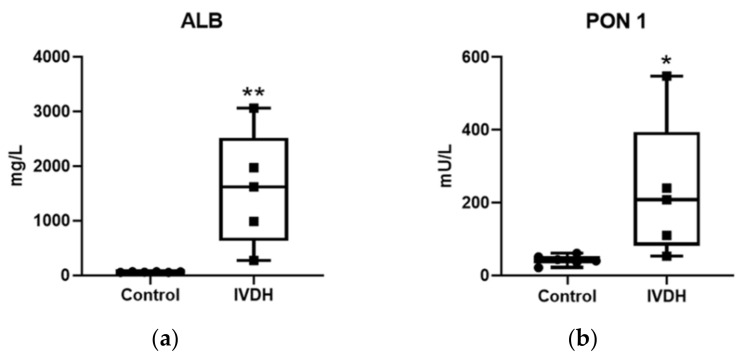
Herniation of the intervertebral disc (IVDH) is the most common cause of neurological and intervertebral disc degeneration-related diseases. Since the disc starts to degenerate before it can be observed by currently available diagnostic methods, there is an urgent need for novel diagnostic approaches. To identify molecular networks and pathways which may play important roles in intervertebral disc herniation, as well as to reveal the potential features which could be useful for monitoring disease progression and prognosis, multi-omics profiling, including high-resolution liquid chromatography-mass spectrometry (LC-MS)-based metabolomics and tandem mass tag (TMT)-based proteomics was performed. Cerebrospinal fluid of nine dogs with IVDH and six healthy controls were used for the analyses, and an additional five IVDH samples were used for proteomic data validation. Furthermore, multi-omics data were integrated to decipher a complex interaction between individual omics layers, leading to an improved prediction model. Together with metabolic pathways related to amino acids and lipid metabolism and coagulation cascades, our integromics prediction model identified the key features in IVDH, namely the proteins follistatin Like 1 (FSTL1), secretogranin V (SCG5), nucleobindin 1 (NUCB1), calcitonin re-ceptor-stimulating peptide 2 precursor (CRSP2) and the metabolites N-acetyl-D-glucosamine and adenine, involved in neuropathic pain, myelination, and neurotransmission and inflammatory response, respectively. Their clinical application is to be further investigated. The utilization of a novel integrative interdisciplinary approach may provide new opportunities to apply innovative diagnostic and monitoring methods as well as improve treatment strategies and personalized care for patients with degenerative spinal disorders.
椎间盘突出症(IVDH)是引起神经和椎间盘退行性疾病的最常见原因。由于椎间盘在现有诊断方法能够观察到之前就开始退化,因此迫切需要新的诊断方法。为了确定可能在椎间盘突出症中发挥重要作用的分子网络和途径,并揭示可能有助于监测疾病进展和预后的潜在特征,进行了多组学分析,包括基于高分辨率液相色谱-质谱(LC-MS)的代谢组学和串联质量标签(TMT)基于的蛋白质组学。使用 9 只患有 IVDH 的狗和 6 只健康对照的脑脊液进行了分析,并使用另外 5 个 IVDH 样本进行了蛋白质组学数据验证。此外,多组学数据被整合以破译个体组学层之间的复杂相互作用,从而改进预测模型。与氨基酸和脂质代谢以及凝血级联相关的代谢途径一起,我们的整合预测模型确定了 IVDH 的关键特征,即蛋白卵泡抑素样 1(FSTL1)、分泌颗粒 V(SCG5)、核结合蛋白 1(NUCB1)、降钙素受体刺激肽 2 前体(CRSP2)和代谢物 N-乙酰-D-葡萄糖胺和腺嘌呤,分别涉及神经病理性疼痛、髓鞘形成、神经传递和炎症反应。它们的临床应用有待进一步研究。新型综合跨学科方法的应用可能为创新的诊断和监测方法的应用提供新的机会,并改善退行性脊柱疾病患者的治疗策略和个性化护理。