Neurovascular Research Laboratory, Vall d'Hebron Institute of Research (VHIR), Universitat Autònoma de Barcelona, Barcelona, Spain.
Bioinformatics and Biostatistics Unit, Vall d'Hebron Institute of Research (VHIR), Universitat Autònoma de Barcelona, Barcelona, Spain; Genetics, Microbiology and Statistics Dept., Universitat de Barcelona, Barcelona, Spain.
Mol Cell Proteomics. 2020 Dec;19(12):1921-1936. doi: 10.1074/mcp.RA120.002283. Epub 2020 Aug 31.
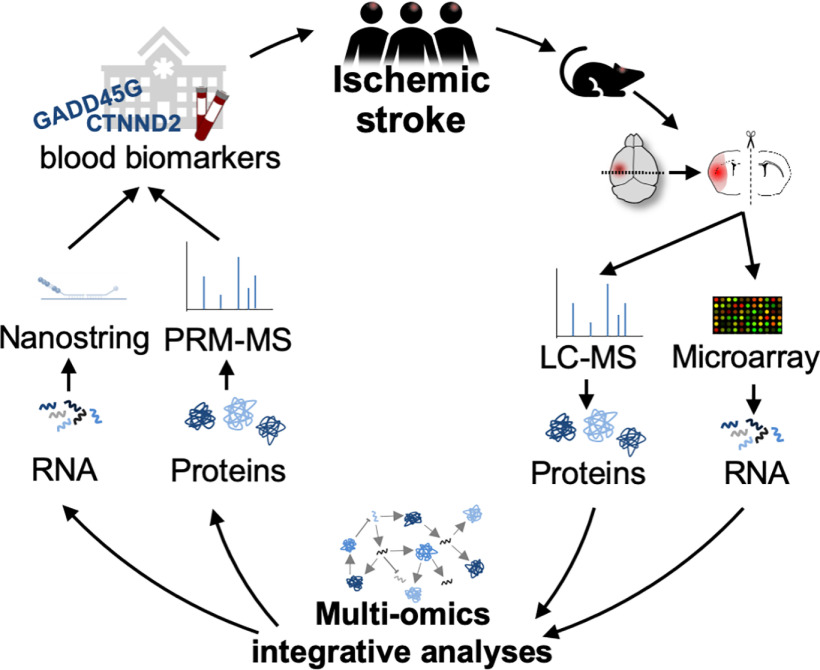
Stroke remains a leading cause of death and disability worldwide. Despite continuous advances, the identification of key molecular signatures in the hyper-acute phase of ischemic stroke is still a primary interest for translational research on stroke diagnosis, prognosis, and treatment. Data integration from high-throughput - techniques has become crucial to unraveling key interactions among different molecular elements in complex biological contexts, such as ischemic stroke. Thus, we used advanced data integration methods for a multi-level joint analysis of transcriptomics and proteomics data sets obtained from mouse brains at 2 h after cerebral ischemia. By modeling net-like correlation structures, we identified an integrated network of genes and proteins that are differentially expressed at a very early stage after stroke. We validated 10 of these deregulated elements in acute stroke, and changes in their expression pattern over time after cerebral ischemia were described. Of these, CLDN20, GADD45G, RGS2, BAG5, and CTNND2 were next evaluated as blood biomarkers of cerebral ischemia in mice and human blood samples, which were obtained from stroke patients and patients presenting stroke-mimicking conditions. Our findings indicate that CTNND2 levels in blood might potentially be useful for distinguishing ischemic strokes from stroke-mimicking conditions in the hyper-acute phase of the disease. Furthermore, circulating GADD45G content within the first 6 h after stroke could also play a key role in predicting poor outcomes in stroke patients. For the first time, we have used an integrative biostatistical approach to elucidate key molecules in the initial stages of stroke pathophysiology and highlight new notable molecules that might be further considered as blood biomarkers of ischemic stroke.
中风仍然是全球范围内导致死亡和残疾的主要原因。尽管不断取得进展,但在缺血性中风的超急性期确定关键分子特征仍然是中风诊断、预后和治疗转化研究的主要关注点。高通量技术的数据集成对于揭示复杂生物背景(如缺血性中风)中不同分子元素之间的关键相互作用至关重要。因此,我们使用先进的数据集成方法对从脑缺血后 2 小时的小鼠脑中获得的转录组学和蛋白质组学数据集进行多层次联合分析。通过构建网状相关结构模型,我们鉴定了一个在中风后极早期差异表达的基因和蛋白质的综合网络。我们在急性中风中验证了其中的 10 个失调元件,并描述了它们在脑缺血后随时间变化的表达模式。其中,CLDN20、GADD45G、RGS2、BAG5 和 CTNND2 被进一步评估为小鼠和人类中风患者及中风模拟条件患者血液样本中的脑缺血的血液生物标志物。我们的研究结果表明,血液中的 CTNND2 水平可能有助于在疾病的超急性期区分缺血性中风和中风模拟条件。此外,中风后 6 小时内循环中的 GADD45G 含量也可能在预测中风患者不良预后方面发挥关键作用。我们首次使用整合生物统计学方法来阐明中风病理生理学早期的关键分子,并强调可能进一步被考虑作为缺血性中风血液生物标志物的新的显著分子。