Graduate Program in Physical Education, Catholic University of Brasília, Brasília 71966-700, Brazil.
Department of Nephrology, Federal University of São Paulo, São Paulo 04021-001, Brazil.
Int J Environ Res Public Health. 2021 Oct 27;18(21):11299. doi: 10.3390/ijerph182111299.
Hemodialysis patients are suffering from depressive symptoms. Brain-derived neurotrophic factor (BDNF) levels are negatively associated with depressive symptoms and decrease during a single hemodialysis session. Resistance training (RT) might be an additional non-pharmacological tool to increase BDNF and promote mental health.
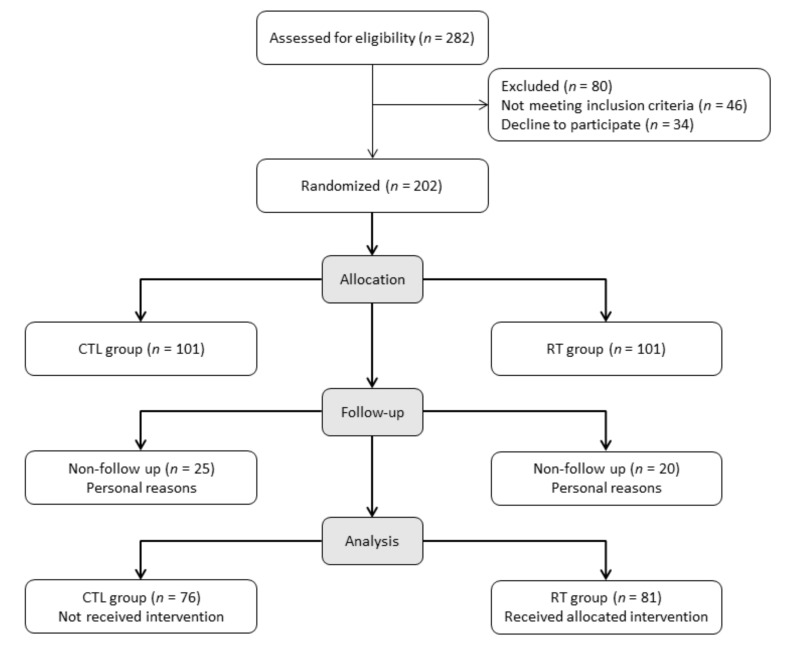
Two randomized groups of hemodialysis patients: control (CTL, = 76/F36; 66.33 ± 3.88 years) and RT ( = 81/F35; 67.27 ± 3.24 years). RT completed six months of training thrice a week under the supervision of strength and conditioning professional immediately before the dialysis session. Training loads were adjusted using the OMNI rating of perceived exertion. The total antioxidant capacity (TROLOX), glutathione (GSH), thiobarbituric acid reactive substance (TBARS), and BDNF levels were analyzed in serum samples. Quality of life (assessed through Medical Outcomes-SF36), and Beck Depression Inventory was applied.
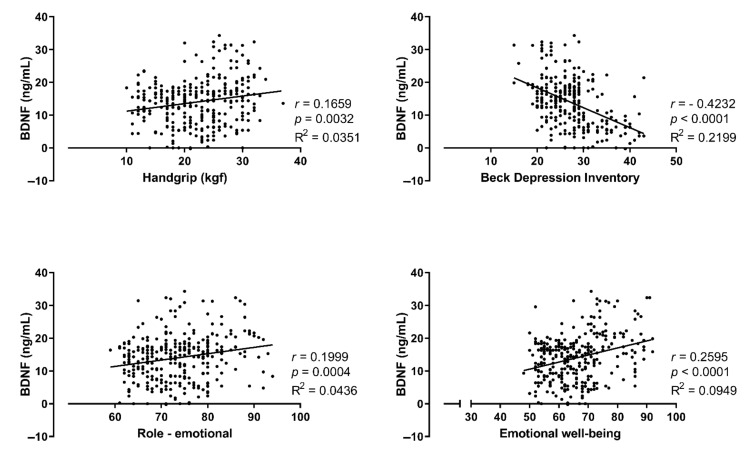
RT improved handgrip strength (21.17 ± 4.38 vs. 27.17 ± 4.34; 0.001) but not for CTL (20.09 ± 5.19 vs. 19.75 ± 5.54; 0.001). Post-training, RT group had higher values as compared to CTL related to TROLOX (RT,680.8 ± 225.2 vs. CTL,589.5 ± 195.9; 0.001) and GSH (RT, 9.33 ± 2.09 vs. CTL,5.00 ± 2.96; 0.001). RT group had lower values of TBARS as compared to CTL at post-training (RT, 11.06 ± 2.95 vs. CTL, 13.66 ± 2.62; 0.001). BDNF increased for RT (11.66 ± 5.20 vs. 19.60 ± 7.23; 0.001), but decreased for CTL (14.40 ± 4.99 vs. 10.84 ± 5.94; 0.001). Quality of life and mental health increased ( 0.001) for RT, but did not change for CTL ( 0.001). BDNF levels were associated with emotional dimensions of SF36, depressive symptoms, and handgrip ( = 0.001).
RT was effective as a non-pharmacological tool to increased BDNF levels, quality of life, temper the redox balance and decrease depressive symptoms intensity in hemodialysis patients.
血液透析患者患有抑郁症状。脑源性神经营养因子(BDNF)水平与抑郁症状呈负相关,并在单次血液透析过程中降低。阻力训练(RT)可能是增加 BDNF 和促进心理健康的另一种非药物工具。
两组血液透析患者随机分组:对照组(CTL,=76/F36;66.33±3.88 岁)和 RT 组(=81/F35;67.27±3.24 岁)。RT 在透析治疗前在力量和调节专业人员的监督下每周进行三次六个月的训练。使用 OMNI 感知用力量表调整训练负荷。分析血清样本中的总抗氧化能力(TROLOX)、谷胱甘肽(GSH)、硫代巴比妥酸反应物质(TBARS)和 BDNF 水平。通过医疗结果-SF36 评估生活质量,以及贝克抑郁量表。
RT 提高了握力(21.17±4.38 与 27.17±4.34; 0.001),但 CTL 没有(20.09±5.19 与 19.75±5.54; 0.001)。与 CTL 相比,RT 组在训练后具有更高的 TROLOX(RT,680.8±225.2 与 CTL,589.5±195.9; 0.001)和 GSH(RT,9.33±2.09 与 CTL,5.00±2.96; 0.001)值。与 CTL 相比,RT 组在训练后 TBARS 值较低(RT,11.06±2.95 与 CTL,13.66±2.62; 0.001)。BDNF 增加了 RT(11.66±5.20 与 19.60±7.23; 0.001),但 CTL 减少了(14.40±4.99 与 10.84±5.94; 0.001)。RT 组的生活质量和心理健康均有所提高( 0.001),而 CTL 组则没有变化( 0.001)。BDNF 水平与 SF36 的情感维度、抑郁症状和握力相关( = 0.001)。
RT 是一种有效的非药物工具,可增加 BDNF 水平、生活质量、调节氧化还原平衡并降低血液透析患者的抑郁症状强度。