da Silva Victor, Corrêa Hugo, Neves Rodrigo, Deus Lysleine, Reis Andrea, Souza Michel, Dos Santos Cláudio, de Castro Danilo, Honorato Fernando, Simões Herbert, Moraes Milton, Schoenfeld Brad, Prestes Jonato, Rosa Thiago
Graduate Program of Physical Education, Catholic University of Brasilia, Brasília, Brazil.
Department of Nephrology, Federal University of São Paulo, São Paulo, Brazil.
Front Physiol. 2021 Mar 10;12:619054. doi: 10.3389/fphys.2021.619054. eCollection 2021.
The purpose of this study was to: (i) investigate the effect of six months of resistance training (RT) on body composition, muscle strength, hematological patterns, and redox profile in maintenance hemodialysis (HD) patients, and; (ii) evaluate the effects of baseline concentrations of hemoglobin on the RT response.
One hundred fifty-seven subjects with chronic kidney disease (CKD) were randomly allocated into two groups: Control [CTL, ( = 76)] and RT ( = 81). A first visit was required for anamnesis and anthropometric measurements. Venous blood samples were collected at baseline and after twenty-four weeks of training in all patients for the analysis of clinical and redox balance markers. The RT program spanned six months and consisted of three sets of 8-12 repetitions with a rating of perceived exertion between 5 and 8 for three weekly sessions. Each exercise session was performed in twelve resistance exercises and it least for approximately 40 min.
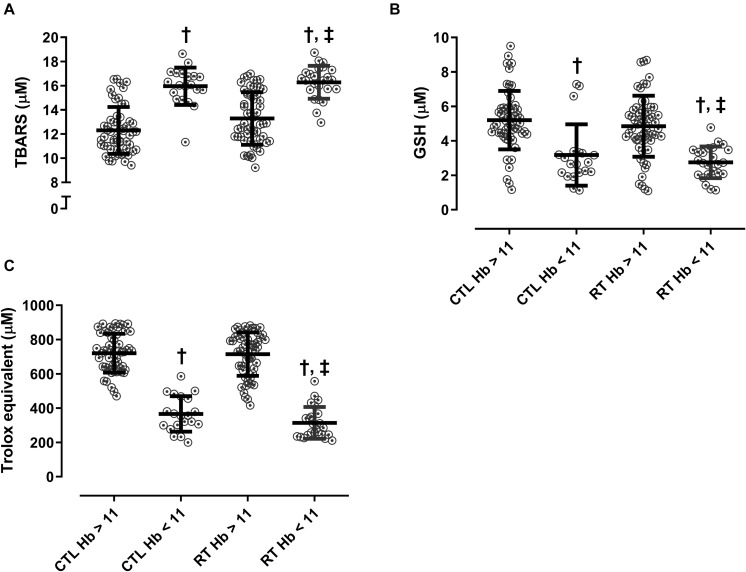
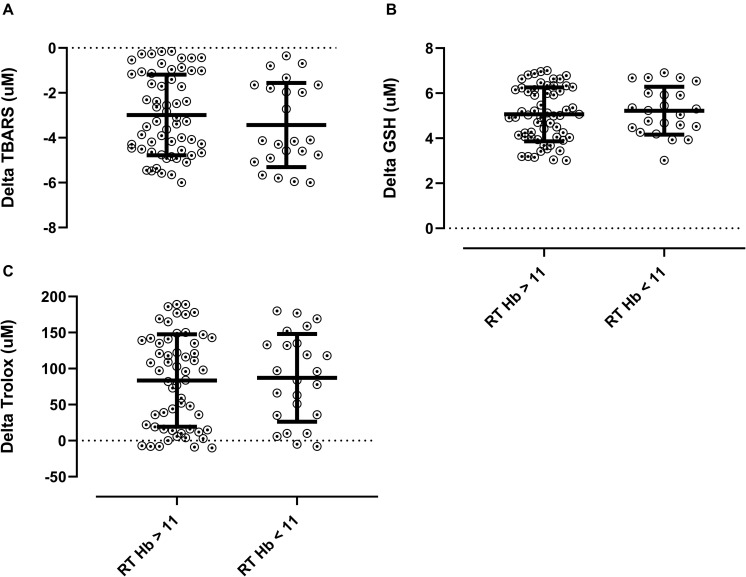
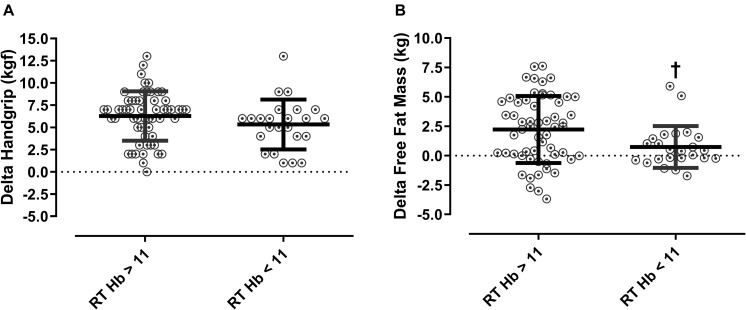
The main results demonstrated that RT decreased waist circumference by 3%, and decreased thiobarbituric reactive species (TBARS) by 28%. Moreover, RT increased handgrip strength by 28.4%, fat-free mass by 4.1%, hemoglobin by 5%, iron by 33.4%, glutathione by 121%, and Trolox equivalent antioxidant capacity by 14.2% ( < 0.05). Low hemoglobin concentrations impaired the effect of RT on fat-free mass gain.
Six months of RT in HD patients improved clinical parameters, such as hemoglobin, iron, body composition, and redox balance, while low hemoglobin concentration impaired exercise-benefits on fat-free mass in patients with CKD. These findings can contribute to a better clinical application of RT in the maintenance of hemodialysis patients.
本研究的目的是:(i)调查为期六个月的抗阻训练(RT)对维持性血液透析(HD)患者身体成分、肌肉力量、血液学指标和氧化还原状态的影响,以及;(ii)评估血红蛋白基线浓度对RT反应的影响。
157名慢性肾脏病(CKD)患者被随机分为两组:对照组[CTL,(n = 76)]和RT组(n = 81)。首次就诊时进行问诊和人体测量。所有患者在基线和训练24周后采集静脉血样,用于分析临床和氧化还原平衡指标。RT计划为期六个月,包括三组,每组8 - 12次重复,每周进行三次训练,主观用力程度评分为5至8分。每次训练进行12项抗阻运动,持续约40分钟。
主要结果表明,RT使腰围降低了3%,硫代巴比妥酸反应性物质(TBARS)降低了28%。此外,RT使握力增加了28.4%,去脂体重增加了4.1%,血红蛋白增加了5%,铁增加了33.4%,谷胱甘肽增加了121%,以及Trolox等效抗氧化能力增加了14.2%(P < 0.05)。低血红蛋白浓度削弱了RT对去脂体重增加的影响。
HD患者进行六个月的RT可改善临床参数,如血红蛋白、铁、身体成分和氧化还原平衡,而低血红蛋白浓度会削弱CKD患者运动对去脂体重的益处。这些发现有助于更好地将RT临床应用于维持性血液透析患者。