Spinal Cord Injury Research Center, University Hospital Balgrist, 8008 Zurich, Switzerland.
Rehabilitation Engineering Laboratory, Department of Health Sciences and Technology, ETH Zurich, 8008 Zurich, Switzerland.
Sensors (Basel). 2021 Nov 6;21(21):7381. doi: 10.3390/s21217381.
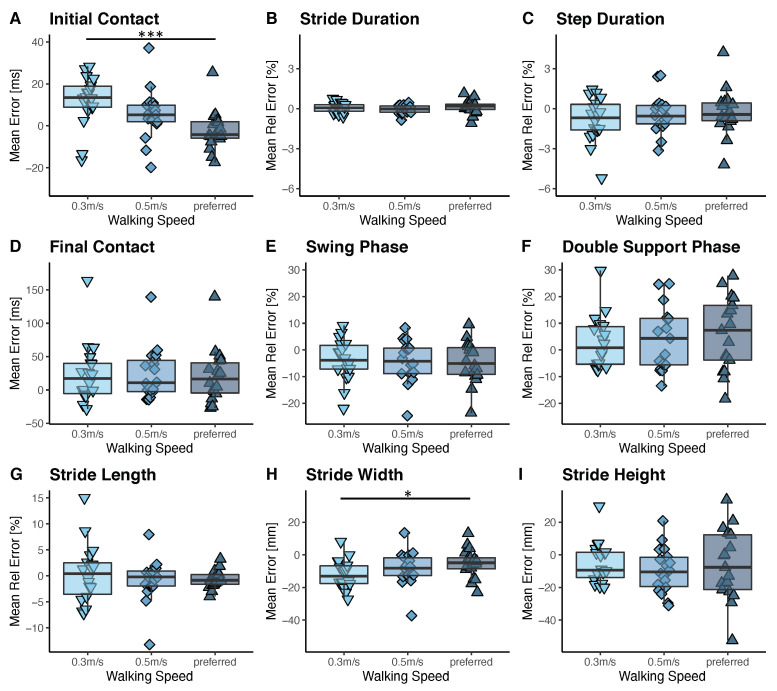
Spinal cord injury (SCI) patients suffer from diverse gait deficits depending on the severity of their injury. Gait assessments can objectively track the progress during rehabilitation and support clinical decision making, but a comprehensive gait analysis requires far more complex setups and time-consuming protocols that are not feasible in the daily clinical routine. As using inertial sensors for mobile gait analysis has started to gain ground, this work aimed to develop a sensor-based gait analysis for the specific population of SCI patients that measures the spatio-temporal parameters of typical gait laboratories for day-to-day clinical applications. The proposed algorithm uses shank-mounted inertial sensors and personalized thresholds to detect steps and gait events according to the individual gait profiles. The method was validated in nine SCI patients and 17 healthy controls walking on an instrumented treadmill while wearing reflective markers for motion capture used as a gold standard. The sensor-based algorithm (i) performed similarly well for the two cohorts and (ii) is robust enough to cover the diverse gait deficits of SCI patients, from slow (0.3 m/s) to preferred walking speeds.
脊髓损伤 (SCI) 患者根据损伤的严重程度表现出不同的步态缺陷。步态评估可以客观地跟踪康复过程中的进展,并支持临床决策,但全面的步态分析需要更复杂的设置和耗时的方案,这在日常临床常规中是不可行的。由于使用惯性传感器进行移动步态分析已经开始普及,本工作旨在为 SCI 患者这一特定人群开发一种基于传感器的步态分析,该分析可测量典型步态实验室的时空参数,适用于日常临床应用。所提出的算法使用安装在小腿上的惯性传感器和个性化阈值,根据个体步态曲线来检测步伐和步态事件。该方法在九名 SCI 患者和十七名健康对照者在安装有传感器的跑步机上行走时进行了验证,他们穿着反光标记进行运动捕捉,作为黄金标准。基于传感器的算法 (i) 对两个队列的表现都非常相似,(ii) 具有足够的鲁棒性,可以涵盖 SCI 患者从缓慢(0.3 m/s)到最佳行走速度的各种步态缺陷。