de la Pinta Carolina, Castillo María E, Collado Manuel, Galindo-Pumariño Cristina, Peña Cristina
Radiation Oncology Department, Ramón y Cajal University Hospital, IRYCIS, Alcalá University, 28034 Madrid, Spain.
Medical Oncology Department, Ramón y Cajal University Hospital, IRYCIS, Alcalá University, 28034 Madrid, Spain.
Cancers (Basel). 2021 Nov 5;13(21):5547. doi: 10.3390/cancers13215547.
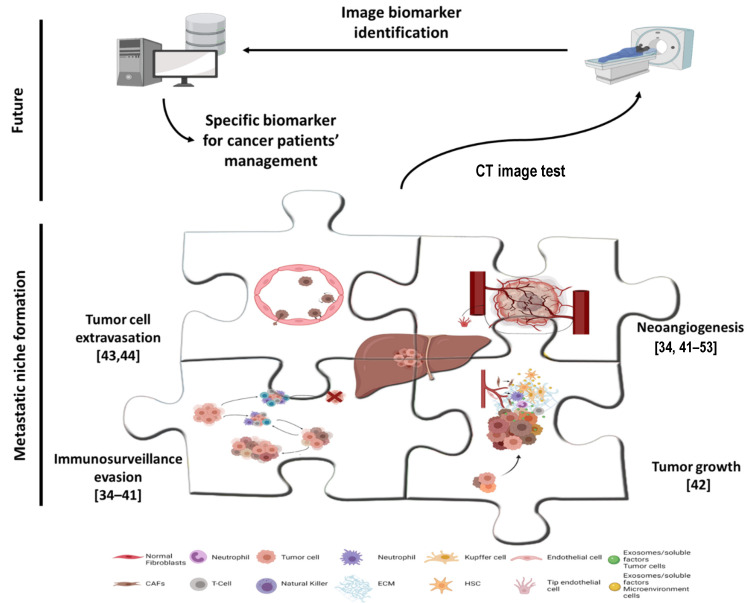
Radiomics is a developing new discipline that analyzes conventional medical images to extract quantifiable data that can be mined for new biomarkers that show the biology of pathological processes at microscopic levels. These data can be converted into image-based signatures to improve diagnostic, prognostic and predictive accuracy in cancer patients. The combination of radiomics and molecular data, called radiogenomics, has clear implications for cancer patients' management. Though some studies have focused on radiogenomics signatures in hepatocellular carcinoma patients, only a few have examined colorectal cancer metastatic lesions in the liver. Moreover, the need to differentiate between liver lesions is fundamental for accurate diagnosis and treatment. In this review, we summarize the knowledge gained from radiomics and radiogenomics studies in hepatic metastatic colorectal cancer patients and their use in early diagnosis, response assessment and treatment decisions. We also investigate their value as possible prognostic biomarkers. In addition, the great potential of image mining to provide a comprehensive view of liver niche formation is examined thoroughly. Finally, new challenges and current limitations for the early detection of the liver premetastatic niche, based on radiomics and radiogenomics, are also discussed.
放射组学是一门正在发展的新学科,它分析传统医学图像以提取可量化数据,这些数据可用于挖掘新的生物标志物,这些生物标志物能在微观层面显示病理过程的生物学特性。这些数据可转化为基于图像的特征,以提高癌症患者诊断、预后和预测的准确性。放射组学与分子数据的结合,即放射基因组学,对癌症患者的管理具有明确意义。尽管一些研究聚焦于肝细胞癌患者的放射基因组学特征,但仅有少数研究探讨了肝脏中的结直肠癌转移灶。此外,区分肝脏病变对于准确诊断和治疗至关重要。在本综述中,我们总结了从肝脏转移性结直肠癌患者的放射组学和放射基因组学研究中获得的知识,以及它们在早期诊断、疗效评估和治疗决策中的应用。我们还研究了它们作为可能的预后生物标志物的价值。此外,深入探讨了图像挖掘在全面了解肝脏生态位形成方面的巨大潜力。最后,还讨论了基于放射组学和放射基因组学早期检测肝脏前转移生态位面临的新挑战和当前局限性。