Department of Spinal Surgery, Changzhou Hospital of Traditional Chinese Medicine, No. 25 Heping North Road, Changzhou, Jiangsu, 213000, P.R. China.
J Orthop Surg Res. 2021 Nov 12;16(1):665. doi: 10.1186/s13018-021-02694-x.
Osteoporosis is a systemic disease characterized by impaired bone formation, increased bone resorption, and brittle bone fractures. The osteogenic differentiation of human bone marrow-derived mesenchymal stem cells (hBMSCs) is considered to be a vital process for bone formation. Numerous studies have reported that long non-coding RNAs (lncRNAs) are involved in the osteogenic differentiation of hBMSCs. The present study aimed to investigate the effect of FGD5 antisense RNA 1 (FGD5-AS1) on osteogenic differentiation.
RT-qPCR was performed to detect the expression of FGD5-AS1, miR-506-3p, and osteogenesis-related genes OCN, OPN, OSX, and RUNX2. Western blotting was carried out to detect the protein levels of osteogenesis-related markers. In addition, the regulatory effect of FGD5-AS1 on osteogenic differentiation was detected through alkaline phosphatase (ALP) activity, Alizarin Red S (ARS) staining, and Cell Counting Kit-8 (CCK-8). Bioinformatics analysis and luciferase reporter assay were used to predict and validate the interaction between FGD5-AS1 and miR-506-3p as well as miR-506-3p and bone morphogenetic protein 7 (BMP7).
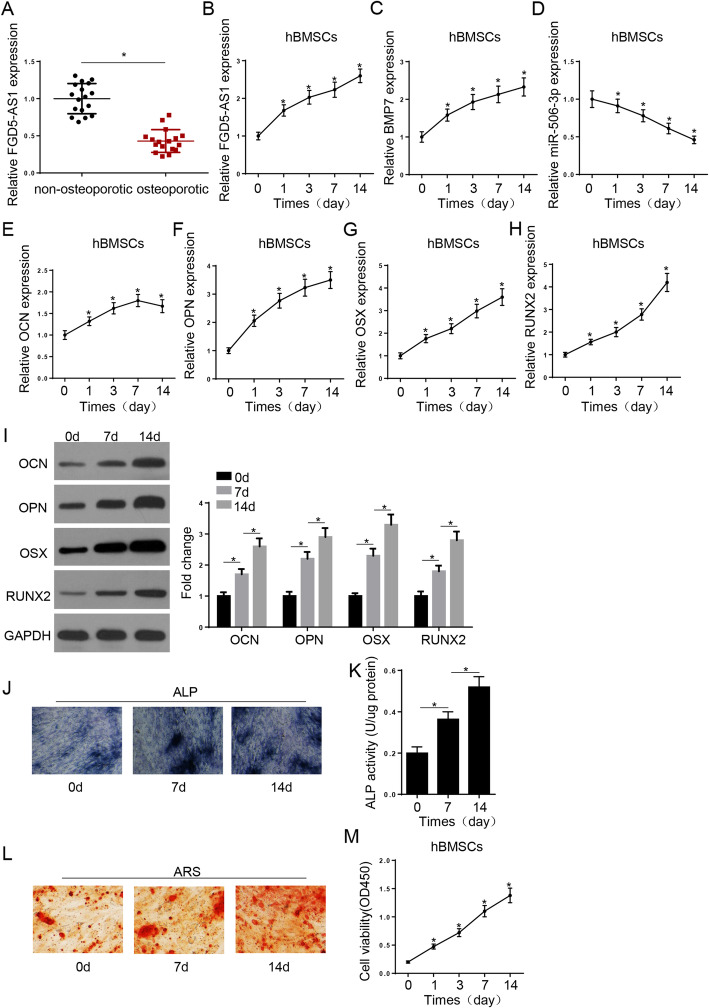
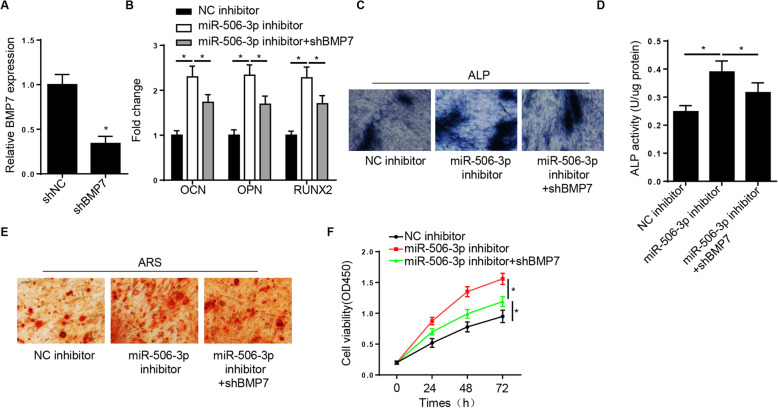
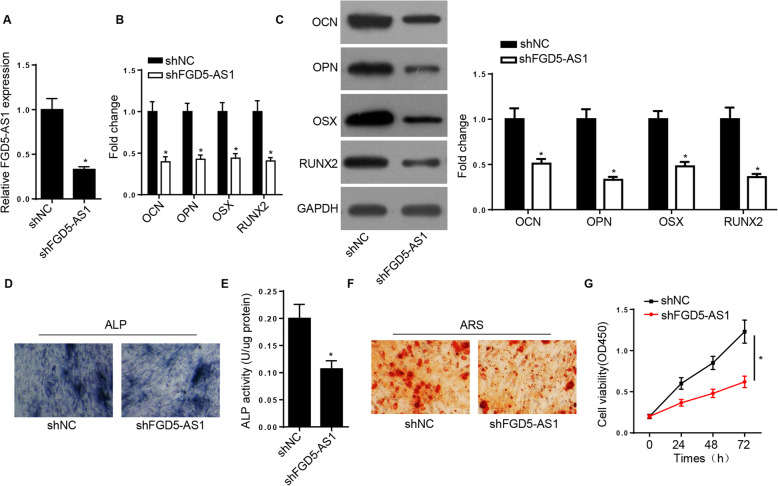
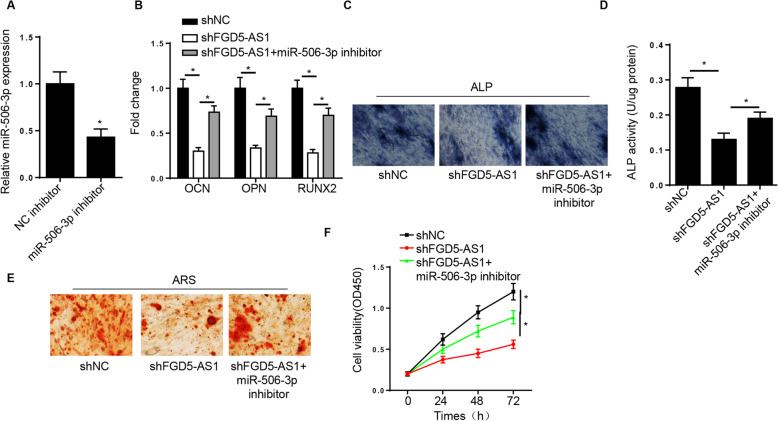
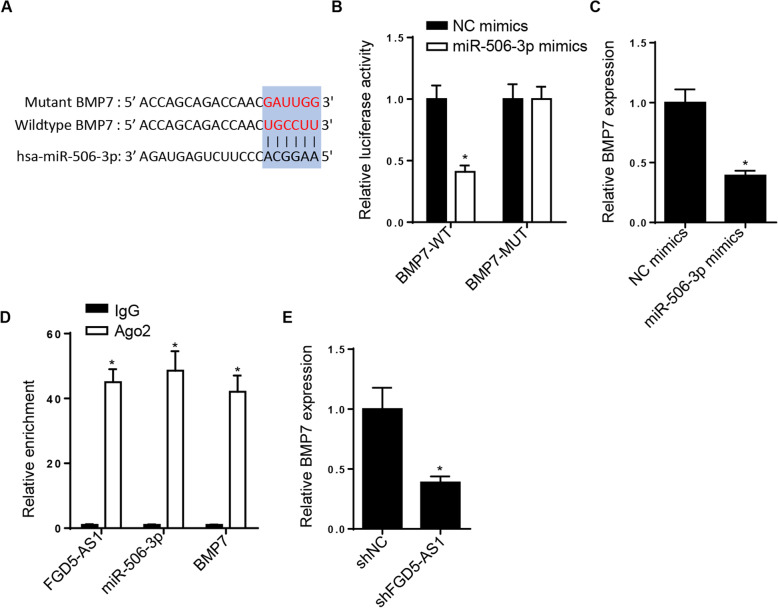
The RT-qPCR analysis revealed that FGD5-AS1 was upregulated in hBMSCs following induction of osteogenic differentiation. In addition, FGD5-AS1 knockdown attenuated hBMSC viability and osteogenic differentiation. Bioinformatics analysis and luciferase reporter assays verified that FGD5-AS1 could directly interact with microRNA (miR)-506-3p. Furthermore, miR-506-3p could directly target the 3'-untranslated region (3'-UTR) of BMP7. Additionally, functional assays demonstrated that miR-506-3p silencing could restore the suppressive effect of FGD5-AS1 knockdown on osteogenic differentiation and viability of hBMSCs, and miR-506-3p could attenuate osteogenic differentiation via targeting BMP7.
Taken together, the results of the present study suggested that FGD5-AS1 could positively regulate the osteogenic differentiation of hBMSCs via targeting the miR-506-3p/BMP7 axis.
骨质疏松症是一种以骨形成受损、骨吸收增加和脆性骨折为特征的系统性疾病。人骨髓间充质干细胞(hBMSCs)的成骨分化被认为是骨形成的重要过程。许多研究报道长链非编码 RNA(lncRNA)参与 hBMSCs 的成骨分化。本研究旨在探讨 FGD5 反义 RNA 1(FGD5-AS1)对成骨分化的影响。
采用 RT-qPCR 检测 FGD5-AS1、miR-506-3p 及成骨相关基因 OCN、OPN、OSX、RUNX2 的表达。采用 Western blot 检测成骨相关标志物的蛋白水平。此外,通过碱性磷酸酶(ALP)活性、茜素红 S(ARS)染色和细胞计数试剂盒-8(CCK-8)检测 FGD5-AS1 对成骨分化的调节作用。通过生物信息学分析和荧光素酶报告基因实验预测和验证 FGD5-AS1 与 miR-506-3p 以及 miR-506-3p 与骨形态发生蛋白 7(BMP7)之间的相互作用。
RT-qPCR 分析显示,在 hBMSCs 诱导成骨分化后,FGD5-AS1 上调。此外,FGD5-AS1 敲低降低了 hBMSC 的活力和成骨分化。生物信息学分析和荧光素酶报告基因实验验证了 FGD5-AS1 可以直接与 microRNA(miR)-506-3p 相互作用。此外,miR-506-3p 可以直接靶向 BMP7 的 3'-非翻译区(3'-UTR)。此外,功能分析表明,miR-506-3p 沉默可以恢复 FGD5-AS1 敲低对 hBMSCs 成骨分化和活力的抑制作用,miR-506-3p 可以通过靶向 BMP7 来抑制成骨分化。
综上所述,本研究结果表明,FGD5-AS1 可以通过靶向 miR-506-3p/BMP7 轴正向调节 hBMSCs 的成骨分化。