Gillings School of Global Public Health, University of North Carolina, Chapel Hill, NC, USA.
Department of Family and Community Medicine, School of Medicine, University of California, San Francisco, CA, USA.
BMC Public Health. 2021 Nov 13;21(1):2084. doi: 10.1186/s12889-021-12082-z.
Strategies to control coronavirus 2019 disease (COVID-19) have often been based on preliminary and limited data and have tended to be slow to evolve as new evidence emerges. Yet knowledge about COVID-19 has grown exponentially, and the expanding rollout of vaccines presents further opportunity to reassess the response to the pandemic more broadly.
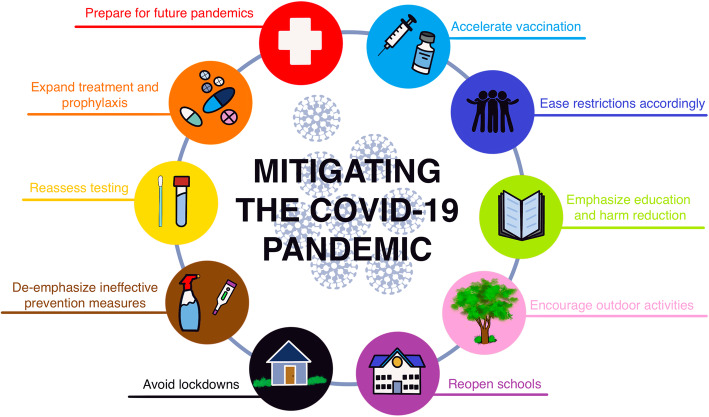
We review the latest evidence concerning 10 key COVID-19 policy and strategic areas, specifically addressing: 1) the expansion of equitable vaccine distribution, 2) the need to ease restrictions as hospitalization and mortality rates eventually fall, 3) the advantages of emphasizing educational and harm reduction approaches over coercive and punitive measures, 4) the need to encourage outdoor activities, 5) the imperative to reopen schools, 6) the far-reaching and long-term economic and psychosocial consequences of sustained lockdowns, 7) the excessive focus on surface disinfection and other ineffective measures, 8) the importance of reassessing testing policies and practices, 9) the need for increasing access to outpatient therapies and prophylactics, and 10) the necessity to better prepare for future pandemics.
While remarkably effective vaccines have engendered great hope, some widely held assumptions underlying current policy approaches call for an evidence-based reassessment. COVID-19 will require ongoing mitigation for the foreseeable future as it transforms from a pandemic into an endemic infection, but maintaining a constant state of emergency is not viable. A more realistic public health approach is to adjust current mitigation goals to be more data-driven and to minimize unintended harms associated with unfocused or ineffective control efforts. Based on the latest evidence, we therefore present recommendations for refining 10 key policy areas, and for applying lessons learned from COVID-19 to prevent and prepare for future pandemics.
控制 2019 年冠状病毒病(COVID-19)的策略通常基于初步和有限的数据,并且随着新证据的出现,往往演变缓慢。然而,COVID-19 的知识呈指数级增长,疫苗的广泛推出为更广泛地重新评估对大流行的应对提供了进一步的机会。
我们回顾了有关 COVID-19 政策和战略的 10 个关键领域的最新证据,具体涉及:1)扩大公平疫苗分配,2)随着住院和死亡率最终下降,需要放宽限制,3)强调教育和减少伤害方法优于强制性和惩罚性措施的优势,4)需要鼓励户外活动,5)必须重新开放学校,6)长期封锁对经济和社会心理的深远和长期影响,7)过分关注表面消毒和其他无效措施,8)重新评估检测政策和实践的重要性,9)增加获得门诊治疗和预防措施的机会,10)更好地为未来的大流行做准备的必要性。
虽然效果显著的疫苗带来了巨大的希望,但当前政策方法所依据的一些广泛持有的假设需要进行基于证据的重新评估。由于 COVID-19 将从大流行转变为地方病,因此在可预见的未来仍将需要持续缓解,但保持持续的紧急状态是不可行的。更现实的公共卫生方法是调整当前缓解目标,使其更加以数据为导向,并最大限度地减少与无重点或无效控制措施相关的意外危害。基于最新证据,我们因此提出了改进 10 个关键政策领域的建议,并为预防和应对未来的大流行应用从 COVID-19 中吸取的经验教训。