Hepatitis and AIDS Department, Pasteur Institute of Iran, Tehran, Iran.
Viral Vaccine Research Center, Pasteur Institute of Iran, Tehran, Iran.
Virol J. 2021 Nov 14;18(1):221. doi: 10.1186/s12985-021-01692-z.
The recent pandemic caused by severe acute respiratory syndrome coronavirus-2 (SARS-CoV-2) has elevated several clinical and scientific questions. These include how host genetic factors influence the pathogenesis and disease susceptibility. Therefore, the aim of this study was to evaluate the impact of interferon lambda 3 and 4 (IFNL3/4) gene polymorphisms and clinical parameters on the resistance and susceptibility to coronavirus disease 2019 (COVID-19) infection.
A total of 750 SARS-CoV-2 positive patients (375 survivors and 375 nonsurvivors) were included in this study. All single-nucleotide polymorphisms (SNPs) on IFNL3 (rs12979860, rs8099917, and rs12980275) and IFNL4 rs368234815 were genotyped by the polymerase chain reaction-restriction fragment length polymorphism (PCR-RFLP) method.
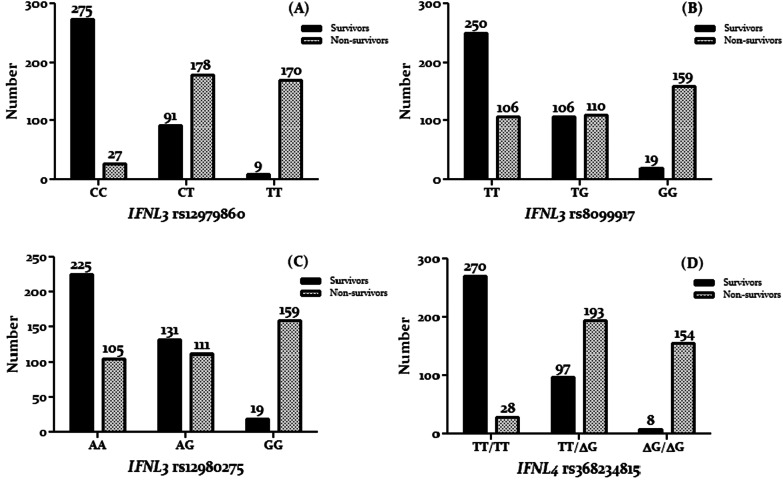
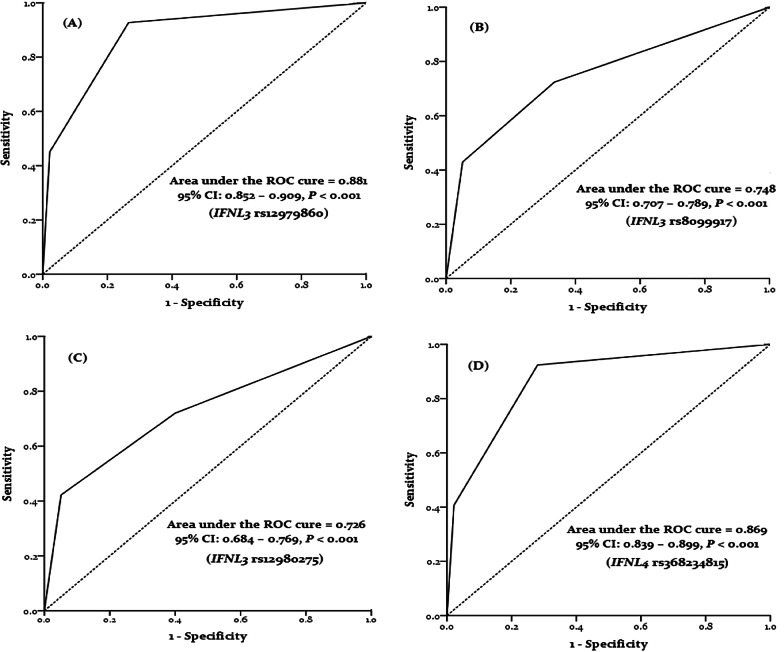
In this study, a higher viral load (low PCR Ct value) was shown in nonsurvivor patients. In survivor patients, the frequency of the favorable genotypes of IFNL3/4 SNPs (rs12979860 CC, rs12980275 AA, rs8099917 TT, and rs368234815 TT/TT) was significantly higher than in nonsurvivor patients. Multivariate logistic regression analysis has shown that a higher low-density lipoprotein (LDL), erythrocyte sedimentation rate (ESR), C-reactive protein (CRP), and PCR Ct value, and lower 25-hydroxyvitamin D, and also IFNL3 rs12979860 TT, IFNL3 rs8099917 GG, IFNL3 rs12980275 GG, and IFNL4 rs368234815 ∆G/∆G genotypes were associated with the severity of COVID-19 infection.
The results of this study proved that the severity of COVID-19 infection was associated with clinical parameters and unfavorable genotypes of IFNL3/IFNL4 SNPs. Further studies in different parts of the world are needed to show the relationship between severity of COVID-19 infection and host genetic factors.
由严重急性呼吸系统综合症冠状病毒 2(SARS-CoV-2)引起的最近的大流行引起了若干临床和科学问题。其中包括宿主遗传因素如何影响发病机制和疾病易感性。因此,本研究的目的是评估干扰素 lambda 3 和 4(IFNL3/4)基因多态性和临床参数对 2019 年冠状病毒病(COVID-19)感染的抵抗力和易感性的影响。
本研究共纳入 750 例 SARS-CoV-2 阳性患者(375 例幸存者和 375 例非幸存者)。通过聚合酶链反应-限制性片段长度多态性(PCR-RFLP)方法对 IFNL3(rs12979860、rs8099917 和 rs12980275)和 IFNL4 rs368234815 上的所有单核苷酸多态性(SNP)进行基因分型。
本研究表明,非幸存者患者的病毒载量(低 PCR Ct 值)较高。在幸存者患者中,IFNL3/4 SNP(rs12979860 CC、rs12980275 AA、rs8099917 TT 和 rs368234815 TT/TT)的有利基因型频率明显高于非幸存者患者。多变量逻辑回归分析表明,较高的低密度脂蛋白(LDL)、红细胞沉降率(ESR)、C 反应蛋白(CRP)和 PCR Ct 值,以及较低的 25-羟维生素 D,以及 IFNL3 rs12979860 TT、IFNL3 rs8099917 GG、IFNL3 rs12980275 GG 和 IFNL4 rs368234815 ∆G/∆G 基因型与 COVID-19 感染的严重程度相关。
本研究结果证明,COVID-19 感染的严重程度与 IFNL3/IFNL4 SNP 的临床参数和不利基因型有关。需要在世界不同地区进行进一步的研究,以显示 COVID-19 感染严重程度与宿主遗传因素之间的关系。