General Surgery Department of Ezhou Central Hospital of Hubei Province, 436000, China.
Infectious Diseases Department of Ezhou Central Hospital of Hubei Province, 436000, China.
Mediators Inflamm. 2021 Nov 3;2021:9059601. doi: 10.1155/2021/9059601. eCollection 2021.
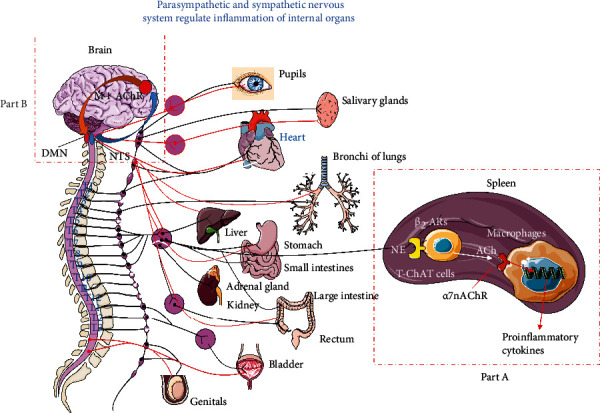
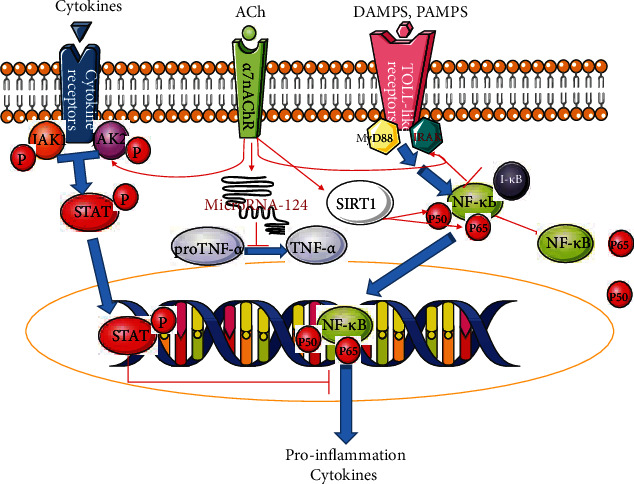
The inflammatory storm in the early stage and immunosuppression in the late stage are responsible for the high mortality rates and multiple organ dysfunction in sepsis. In recent years, studies have found that the body's cholinergic system can spontaneously and dynamically regulate inflammation and immunity in sepsis according to the needs of the body. Firstly, the vagus nerve senses and regulates local or systemic inflammation by means of the Cholinergic Anti-inflammatory Pathway (CAP) and activation of 7-nicotinic acetylcholine receptors (7nAChRs); thus, 7nAChRs play important roles for the central nervous system (CNS) to modulate peripheral inflammation; secondly, the activation of muscarinic acetylcholine receptors 1 (M1AChRs) in the forebrain can affect the neurons of the Medullary Visceral Zone (MVZ), the core of CAP, to regulate systemic inflammation and immunity. Based on the critical role of these two cholinergic receptor systems in sepsis, it is necessary to collect and analyze the related findings in recent years to provide ideas for further research studies and clinical applications. By consulting the related literature, we draw some conclusions: MVZ is the primary center for the nervous system to regulate inflammation and immunity. It coordinates not only the sympathetic system and vagus system but also the autonomic nervous system and neuroendocrine system to regulate inflammation and immunity; 7nAChRs are widely expressed in immune cells, neurons, and muscle cells; the activation of 7nAChRs can suppress local and systemic inflammation; the expression of 7nAChRs represents the acute or chronic inflammatory state to a certain extent; M1AChRs are mainly expressed in the advanced centers of the brain and regulate systemic inflammation; neuroinflammation of the MVZ, hypothalamus, and forebrain induced by sepsis not only leads to their dysfunctions but also underlies the regulatory dysfunction on systemic inflammation and immunity. Correcting the neuroinflammation of these regulatory centers and adjusting the function of 7nAChRs and M1AChRs may be two key strategies for the treatment of sepsis in the future.
在脓毒症中,早期的炎症风暴和晚期的免疫抑制是导致高死亡率和多器官功能障碍的原因。近年来,研究发现,机体的胆碱能系统可以根据机体的需要,自发地、动态地调节脓毒症中的炎症和免疫。首先,迷走神经通过胆碱能抗炎途径(CAP)和 7 型烟碱乙酰胆碱受体(7nAChRs)的激活来感知和调节局部或全身炎症;因此,7nAChRs 对中枢神经系统(CNS)调节外周炎症起着重要作用;其次,前脑的毒蕈碱乙酰胆碱受体 1(M1AChRs)的激活可以影响 CAP 的核心——延髓内脏区(MVZ)的神经元,从而调节全身炎症和免疫。基于这两个胆碱能受体系统在脓毒症中的关键作用,有必要收集和分析近年来的相关研究结果,为进一步的研究和临床应用提供思路。通过查阅相关文献,我们得出以下结论:MVZ 是神经系统调节炎症和免疫的主要中枢。它不仅协调交感神经系统和迷走神经系统,还协调自主神经系统和神经内分泌系统来调节炎症和免疫;7nAChRs 广泛表达于免疫细胞、神经元和肌肉细胞;激活 7nAChRs 可以抑制局部和全身炎症;7nAChRs 的表达在一定程度上代表了急性或慢性炎症状态;M1AChRs 主要表达于脑的高级中枢,调节全身炎症;脓毒症引起的 MVZ、下丘脑和前脑的神经炎症不仅导致其功能障碍,而且还导致全身炎症和免疫的调节功能障碍。纠正这些调节中枢的神经炎症,调节 7nAChRs 和 M1AChRs 的功能,可能是未来脓毒症治疗的两个关键策略。