Thanthrige Nipuni, Bhowmik Sudipta Das, Ferguson Brett J, Kabbage Mehdi, Mundree Sagadevan G, Williams Brett
Centre for Agriculture and the Bioeconomy, Queensland University of Technology, Brisbane, QLD, Australia.
School of Agriculture and Food Sciences, University of Queensland, Brisbane, QLD, Australia.
Front Plant Sci. 2021 Oct 27;12:760407. doi: 10.3389/fpls.2021.760407. eCollection 2021.
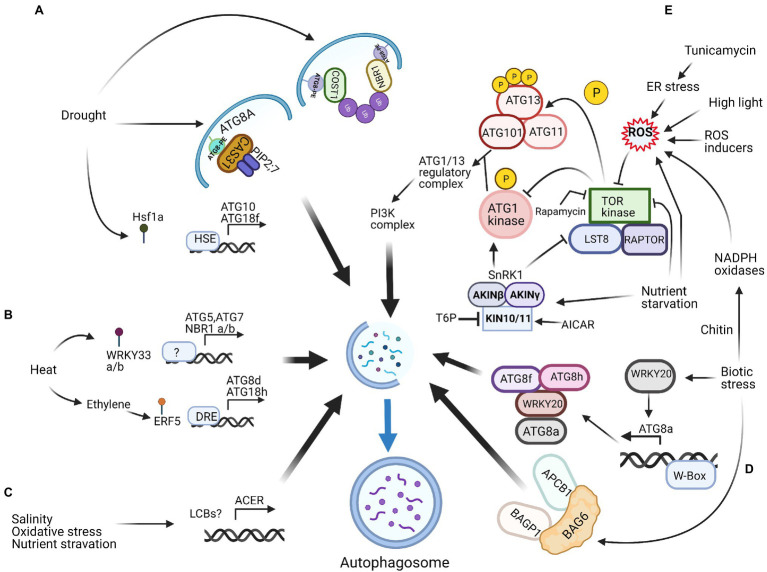
Autophagy is a genetically regulated, eukaryotic cellular degradation system that sequestrates cytoplasmic materials in specialised vesicles, termed autophagosomes, for delivery and breakdown in the lysosome or vacuole. In plants, autophagy plays essential roles in development (e.g., senescence) and responses to abiotic (e.g., nutrient starvation, drought and oxidative stress) and biotic stresses (e.g., hypersensitive response). Initially, autophagy was considered a non-selective bulk degradation mechanism that provides energy and building blocks for homeostatic balance during stress. Recent studies, however, reveal that autophagy may be more subtle and selectively target ubiquitylated protein aggregates, protein complexes and even organelles for degradation to regulate vital cellular processes even during favourable conditions. The selective nature of autophagy lends itself to potential manipulation and exploitation as part of designer protein turnover machinery for the development of stress-tolerant and disease-resistant crops, crops with increased yield potential and agricultural efficiency and reduced post-harvest losses. Here, we discuss our current understanding of autophagy and speculate its potential manipulation for improved agricultural performance.
自噬是一种由基因调控的真核细胞降解系统,它将细胞质物质隔离在称为自噬体的特殊囊泡中,以便在溶酶体或液泡中进行运输和分解。在植物中,自噬在发育(如衰老)以及对非生物胁迫(如营养饥饿、干旱和氧化应激)和生物胁迫(如过敏反应)的响应中发挥着重要作用。最初,自噬被认为是一种非选择性的大量降解机制,在胁迫期间为体内平衡提供能量和构建模块。然而,最近的研究表明,自噬可能更为精细,甚至在有利条件下也能选择性地靶向泛素化的蛋白质聚集体、蛋白质复合物乃至细胞器进行降解,以调控重要的细胞过程。自噬的选择性使其有可能作为设计蛋白质周转机制的一部分进行操控和利用,从而培育出耐胁迫和抗病的作物、具有更高产量潜力和农业效率以及减少收获后损失的作物。在此,我们讨论了目前对自噬的理解,并推测了其在改善农业性能方面的潜在应用。