Xin Xing, Tan Qizhao, Li Fang, Chen Zhongqiang, Zhang Ke, Li Feng, Yang Bin, Xing Zhili, Zhou Fang, Tian Yun, Lv Yang, Zhu Tengjiao
International Hospital, Third Hospital, Peking University, Beijing, China.
Engineering Research Center of Bone and Joint Precision Medicine, Ministry of Education, Beijing, China.
Front Surg. 2021 Oct 29;8:750047. doi: 10.3389/fsurg.2021.750047. eCollection 2021.
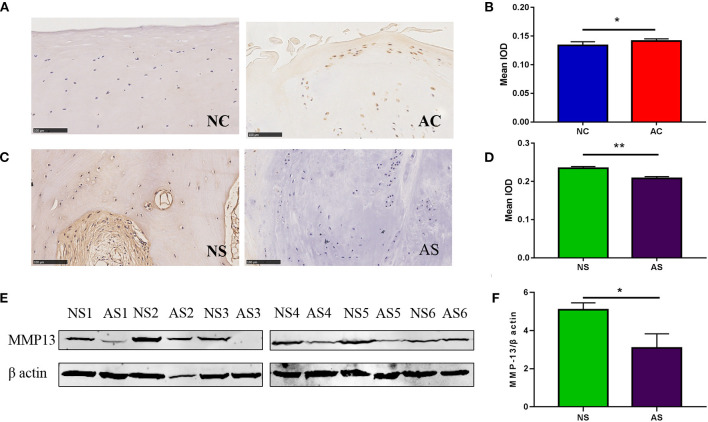
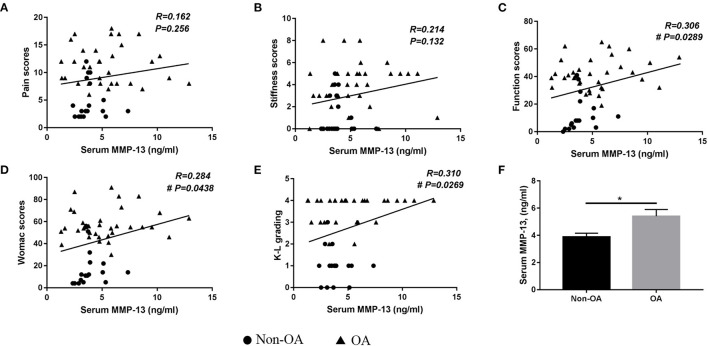
Emerging knowledge has highlighted the role of matrix metalloproteinase (MMP)-13 in osteoarthritis (OA); however, the suitability of MMP-13 as a biomarker for OA remains unclear. Therefore, this study aimed to assess the potential value of MMP-13 as a biomarker for OA. The study enrolled 51 patients, of which 33 had advanced varus OA and 18 did not have OA. Immunohistochemistry and western blotting analyses were performed to measure MMP-13 activity in the cartilage and subchondral bone of patients with OA. Enzyme-linked immunosorbent assay was used to measure serum MMP-13 levels in patients with or without OA. The Western Ontario and McMaster Universities Osteoarthritis Index (WOMAC) was used to assess the association between serum MMP-13 levels and clinical symptoms. Furthermore, the association between serum MMP-13 levels and radiological severity of OA was evaluated using the Kellgren-Lawrence (KL) grading system. Finally, we built the proportional odds logistic regression models to evaluate serum MMP-13 levels as a potential predictor for OA. MMP-13 levels were significantly higher in the severe-worn cartilage of the medial tibial plateau than in the relatively intact portion of the lateral cartilage ( < 0.05). This was contrary to the findings for MMP-13 differential expression in the subchondral bone in knee OA ( < 0.05). Patients with OA had significantly higher serum MMP-13 levels compared with patients without OA. Additionally, remarkable associations among serum MMP-13 levels, WOMAC scores, and KL grading scores were found in the end-stage OA. Furthermore, the subsequent analysis suggested that serum MMP-13 level was a significant predictor for OA. MMP-13 is valuable for diagnosing, measuring disease severity, and predicting OA in the advanced period of the disease, suggesting that it has potential possibility as a biomarker for OA. However, the underlying mechanisms and clinical application of MMP-13 as a biomarker for OA require to be further investigated.
新的研究发现突出了基质金属蛋白酶(MMP)-13在骨关节炎(OA)中的作用;然而,MMP-13作为OA生物标志物的适用性仍不明确。因此,本研究旨在评估MMP-13作为OA生物标志物的潜在价值。该研究纳入了51名患者,其中33名患有晚期内翻性OA,18名没有OA。采用免疫组织化学和蛋白质免疫印迹分析来测量OA患者软骨和软骨下骨中的MMP-13活性。采用酶联免疫吸附测定法来测量有或无OA患者的血清MMP-13水平。使用西安大略和麦克马斯特大学骨关节炎指数(WOMAC)来评估血清MMP-13水平与临床症状之间的关联。此外,使用凯尔格伦-劳伦斯(KL)分级系统评估血清MMP-13水平与OA放射学严重程度之间的关联。最后,我们建立了比例优势逻辑回归模型来评估血清MMP-13水平作为OA潜在预测指标的价值。内侧胫骨平台严重磨损软骨中的MMP-13水平显著高于外侧软骨相对完整部分中的MMP-13水平(<0.05)。这与膝关节OA软骨下骨中MMP-13差异表达的研究结果相反(<0.05)。与没有OA的患者相比,OA患者的血清MMP-13水平显著更高。此外,在终末期OA中发现血清MMP-13水平、WOMAC评分和KL分级评分之间存在显著关联。此外,后续分析表明血清MMP-13水平是OA的重要预测指标。MMP-13对于疾病晚期OA的诊断、疾病严重程度的测量和预测具有重要价值,表明其有潜力作为OA的生物标志物。然而,MMP-13作为OA生物标志物的潜在机制和临床应用仍需进一步研究。