Favaretto C, Talip Z, Borgna F, Grundler P V, Dellepiane G, Sommerhalder A, Zhang H, Schibli R, Braccini S, Müller C, van der Meulen N P
Center for Radiopharmaceutical Sciences, ETH-PSI-USZ, Paul Scherrer Institute, 5232, Villigen-PSI, Switzerland.
Department of Chemistry and Applied Biosciences, ETH Zurich, 8093, Zurich, Switzerland.
EJNMMI Radiopharm Chem. 2021 Nov 14;6(1):37. doi: 10.1186/s41181-021-00153-w.
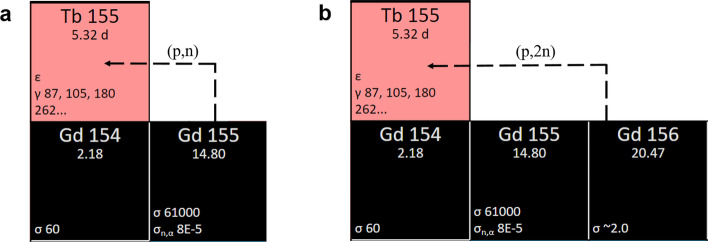
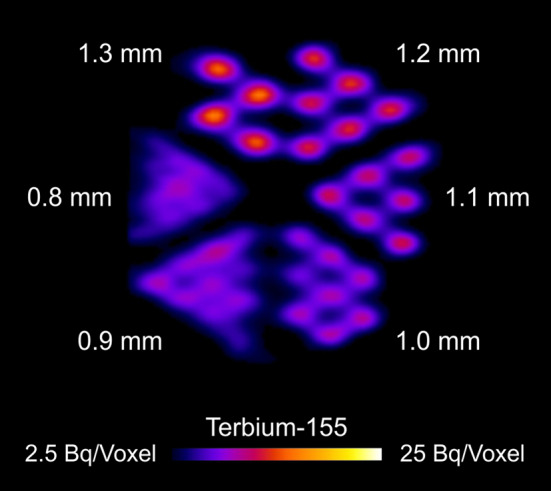
Terbium-155 [T = 5.32 d, Eγ = 87 keV (32%) 105 keV (25%)] is an interesting radionuclide suitable for single photon emission computed tomography (SPECT) imaging with potential application in the diagnosis of oncological disease. It shows similar decay characteristics to the clinically established indium-111 and would be a useful substitute for the diagnosis and prospective dosimetry with biomolecules that are afterwards labeled with therapeutic radiolanthanides and pseudo-radiolanthanides, such as lutetium-177 and yttrium-90. Moreover, terbium-155 could form part of the perfect "matched pair" with the therapeutic radionuclide terbium-161, making the concept of true radiotheragnostics a reality. The aim of this study was the investigation of the production of terbium-155 via the Gd(p,n)Tb and Gd(p,2n)Tb nuclear reactions and its subsequent purification, in order to obtain a final product in quantity and quality sufficient for preclinical application. The Gd(p,2n)Tb nuclear reaction was performed with 72 MeV protons (degraded to ~ 23 MeV), while the Gd(p,n)Tb reaction was degraded further to ~ 10 MeV, as well as performed at an 18 MeV medical cyclotron, to demonstrate its feasibility of production.
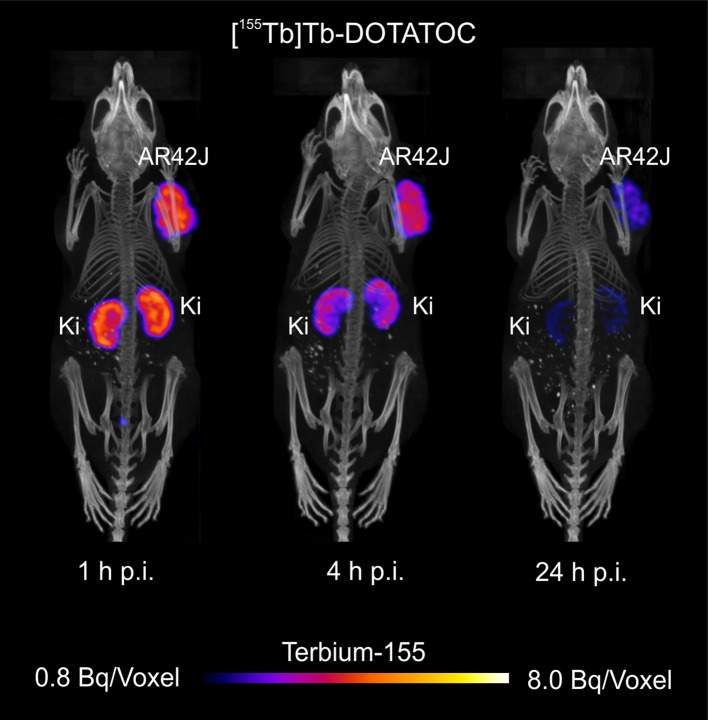
The Gd(p,2n)Tb nuclear reaction demonstrated higher production yields of up to 1.7 GBq, however, lower radionuclidic purity when compared to the final product (~ 200 MBq) of the Gd(p,n)Tb nuclear reaction. In particular, other radioisotopes of terbium were produced as side products. The radiochemical purification of terbium-155 from the target material was developed to provide up to 1.0 GBq product in a small volume (~ 1 mL 0.05 M HCl), suitable for radiolabeling purposes. The high chemical purity of terbium-155 was proven by radiolabeling experiments at molar activities up to 100 MBq/nmol. SPECT/CT experiments were performed in tumor-bearing mice using [Tb]Tb-DOTATOC.
This study demonstrated two possible production routes for high activities of terbium-155 using a cyclotron, indicating that the radionuclide is more accessible than the exclusive mass-separated method previously demonstrated. The developed radiochemical purification of terbium-155 from the target material yielded [Tb]TbCl in high chemical purity. As a result, initial cell uptake investigations, as well as SPECT/CT in vivo studies with [Tb]Tb-DOTATOC, were successfully performed, indicating that the chemical separation produced a product with suitable quality for preclinical studies.
铽 - 155 [半衰期T = 5.32天,γ射线能量Eγ = 87 keV(32%)、105 keV(25%)]是一种有趣的放射性核素,适用于单光子发射计算机断层扫描(SPECT)成像,在肿瘤疾病诊断中具有潜在应用价值。它显示出与临床常用的铟 - 111相似的衰变特性,对于后续用治疗性放射性镧系元素和准放射性镧系元素(如镥 - 177和钇 - 90)标记的生物分子的诊断和前瞻性剂量测定而言,它将是一种有用的替代物。此外,铽 - 155可以与治疗性放射性核素铽 - 161构成完美的“匹配对”,使真正的放射诊断学概念成为现实。本研究的目的是通过Gd(p,n)Tb和Gd(p,2n)Tb核反应研究铽 - 155的生产及其后续纯化,以获得数量和质量足以用于临床前应用的最终产品。Gd(p,2n)Tb核反应使用72 MeV质子(降解至约23 MeV)进行,而Gd(p,n)Tb反应进一步降解至约10 MeV,并在18 MeV医用回旋加速器上进行,以证明其生产的可行性。
Gd(p,2n)Tb核反应显示出高达1.7 GBq的更高产量,然而,与Gd(p,n)Tb核反应的最终产品(约200 MBq)相比,其放射性核素纯度较低。特别是,铽的其他放射性同位素作为副产物产生。开发了从靶材料中对铽 - 155进行放射化学纯化的方法,以在小体积(约1 mL 0.05 M HCl)中提供高达1.0 GBq的产品,适用于放射性标记目的。通过高达100 MBq/nmol摩尔活度的放射性标记实验证明了铽 - 155的高化学纯度。使用[Tb]Tb - DOTATOC在荷瘤小鼠中进行了SPECT/CT实验。
本研究展示了使用回旋加速器生产高活度铽 - 155的两种可能途径,表明该放射性核素比先前证明的独家质量分离方法更容易获得。从靶材料中开发的铽 - 155放射化学纯化方法产生了高化学纯度的[Tb]TbCl。结果,成功进行了初始细胞摄取研究以及用[Tb]Tb - DOTATOC进行的体内SPECT/CT研究,表明化学分离产生了质量适合临床前研究的产品。