Department of Biomechanical Engineering, Faculty of Mechanical, Maritime and Materials Engineering, Delft University of Technology, Mekelweg 2, 2628 CD Delft, The Netherlands.
ACS Biomater Sci Eng. 2023 Jul 10;9(7):3810-3831. doi: 10.1021/acsbiomaterials.1c00620. Epub 2021 Nov 16.
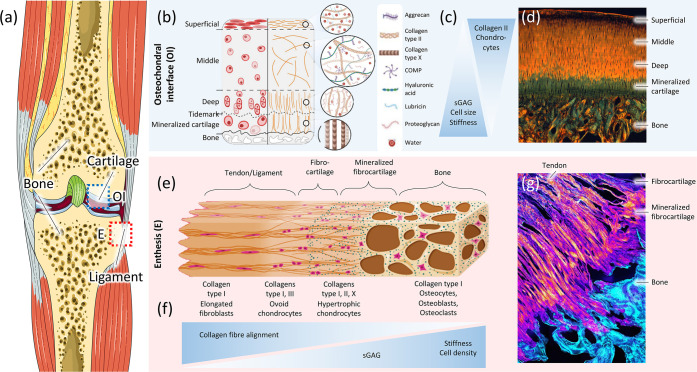
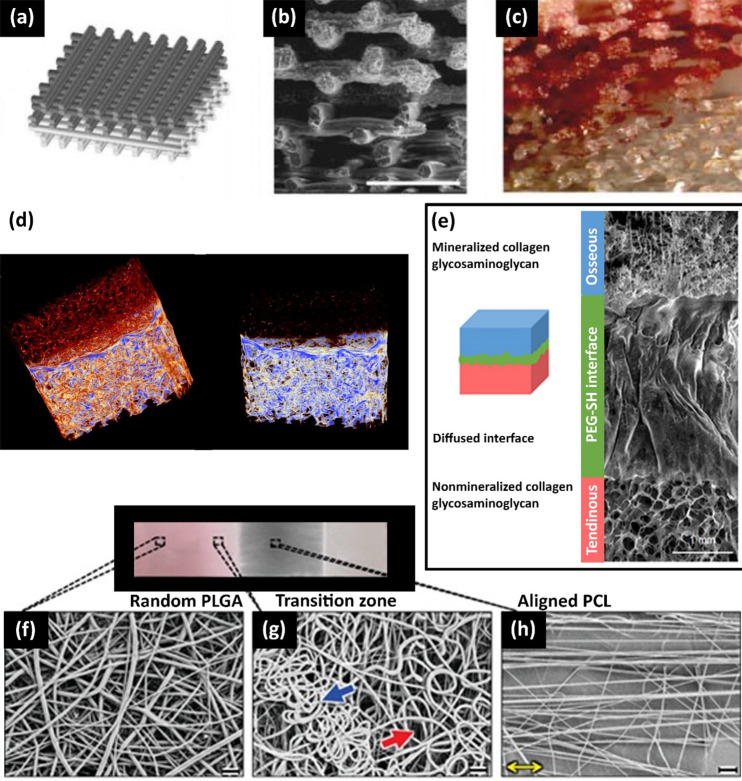
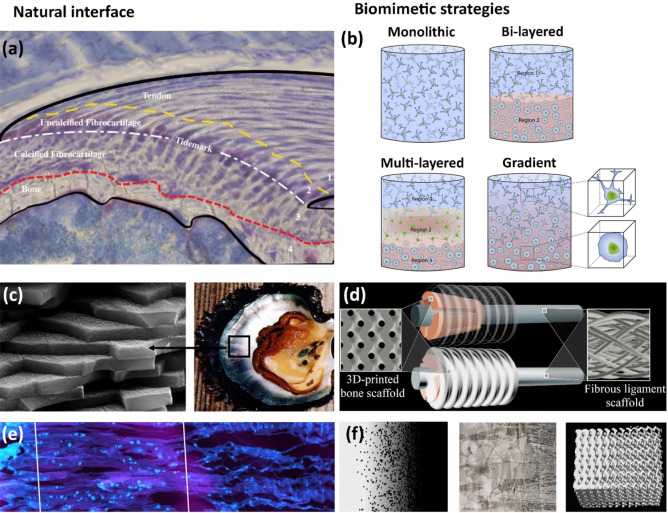
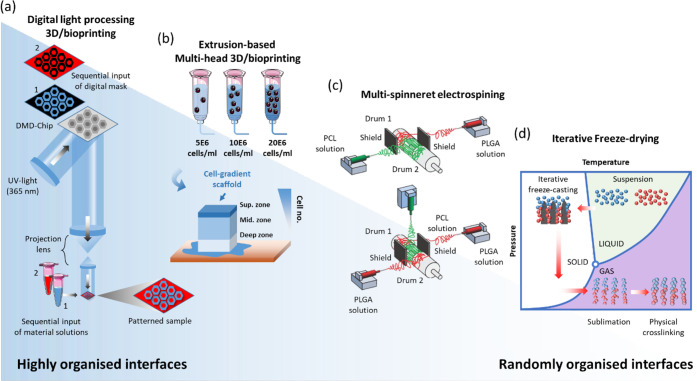
Bone-to-soft tissue interfaces are responsible for transferring loads between tissues with significantly dissimilar material properties. The examples of connective soft tissues are ligaments, tendons, and cartilages. Such natural tissue interfaces have unique microstructural properties and characteristics which avoid the abrupt transitions between two tissues and prevent formation of stress concentration at their connections. Here, we review some of the important characteristics of these natural interfaces. The native bone-to-soft tissue interfaces consist of several hierarchical levels which are formed in a highly specialized anisotropic fashion and are composed of different types of heterogeneously distributed cells. The characteristics of a natural interface can rely on two main design principles, namely by changing the local microarchitectural features (., complex cell arrangements, and introducing interlocking mechanisms at the interfaces through various geometrical designs) and changing the local chemical compositions (., a smooth and gradual transition in the level of mineralization). Implementing such design principles appears to be a promising approach that can be used in the design, reconstruction, and regeneration of engineered biomimetic tissue interfaces. Furthermore, prominent fabrication techniques such as additive manufacturing (AM) including 3D printing and electrospinning can be used to ease these implementation processes. Biomimetic interfaces have several biological applications, for example, to create synthetic scaffolds for osteochondral tissue repair.
骨-软组织界面负责在具有显著不同材料特性的组织之间传递负荷。结缔组织的例子有韧带、肌腱和软骨。这些天然组织界面具有独特的微观结构特性和特征,可以避免两种组织之间的突然过渡,并防止在连接处形成应力集中。在这里,我们回顾了这些天然界面的一些重要特征。天然的骨-软组织界面由几个层次组成,这些层次以高度专门的各向异性方式形成,并由不同类型的不均匀分布的细胞组成。天然界面的特征可以依赖于两个主要的设计原则,即通过改变局部微观结构特征(例如,复杂的细胞排列,并通过各种几何设计在界面引入互锁机制)和改变局部化学成分(例如,在矿化水平上的平滑和逐渐过渡)。实施这些设计原则似乎是一种很有前途的方法,可以用于设计、重建和再生工程仿生组织界面。此外,增材制造(AM)技术,如 3D 打印和静电纺丝等,也可以用于简化这些实施过程。仿生界面具有多种生物学应用,例如,为骨软骨组织修复创建合成支架。