Department of Biomedical Informatics, Emory University, Atlanta, GA, United States of America.
AliveCor Inc., Mountain View, CA, United States of America.
PLoS One. 2021 Nov 16;16(11):e0259916. doi: 10.1371/journal.pone.0259916. eCollection 2021.
Atrial fibrillation (AFib) is the most common cardiac arrhythmia associated with stroke, blood clots, heart failure, coronary artery disease, and/or death. Multiple methods have been proposed for AFib detection, with varying performances, but no single approach appears to be optimal. We hypothesized that each state-of-the-art algorithm is appropriate for different subsets of patients and provides some independent information. Therefore, a set of suitably chosen algorithms, combined in a weighted voting framework, will provide a superior performance to any single algorithm.
We investigate and modify 38 state-of-the-art AFib classification algorithms for a single-lead ambulatory electrocardiogram (ECG) monitoring device. All algorithms are ranked using a random forest classifier and an expert-labeled training dataset of 2,532 recordings. The seven top-ranked algorithms are combined by using an optimized weighting approach.
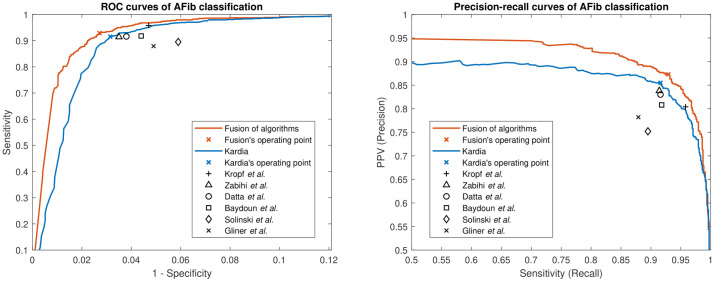
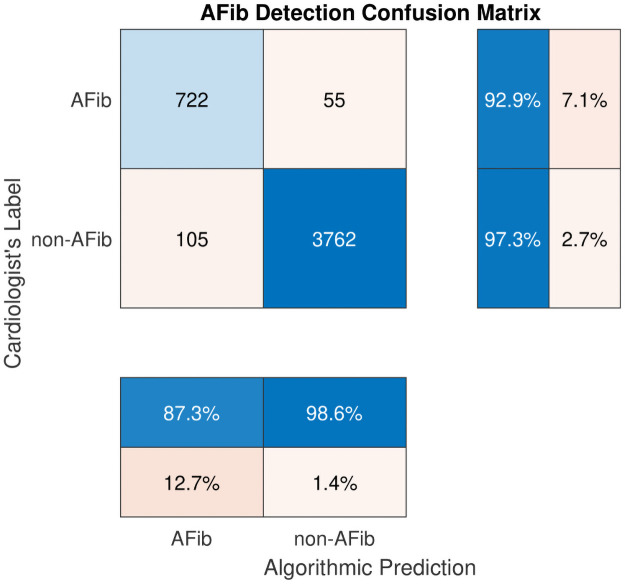
The proposed fusion algorithm, when validated on a separate test dataset consisting of 4,644 recordings, resulted in an area under the receiver operating characteristic (ROC) curve of 0.99. The sensitivity, specificity, positive-predictive-value (PPV), negative-predictive-value (NPV), and F1-score of the proposed algorithm were 0.93, 0.97, 0.87, 0.99, and 0.90, respectively, which were all superior to any single algorithm or any previously published.
This study demonstrates how a set of well-chosen independent algorithms and a voting mechanism to fuse the outputs of the algorithms, outperforms any single state-of-the-art algorithm for AFib detection. The proposed framework is a case study for the general notion of crowdsourcing between open-source algorithms in healthcare applications. The extension of this framework to similar applications may significantly save time, effort, and resources, by combining readily existing algorithms. It is also a step toward the democratization of artificial intelligence and its application in healthcare.
心房颤动(房颤)是最常见的与中风、血栓、心力衰竭、冠心病和/或死亡相关的心律失常。已经提出了多种用于房颤检测的方法,其性能各不相同,但似乎没有一种方法是最优的。我们假设每种最先进的算法都适用于不同的患者子集,并提供一些独立的信息。因此,一组经过适当选择的算法,结合在加权投票框架中,将提供优于任何单个算法的性能。
我们研究并修改了 38 种用于单导联动态心电图(ECG)监测设备的房颤分类算法。使用随机森林分类器和一个由 2532 条记录组成的专家标记训练数据集对所有算法进行排名。通过使用优化的加权方法对七种排名最高的算法进行组合。
在所提出的融合算法在由 4644 条记录组成的独立测试数据集上进行验证时,接收器工作特性(ROC)曲线下的面积达到 0.99。该算法的灵敏度、特异性、阳性预测值(PPV)、阴性预测值(NPV)和 F1 分数分别为 0.93、0.97、0.87、0.99 和 0.90,均优于任何单一算法或任何先前发表的算法。
本研究表明,一组经过精心选择的独立算法和一种投票机制,用于融合算法的输出,可以优于任何用于房颤检测的最先进算法。所提出的框架是在医疗保健应用中开源算法之间进行众包的一般概念的一个案例研究。将该框架扩展到类似的应用程序可能会通过组合现成的算法,显著节省时间、精力和资源。这也是人工智能民主化及其在医疗保健中的应用的一步。