Applied Physics Program, University of Michigan, Ann Arbor, Michigan, United States of America.
Biophysics Program, University of Michigan, Ann Arbor, Michigan, United States of America.
PLoS One. 2021 Nov 17;16(11):e0259462. doi: 10.1371/journal.pone.0259462. eCollection 2021.
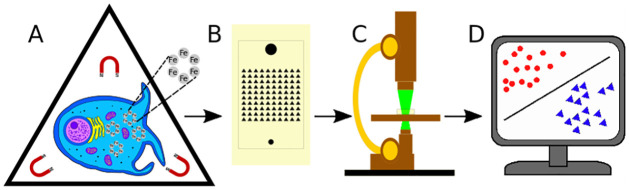
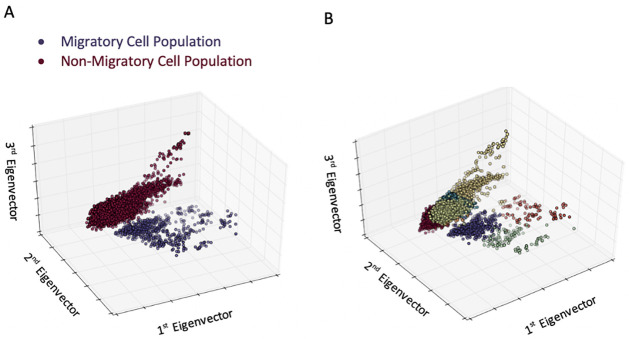
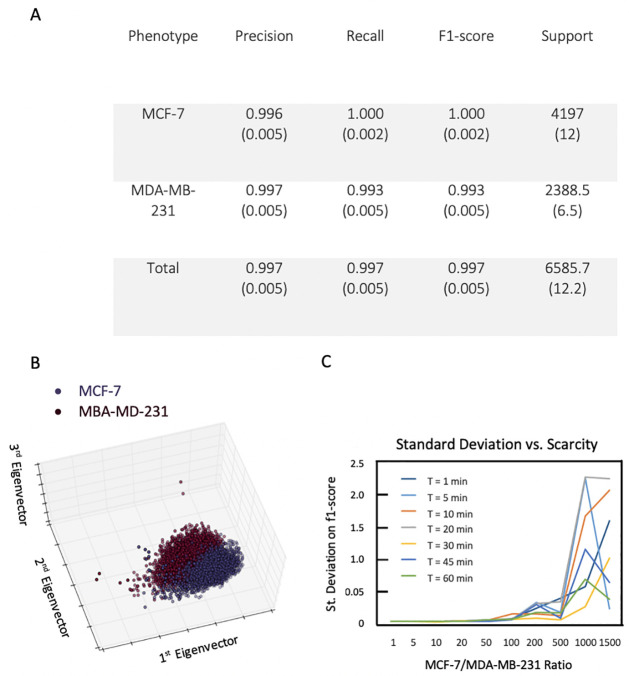
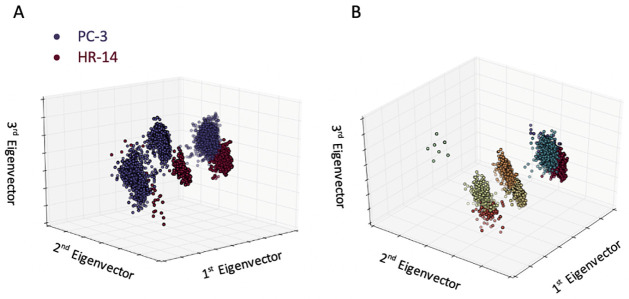
We define cell morphodynamics as the cell's time dependent morphology. It could be called the cell's shape shifting ability. To measure it we use a biomarker free, dynamic histology method, which is based on multiplexed Cell Magneto-Rotation and Machine Learning. We note that standard studies looking at cells immobilized on microscope slides cannot reveal their shape shifting, no more than pinned butterfly collections can reveal their flight patterns. Using cell magnetorotation, with the aid of cell embedded magnetic nanoparticles, our method allows each cell to move freely in 3 dimensions, with a rapid following of cell deformations in all 3-dimensions, so as to identify and classify a cell by its dynamic morphology. Using object recognition and machine learning algorithms, we continuously measure the real-time shape dynamics of each cell, where from we successfully resolve the inherent broad heterogeneity of the morphological phenotypes found in a given cancer cell population. In three illustrative experiments we have achieved clustering, differentiation, and identification of cells from (A) two distinct cell lines, (B) cells having gone through the epithelial-to-mesenchymal transition, and (C) cells differing only by their motility. This microfluidic method may enable a fast screening and identification of invasive cells, e.g., metastatic cancer cells, even in the absence of biomarkers, thus providing a rapid diagnostics and assessment protocol for effective personalized cancer therapy.
我们将细胞形态动力学定义为细胞随时间变化的形态。它可以被称为细胞的形状变化能力。为了测量它,我们使用一种无生物标志物的动态组织学方法,该方法基于多重细胞磁旋转和机器学习。我们注意到,标准的研究着眼于固定在显微镜载玻片上的细胞,无法揭示它们的形状变化,就像固定的蝴蝶标本无法揭示它们的飞行模式一样。使用细胞磁旋转,借助嵌入细胞的磁性纳米粒子,我们的方法允许每个细胞在三维空间中自由移动,并快速跟踪所有三维方向的细胞变形,从而通过其动态形态来识别和分类细胞。我们使用目标识别和机器学习算法,连续测量每个细胞的实时形状动态,从而成功解析了在给定的癌细胞群体中发现的形态表型的固有广泛异质性。在三个说明性实验中,我们实现了(A)两种不同细胞系、(B)经历上皮间质转化的细胞和(C)仅在运动性方面存在差异的细胞的聚类、分化和鉴定。这种微流控方法可以实现侵袭性细胞(例如转移性癌细胞)的快速筛选和鉴定,即使在缺乏生物标志物的情况下,从而为有效的个性化癌症治疗提供快速诊断和评估方案。