Johns Hopkins Physical Sciences-Oncology Center, The Johns Hopkins University, Baltimore, MD 21218, USA.
Department of Chemical and Biomolecular Engineering, The Johns Hopkins University, Baltimore, MD 21218, USA.
Sci Adv. 2020 Jan 22;6(4):eaaw6938. doi: 10.1126/sciadv.aaw6938. eCollection 2020 Jan.
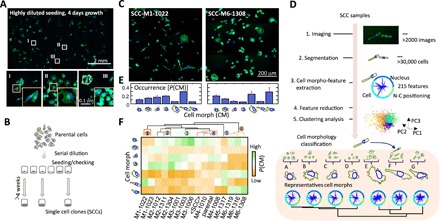
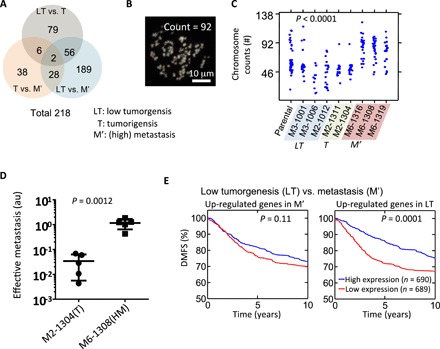
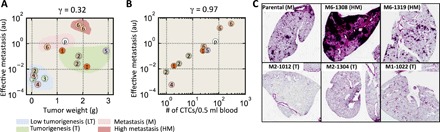
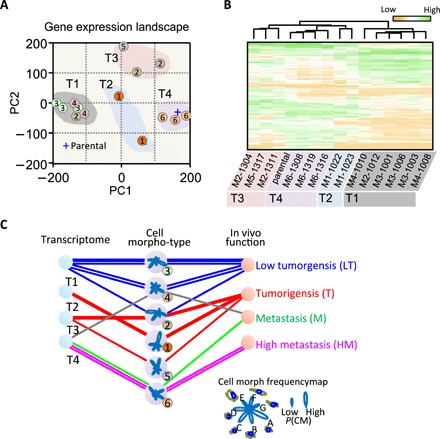
A central goal of precision medicine is to predict disease outcomes and design treatments based on multidimensional information from afflicted cells and tissues. Cell morphology is an emergent readout of the molecular underpinnings of a cell's functions and, thus, can be used as a method to define the functional state of an individual cell. We measured 216 features derived from cell and nucleus morphology for more than 30,000 breast cancer cells. We find that single cell-derived clones (SCCs) established from the same parental cells exhibit distinct and heritable morphological traits associated with genomic (ploidy) and transcriptomic phenotypes. Using unsupervised clustering analysis, we find that the morphological classes of SCCs predict distinct tumorigenic and metastatic potentials in vivo using multiple mouse models of breast cancer. These findings lay the groundwork for using quantitative morpho-profiling in vitro as a potentially convenient and economical method for phenotyping function in cancer in vivo.
精准医学的一个核心目标是根据病变细胞和组织的多维信息来预测疾病结果并设计治疗方法。细胞形态是细胞功能分子基础的一个涌现结果,因此可以作为定义单个细胞功能状态的方法。我们测量了超过 30000 个乳腺癌细胞的 216 个源自细胞和细胞核形态的特征。我们发现,从相同母细胞中建立的单细胞衍生克隆(SCC)表现出与基因组(ploidy)和转录组表型相关的独特且可遗传的形态特征。通过无监督聚类分析,我们发现 SCC 的形态类可以预测多种乳腺癌小鼠模型中体内的肿瘤发生和转移潜力。这些发现为使用体外定量形态分析作为一种在体内表型癌症功能的潜在方便和经济的方法奠定了基础。