Institute for Healthcare Policy and Innovation, University of Michigan, Ann Arbor, USA.
Michigan Medicine Virtual Care Team, University of Michigan, Ann Arbor, USA.
J Gen Intern Med. 2022 Apr;37(5):1138-1144. doi: 10.1007/s11606-021-07172-y. Epub 2021 Nov 17.
Most health insurance organizations reimbursed both video and audio-only (i.e., phone) visits during the COVID-19 pandemic, but may discontinue phone visit coverage after the pandemic. The impact of discontinuing phone visit coverage on various patient subgroups is uncertain.
Identify patient subgroups that are more probable to access telehealth through phone versus video.
Retrospective cohort.
All patients at a U.S. academic medical center who had an outpatient visit that was eligible for telehealth from April through June 2020.
The marginal and cumulative effect of patient demographic, socioeconomic, and geographic characteristics on the probability of using video versus phone visits.
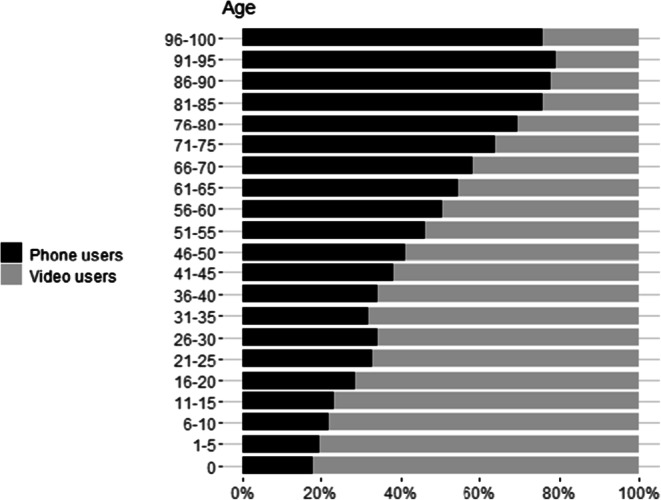
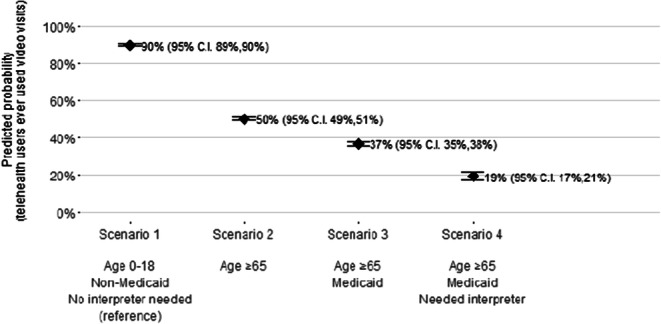
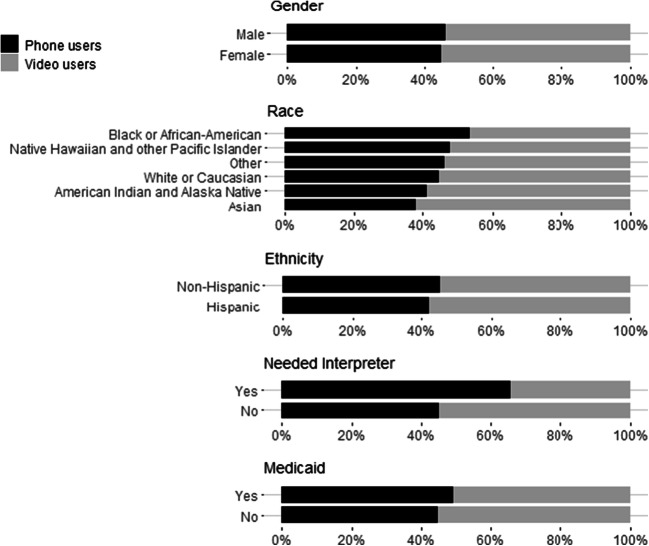
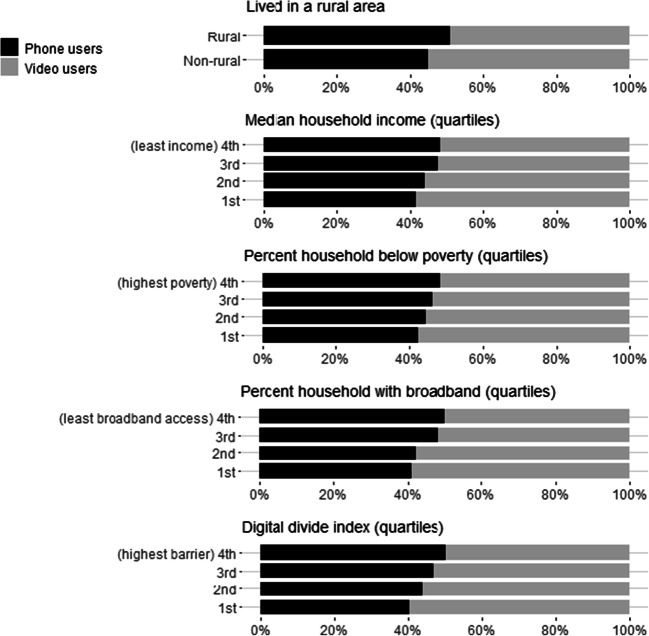
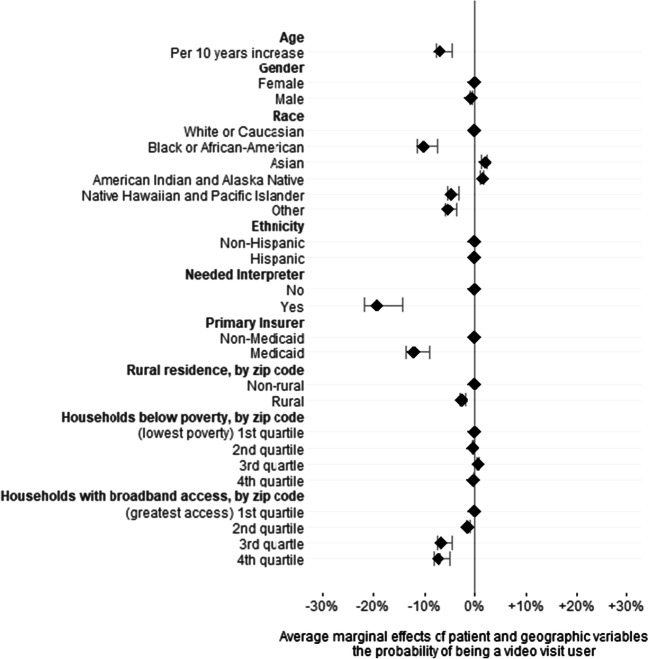
A total of 104,204 patients had at least one telehealth visit and 45.4% received care through phone visits only. Patient characteristics associated with lower probability of using video visits included age (average marginal effect [AME] -6.9% for every 10 years of age increase, 95%CI -7.8, -4.5), African-American (AME -10.2%, 95%CI -11.4, -7.6), need an interpreter (AME -19.3%, 95%CI -21.8, -14.4), Medicaid as primary insurance (AME -12.1%, 95%CI -13.7, -9.0), and live in a zip code with low broadband access (AME -7.2%, 95%CI -8.1, -4.8). Most patients had more than one factor which further reduced their probability of using video visits.
Patients who are older, are African-American, require an interpreter, use Medicaid, and live in areas with low broadband access are less likely to use video visits as compared to phone. Post-pandemic policies that eliminate insurance coverage for phone visits may decrease telehealth access for patients who have one or more of these characteristics.
在 COVID-19 大流行期间,大多数健康保险组织都报销视频和仅音频(即电话)就诊,但在大流行后可能会停止电话就诊报销。停止电话就诊报销对各种患者亚组的影响尚不确定。
确定更有可能通过电话而非视频使用远程医疗的患者亚组。
回顾性队列研究。
2020 年 4 月至 6 月期间,在美国一家学术医疗中心进行的符合远程医疗条件的门诊患者。
患者人口统计学、社会经济和地理特征对使用视频与电话就诊的概率的边际和累积影响。
共有 104204 名患者至少进行了一次远程医疗就诊,其中 45.4%仅通过电话就诊。与使用视频就诊概率较低相关的患者特征包括年龄(每增加 10 岁,平均边际效应 [AME] 降低 6.9%,95%CI 为-7.8,-4.5)、非裔美国人(AME-10.2%,95%CI-11.4,-7.6)、需要翻译(AME-19.3%,95%CI-21.8,-14.4)、医疗补助作为主要保险(AME-12.1%,95%CI-13.7,-9.0)和居住在宽带接入率低的邮政编码(AME-7.2%,95%CI-8.1,-4.8)。大多数患者有多个因素,这进一步降低了他们使用视频就诊的概率。
与电话就诊相比,年龄较大、非裔美国人、需要翻译、使用医疗补助和居住在宽带接入率低地区的患者更不可能使用视频就诊。大流行后取消电话就诊保险报销的政策可能会减少具有这些特征之一的患者的远程医疗机会。