
识别亚利桑那州医疗补助受益人群在新冠疫情之前及期间使用音频视频和仅音频远程医疗服务的人口统计学趋势
Identifying Demographic Trends in the Use of Audio-Video and Audio-Only Telehealth by Arizona Medicaid Beneficiaries Before and During the COVID-19 Pandemic.
作者信息
Hallur Shreyas, Salek Sara, Daulat Sohail, Garcia-Filion Pamela
机构信息
Arizona Health Care Cost Containment System (AHCCCS), Phoenix, AZ, USA.
Duke-Margolis Center for Health Policy, Duke University, Durham, NC, USA.
出版信息
J Gen Intern Med. 2025 Mar;40(4):764-772. doi: 10.1007/s11606-024-09196-6. Epub 2024 Nov 25.
INTRODUCTION
For the first time, our study tracked disparities in the utilization of audio-video and audio-only telehealth for outpatient visits before and during the COVID-19 pandemic.
METHODS
Using a dataset of de-identified claims corresponding to telehealth and in-person visits, a retrospective cohort study was conducted for all beneficiaries continuously enrolled in Arizona Medicaid between October 2019 and November 2020. Our definition of telehealth only covered outpatient services delivered remotely via the audio-video or audio-only modality. Outcomes of interest were indicators of telehealth (vs. in-person) service delivery and audio-video (vs. audio-only) delivery of a telehealth service. Multivariate models evaluated the association between each outcome and demographic factors, including age, urban/rural location, sex, and race/ethnicity.
RESULTS
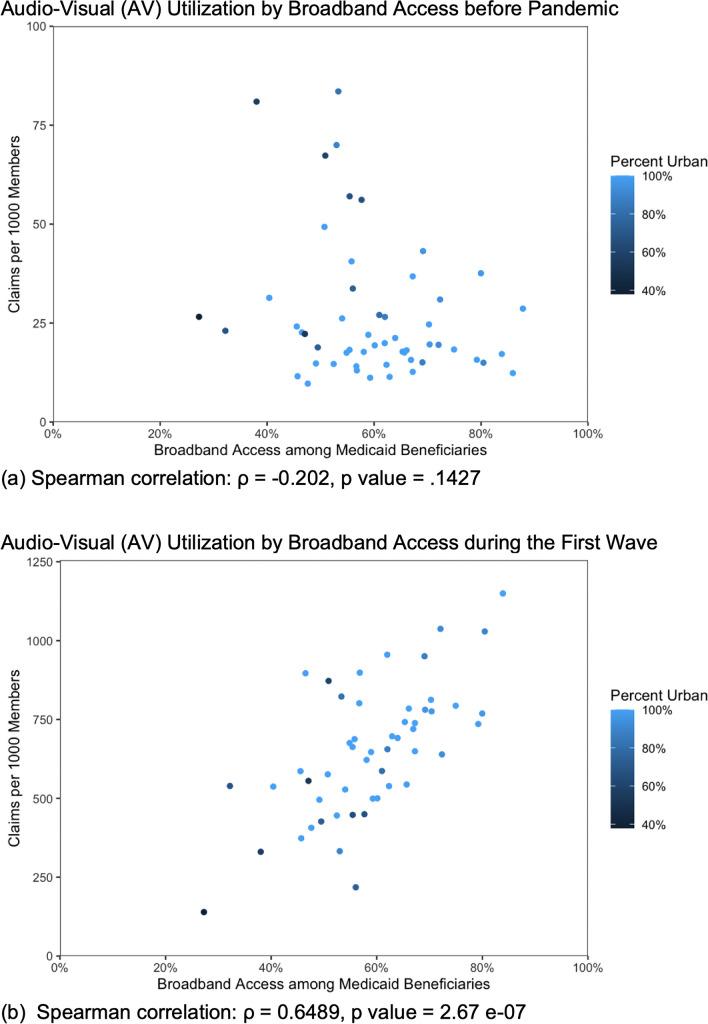
In this cohort study of 1,799,537 beneficiaries, age over 75, male sex, Asian race, Black race, Hispanic ethnicity, and Native American race were associated with reduced odds of telehealth use for outpatient visits pre-pandemic. These deficits persisted for all groups except the Black race after the pandemic's onset. Throughout the study period, older age and Native American race were correlated with greater audio-video use while Black race indicated reduced odds of audio-video use. Hispanic ethnicity indicated lower odds of audio-video use only during the pandemic. Rural members exhibited greater odds of both overall telehealth and audio-video use for outpatient visits prior to the pandemic but both trends reversed as a rural-urban divide emerged during the pandemic. Spearman correlations between broadband access and audio-video uptake yielded no significant results pre-pandemic but a strong correlation emerged during the pandemic.
DISCUSSION
Pandemic-era telehealth expansions reduced but did not eliminate pre-existing disparities in telehealth and audio-video utilization for outpatient visits, indicating a need for health systems to better engage minority, elderly, and rural populations and continue to support audio-only telehealth.
引言
我们的研究首次追踪了在2019冠状病毒病大流行之前和期间门诊就诊中使用音频视频和仅音频远程医疗的差异。
方法
利用与远程医疗和面对面就诊对应的去识别化索赔数据集,对2019年10月至2020年11月期间持续参加亚利桑那医疗补助计划的所有受益人进行了一项回顾性队列研究。我们对远程医疗的定义仅涵盖通过音频视频或仅音频模式远程提供的门诊服务。感兴趣的结果是远程医疗(与面对面)服务提供以及远程医疗服务的音频视频(与仅音频)提供的指标。多变量模型评估了每个结果与人口统计学因素之间的关联,包括年龄、城乡位置、性别和种族/民族。
结果
在这项对1,799,537名受益人的队列研究中,75岁以上、男性、亚裔、黑人、西班牙裔和美洲原住民在大流行前门诊就诊使用远程医疗的几率较低。大流行开始后,除黑人种族外,所有群体的这些差距仍然存在。在整个研究期间,年龄较大和美洲原住民种族与更多地使用音频视频相关,而黑人种族表明使用音频视频的几率较低。西班牙裔仅在大流行期间使用音频视频的几率较低。在大流行之前,农村居民门诊就诊使用总体远程医疗和音频视频的几率更高,但随着大流行期间城乡差距的出现,这两种趋势都发生了逆转。大流行前宽带接入与音频视频采用率之间的斯皮尔曼相关性没有显著结果,但在大流行期间出现了很强的相关性。
讨论
大流行时期远程医疗的扩展减少但并未消除门诊就诊中远程医疗和音频视频使用方面先前存在的差异,这表明卫生系统需要更好地让少数群体、老年人和农村人口参与进来,并继续支持仅音频的远程医疗。


 Zotero 插件