
在 COVID-19 大流行期间,在一家大型医院系统接受肿瘤治疗的患者中,年龄、种族、保险类型和数字鸿沟指数与视频就诊完成情况相关。
Age, race, insurance type, and digital divide index are associated with video visit completion for patients seen for oncologic care in a large hospital system during the COVID-19 pandemic.
机构信息
Department of Radiation Oncology, University of Michigan, Ann Arbor, Michigan, United States of America.
Department of Biostatistics, University of Michigan, Ann Arbor, Michigan, United States of America.
出版信息
PLoS One. 2022 Nov 17;17(11):e0277617. doi: 10.1371/journal.pone.0277617. eCollection 2022.
INTRODUCTION
The COVID-19 pandemic drove rapid adoption of telehealth across oncologic specialties. This revealed barriers to telehealth access and telehealth-related disparities. We explored disparities in telehealth access in patients with cancer accessing oncologic care.
MATERIALS/METHODS: Data for all unique patient visits at a large academic medical center were acquired pre- and intra-pandemic (7/1/2019-12/31/2020), including visit type (in-person, video, audio only), age, race, ethnicity, rural/urban (per zip code by Federal Office of Rural Health Policy), distance from medical facility, insurance, and Digital Divide Index (DDI; incorporates technology/internet access, age, disability, and educational attainment metrics by geographic area). Pandemic phases were identified based on visit dynamics. Multivariable logistic regression models were used to examine associations of these variables with successful video visit completion.
RESULTS
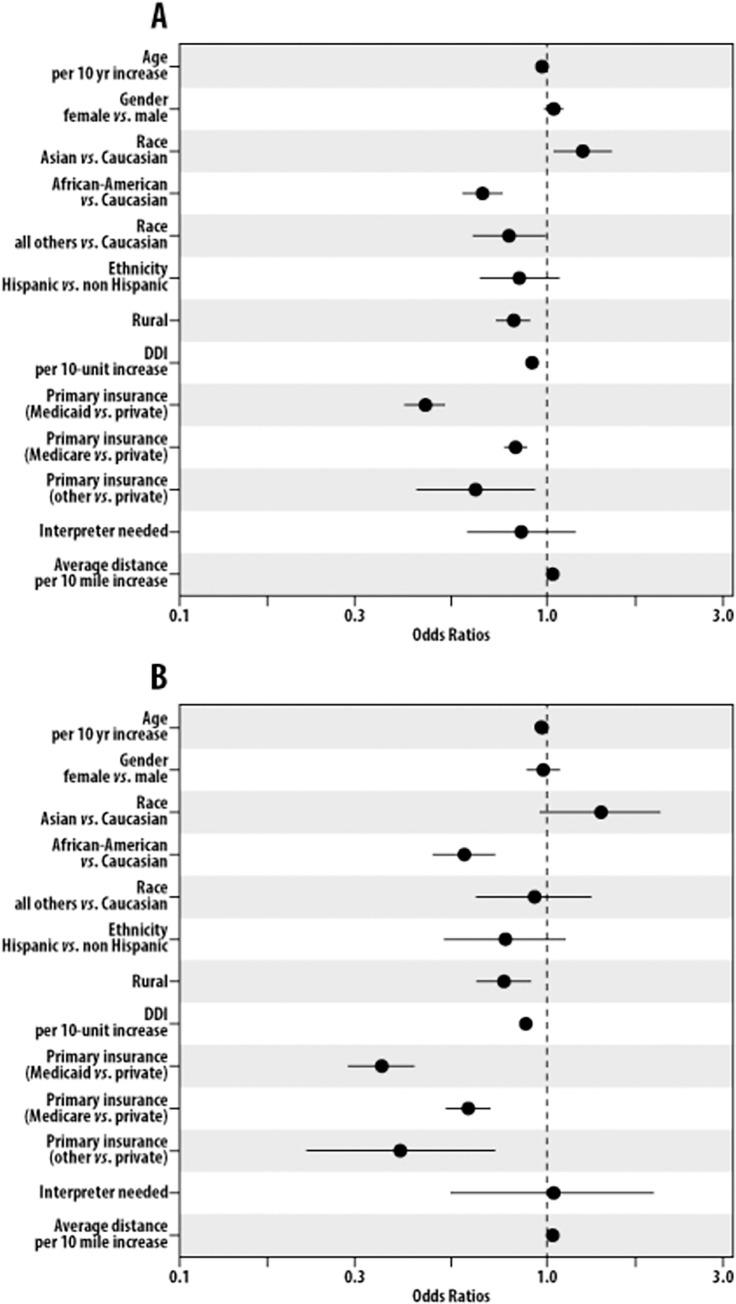
Data were available for 2,398,633 visits for 516,428 patients across all specialties. Among these, there were 253,880 visits from 62,172 patients seen in any oncology clinic. Dramatic increases in telehealth usage were seen during the pandemic (after 3/16/2020). In multivariable analyses, patient age [OR: 0.964, (95% CI 0.961, 0.966) P<0.0001], rural zip code [OR: 0.814 (95% CI 0.733, 0.904) P = 0.0001], Medicaid enrollment [OR: 0.464 (95% CI 0.410, 0.525) P<0.0001], Medicare enrollment [OR: 0.822 (95% CI 0.761, 0.888) P = 0.0053], higher DDI [OR: 0.903 (95% CI 0.877, 0.930) P<0.0001], distance from the facility [OR: 1.028 (95% CI 1.021, 1.035) P<0.0001], black race [OR: 0.663 (95% CI 0.584, 0.753) P<0.0001], and Asian race [OR: 1.229 (95% CI 1.022, 1.479) P<0.0001] were associated with video visit completion early in the pandemic. Factors related to video visit completion later in the pandemic and within sub-specialties of oncology were also explored.
CONCLUSIONS
Patients from older age groups, those with minority backgrounds, and individuals from areas with less access to technology (high DDI) as well as those with Medicare or Medicaid insurance were less likely to use video visits. With greater experience through the pandemic, disparities were not mitigated. Further efforts are required to optimize telehealth to benefit all patients and avoid increasing disparities in care delivery.
简介
COVID-19 大流行推动了肿瘤学各专业领域快速采用远程医疗。这揭示了远程医疗获取的障碍和与远程医疗相关的差异。我们探讨了癌症患者接受肿瘤学护理时远程医疗获取方面的差异。
材料/方法:获取了一家大型学术医疗中心在大流行前后(2019 年 7 月 1 日至 2020 年 12 月 31 日)所有独特患者就诊的数据,包括就诊类型(面对面、视频、仅音频)、年龄、种族、族裔、城乡(按联邦农村卫生政策办公室划分的邮政编码)、距医疗机构的距离、保险和数字鸿沟指数(DDI;按地理位置包含技术/互联网接入、年龄、残疾和教育程度指标)。根据就诊动态确定大流行阶段。使用多变量逻辑回归模型检查这些变量与成功完成视频就诊之间的关联。
结果
在所有专业中,共有 516428 名患者的 2398633 次就诊数据。其中,有 253880 次就诊来自任何肿瘤学诊所的 62172 名患者。在大流行期间(2020 年 3 月 16 日之后),远程医疗的使用急剧增加。在多变量分析中,患者年龄[OR:0.964(95%CI 0.961,0.966)P<0.0001]、农村邮政编码[OR:0.814(95%CI 0.733,0.904)P=0.0001]、医疗补助参保[OR:0.464(95%CI 0.410,0.525)P<0.0001]、医疗保险参保[OR:0.822(95%CI 0.761,0.888)P=0.0053]、较高的 DDI[OR:0.903(95%CI 0.877,0.930)P<0.0001]、距医疗机构的距离[OR:1.028(95%CI 1.021,1.035)P<0.0001]、黑种人[OR:0.663(95%CI 0.584,0.753)P<0.0001]和亚洲人[OR:1.229(95%CI 1.022,1.479)P<0.0001]在大流行早期与视频就诊完成相关。还探讨了大流行后期和肿瘤学亚专业中与视频就诊完成相关的因素。
结论
年龄较大的患者、少数民族背景的患者以及技术获取较少(DDI 较高)的患者以及医疗保险或医疗补助保险的患者更不可能使用视频就诊。随着大流行经验的增加,差异并没有得到缓解。需要进一步努力优化远程医疗,使所有患者受益,并避免在医疗服务提供方面出现差距扩大。


 Zotero 插件