Immunology, Heptatology and Dermatology, Novartis AG, Basel, Switzerland.
Advanced Exploratory Analytics, Novartis Pharmaceuticals Corporation, East Hanover, New Jersey, USA.
RMD Open. 2021 Nov;7(3). doi: 10.1136/rmdopen-2021-001845.
Identify distinct clusters of psoriatic arthritis (PsA) patients based on their baseline articular, entheseal and cutaneous disease manifestations and explore their clinical and therapeutic value.
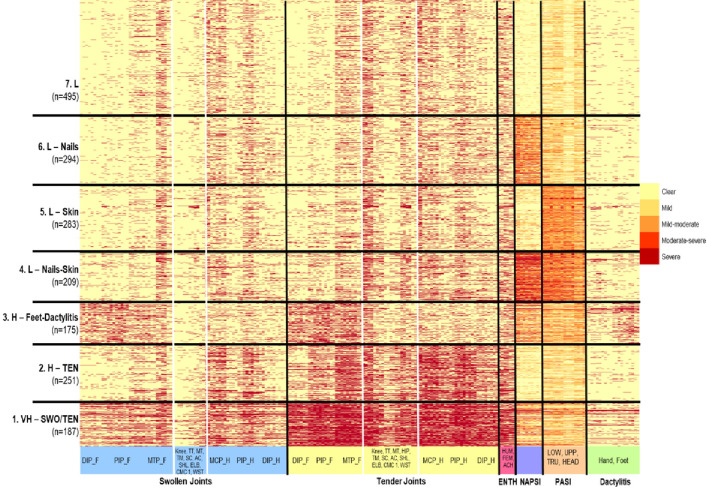
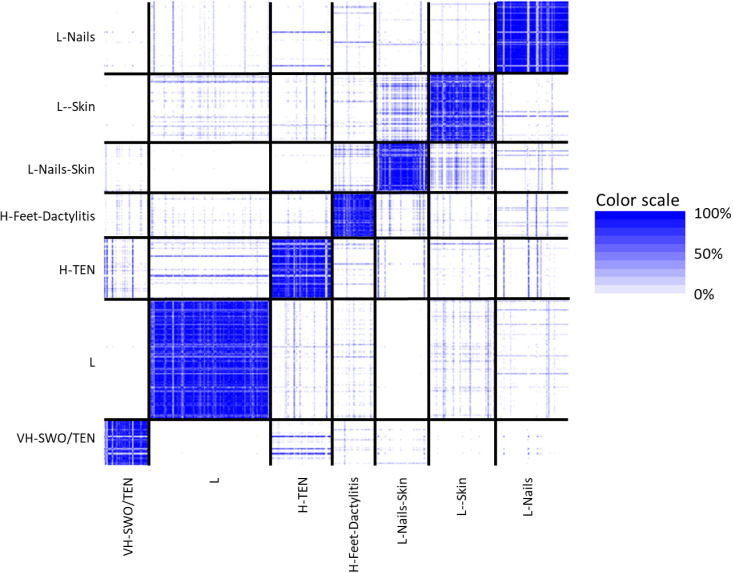
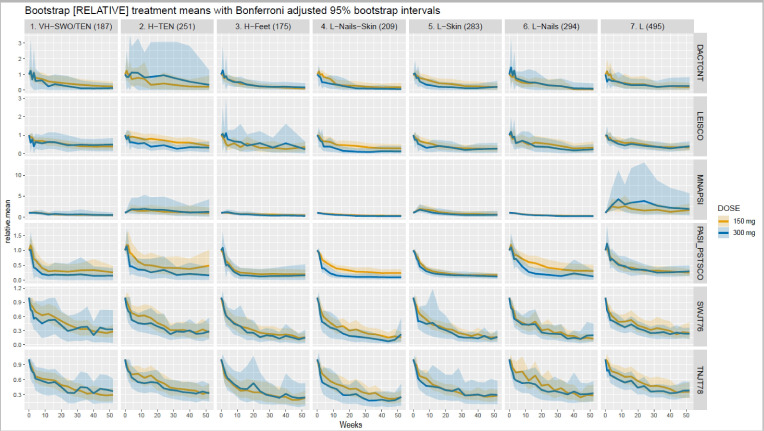
Pooled baseline data in PsA patients (n=1894) treated with secukinumab across four phase 3 studies (FUTURE 2-5) were analysed to determine phenotypes based on clusters of clinical indicators. Finite mixture models methodology was applied to generate clinical clusters and mean longitudinal responses were compared between secukinumab doses (300 vs 150 mg) across identified clusters and clinical indicators through week 52 using machine learning (ML) techniques.
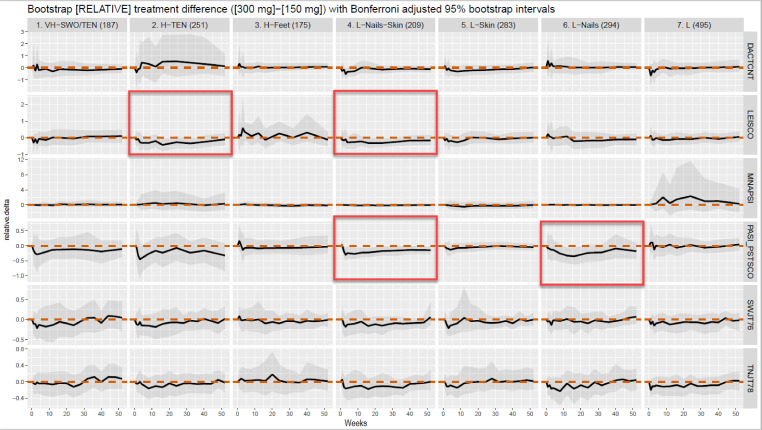
Seven distinct patient clusters were identified. Cluster 1 (very-high (VH) - SWO/TEN (swollen/tender); n=187) was characterised by VH polyarticular burden for both tenderness and swelling of joints, while cluster 2 (H (high) - TEN; n=251) was marked by high polyarticular burden in tender joints and cluster 3 (H - Feet - Dactylitis; n=175) by high burden in joints of feet and dactylitis. For cluster 4 (L (Low) - Nails - Skin; n=209), cluster 5 (L - skin; n=283), cluster 6 (L - Nails; n=294) and cluster 7 (L; n=495) articular burden was low but nail and skin involvement was variable, with cluster 7 marked by mild disease activity across all domains. Greater improvements in the longitudinal responses for enthesitis in cluster 2, enthesitis and Psoriasis Area and Severity Index (PASI) in cluster 4 and PASI in cluster 6 were shown for secukinumab 300 mg compared with 150 mg.
PsA clusters identified by ML follow variable response trajectories indicating their potential to predict precise impact on patients' outcomes.
NCT01752634, NCT01989468, NCT02294227, NCT02404350.
根据基线关节、附着点和皮肤疾病表现,确定银屑病关节炎(PsA)患者的不同聚类,并探讨其临床和治疗价值。
对接受司库奇尤单抗治疗的 1894 例 PsA 患者的四项 3 期研究(FUTURE 2-5)的汇总基线数据进行分析,以确定基于临床指标聚类的表型。采用有限混合模型方法生成临床聚类,使用机器学习(ML)技术,通过第 52 周,比较在确定的聚类和临床指标中,300mg 与 150mg 司库奇尤单抗剂量之间的平均纵向反应。
确定了 7 个不同的患者聚类。聚类 1(非常高(VH)-SWO/TEN(肿胀/压痛);n=187)的特点是关节压痛和肿胀的多关节受累 VH,而聚类 2(H(高)-TEN;n=251)的特点是关节压痛的多关节受累高,聚类 3(H-足部-指炎;n=175)的特点是足部关节和指炎受累高。对于聚类 4(L(低)-指甲-皮肤;n=209)、聚类 5(L-皮肤;n=283)、聚类 6(L-指甲;n=294)和聚类 7(L;n=495),关节受累程度较低,但指甲和皮肤受累程度不同,聚类 7 显示所有领域的疾病活动度均较低。与 150mg 相比,300mg 司库奇尤单抗治疗时,聚类 2 的附着点纵向反应、聚类 4 的附着点和银屑病面积和严重程度指数(PASI)以及聚类 6 的 PASI 改善更大。
通过 ML 确定的 PsA 聚类表现出不同的反应轨迹,表明它们有可能预测对患者结局的精确影响。
NCT01752634、NCT01989468、NCT02294227、NCT02404350。