Department of Pathology and Laboratory Medicine, Division of Biology and Medicine, Brown University, Providence, RI, 02903, USA.
Fox Chase Cancer Center, Temple University Temple Health, Philadelphia, PA, 19111, USA.
J Transl Med. 2019 Apr 5;17(1):114. doi: 10.1186/s12967-019-1864-9.
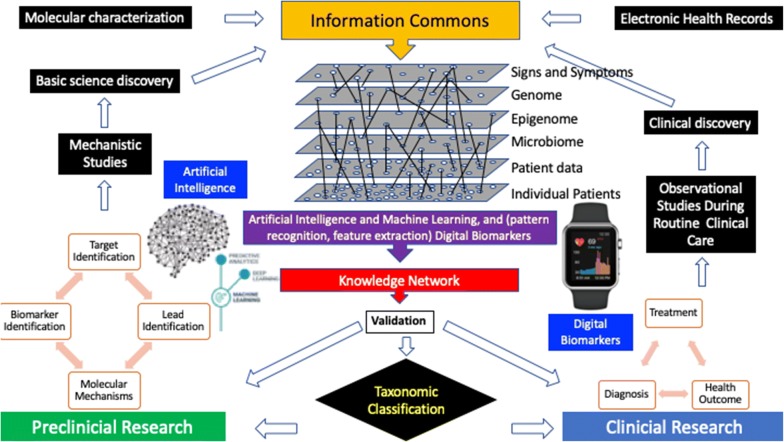
Healthcare is undergoing a transformation, and it is imperative to leverage new technologies to generate new data and support the advent of precision medicine (PM). Recent scientific breakthroughs and technological advancements have improved our understanding of disease pathogenesis and changed the way we diagnose and treat disease leading to more precise, predictable and powerful health care that is customized for the individual patient. Genetic, genomics, and epigenetic alterations appear to be contributing to different diseases. Deep clinical phenotyping, combined with advanced molecular phenotypic profiling, enables the construction of causal network models in which a genomic region is proposed to influence the levels of transcripts, proteins, and metabolites. Phenotypic analysis bears great importance to elucidat the pathophysiology of networks at the molecular and cellular level. Digital biomarkers (BMs) can have several applications beyond clinical trials in diagnostics-to identify patients affected by a disease or to guide treatment. Digital BMs present a big opportunity to measure clinical endpoints in a remote, objective and unbiased manner. However, the use of "omics" technologies and large sample sizes have generated massive amounts of data sets, and their analyses have become a major bottleneck requiring sophisticated computational and statistical methods. With the wealth of information for different diseases and its link to intrinsic biology, the challenge is now to turn the multi-parametric taxonomic classification of a disease into better clinical decision-making by more precisely defining a disease. As a result, the big data revolution has provided an opportunity to apply artificial intelligence (AI) and machine learning algorithms to this vast data set. The advancements in digital health opportunities have also arisen numerous questions and concerns on the future of healthcare practices in particular with what regards the reliability of AI diagnostic tools, the impact on clinical practice and vulnerability of algorithms. AI, machine learning algorithms, computational biology, and digital BMs will offer an opportunity to translate new data into actionable information thus, allowing earlier diagnosis and precise treatment options. A better understanding and cohesiveness of the different components of the knowledge network is a must to fully exploit the potential of it.
医疗保健正在发生变革,利用新技术生成新数据并支持精准医学(PM)的出现势在必行。最近的科学突破和技术进步提高了我们对疾病发病机制的理解,并改变了我们诊断和治疗疾病的方式,从而实现了更精确、可预测和强大的个性化医疗保健。遗传、基因组学和表观遗传学改变似乎与不同的疾病有关。深入的临床表型分析,结合先进的分子表型分析,使我们能够构建因果网络模型,其中提出一个基因组区域影响转录本、蛋白质和代谢物的水平。表型分析对于阐明分子和细胞水平上的网络病理生理学具有重要意义。数字生物标志物(BM)除了在临床试验中的诊断之外,还可以在其他方面得到应用,以识别患有疾病的患者或指导治疗。数字 BM 提供了一个很大的机会,可以以远程、客观和无偏倚的方式测量临床终点。然而,“组学”技术和大样本量的使用产生了大量的数据集,其分析已成为需要复杂计算和统计方法的主要瓶颈。由于不同疾病的信息量丰富,以及与内在生物学的联系,现在的挑战是通过更精确地定义疾病,将疾病的多参数分类转化为更好的临床决策。因此,大数据革命为应用人工智能(AI)和机器学习算法提供了机会,以处理这个庞大的数据集。数字健康机会的进步也引发了人们对医疗保健实践未来的诸多疑问和关注,特别是关于 AI 诊断工具的可靠性、对临床实践的影响以及算法的脆弱性。人工智能、机器学习算法、计算生物学和数字 BM 将为将新数据转化为可操作信息提供机会,从而实现更早的诊断和更精确的治疗选择。为了充分发挥其潜力,必须更好地理解和协调知识网络的不同组成部分。