Wang Zhen, Jamal Sajjad Shaukat, Yang Baonan, Pham Viet-Thanh
Shaanxi International Joint Research Center for Applied Technology of Controllable Neutron Source, School of Science, Xijing University, Xi'an, 710123 People's Republic of China.
Department of Mathematics, College of Science, King Khalid University, Abha, Saudi Arabia.
Eur Phys J Spec Top. 2022;231(5):885-891. doi: 10.1140/epjs/s11734-021-00309-4. Epub 2021 Nov 17.
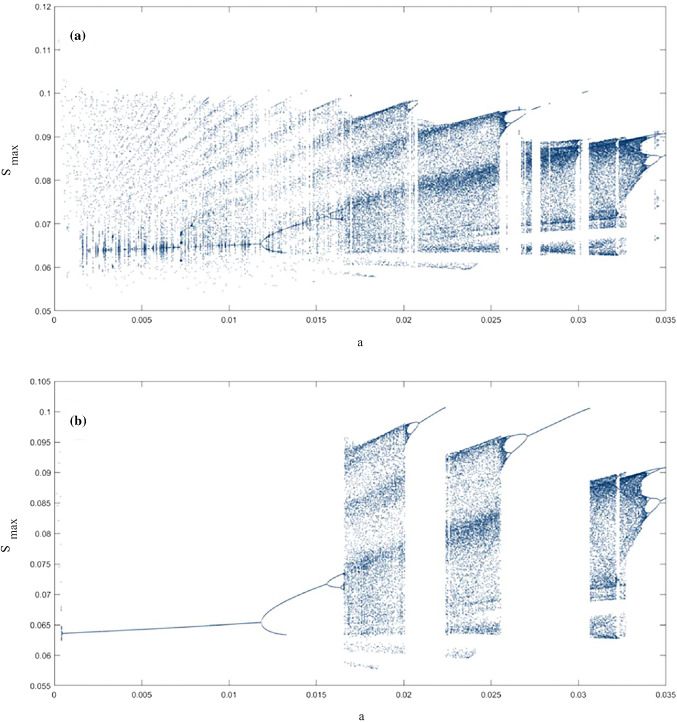
It is almost more than a year that earth has faced a severe worldwide problem called COVID-19. In December 2019, the origin of the epidemic was found in China. After that, this contagious virus was reported almost all over the world with different variants. Besides all the healthcare system attempts, quarantine, and vaccination, it is needed to study the dynamical behavior of this disease specifically. One of the practical tools that may help scientists analyze the dynamical behavior of epidemic disease is mathematical models. Accordingly, here, a novel mathematical system is introduced. Also, the complex behavior of this model is investigated considering different dynamical analyses. The results represent that some range of parameters may lead the model to chaotic behavior. Moreover, comparing the two same bifurcation diagrams with different initial conditions reveals that the model has multi-stability.
地球面临名为COVID-19的严重全球问题已近两年。2019年12月,该疫情起源于中国。此后,这种传染性病毒几乎在世界各地都有报道,并出现了不同变种。除了所有医疗系统的努力、隔离和疫苗接种外,还需要专门研究这种疾病的动态行为。数学模型是可能帮助科学家分析流行病动态行为的实用工具之一。因此,这里引入了一个新颖的数学系统。此外,考虑不同的动态分析来研究该模型的复杂行为。结果表明,一定范围的参数可能导致模型出现混沌行为。此外,比较具有不同初始条件的两个相同分岔图表明该模型具有多稳定性。