Lautenschlager Stephan
School of Geography, Earth and Environmental Sciences, University of Birmingham, Birmingham, UK.
R Soc Open Sci. 2021 Nov 17;8(11):211357. doi: 10.1098/rsos.211357. eCollection 2021 Nov.
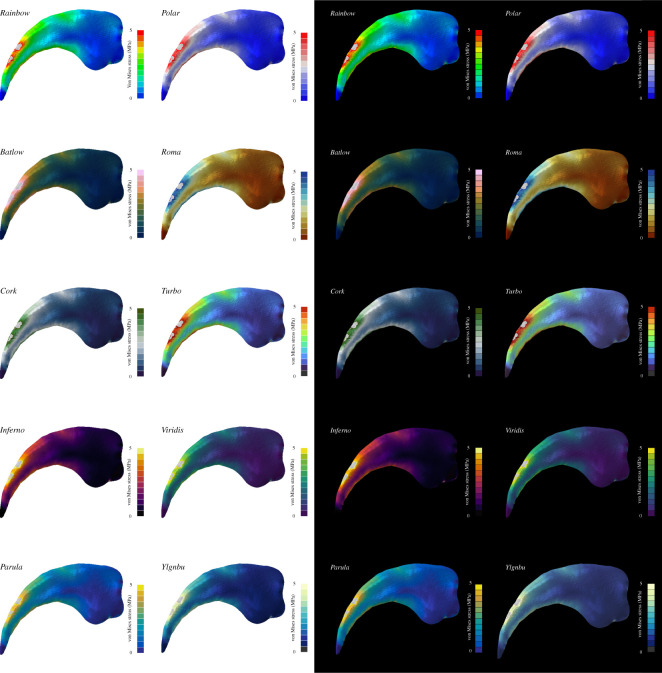
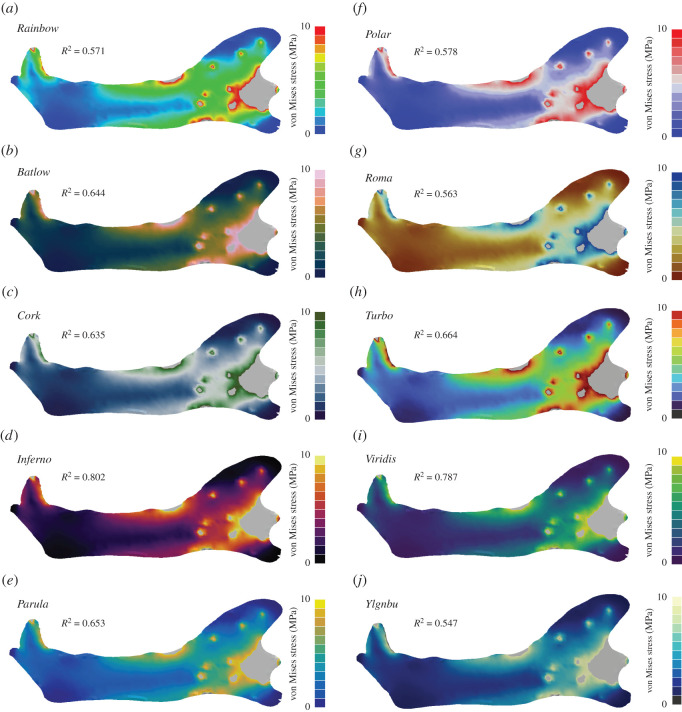
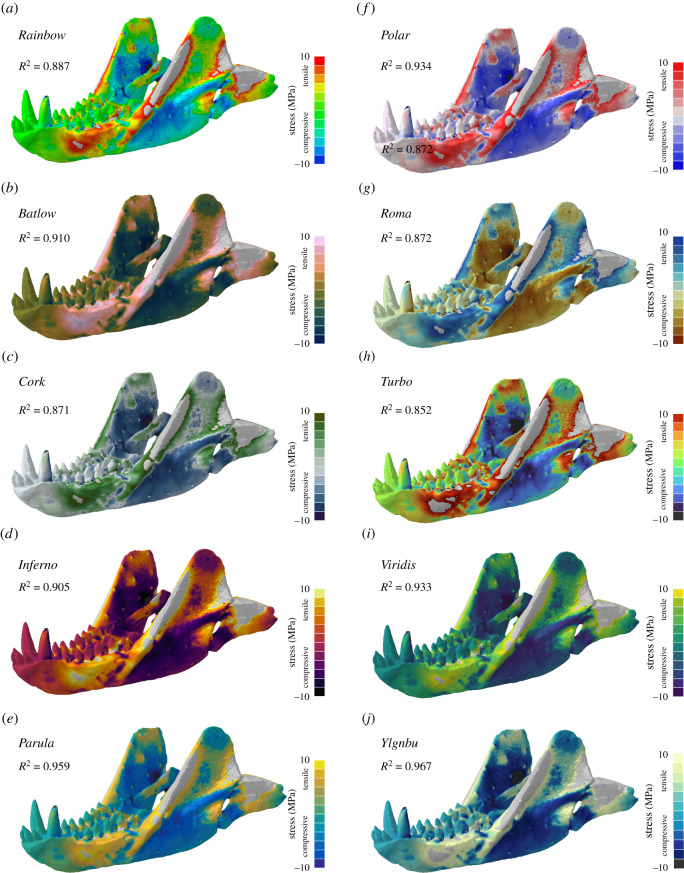
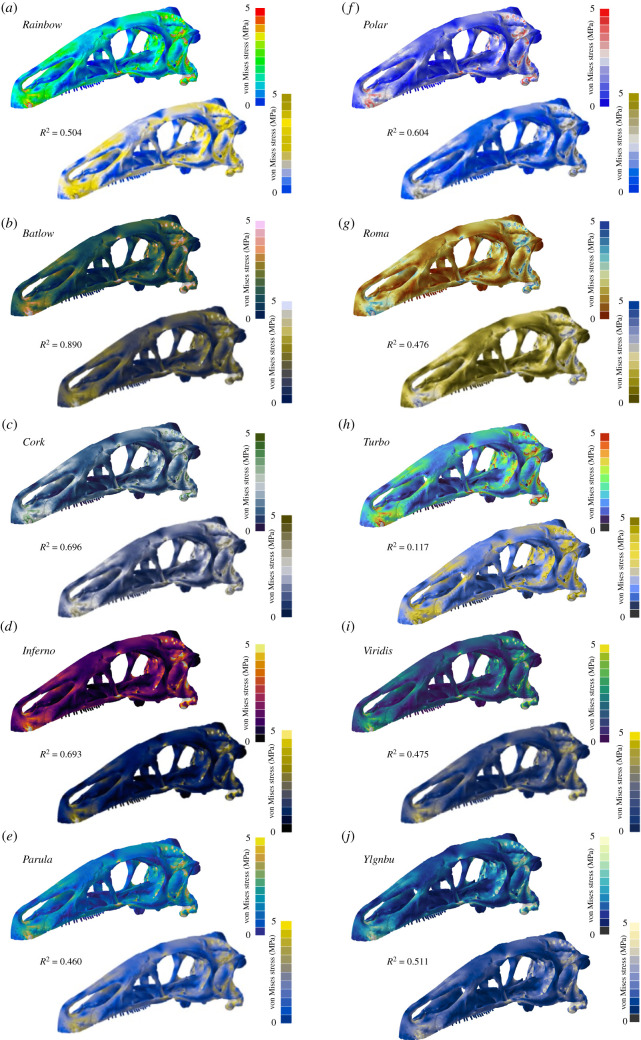
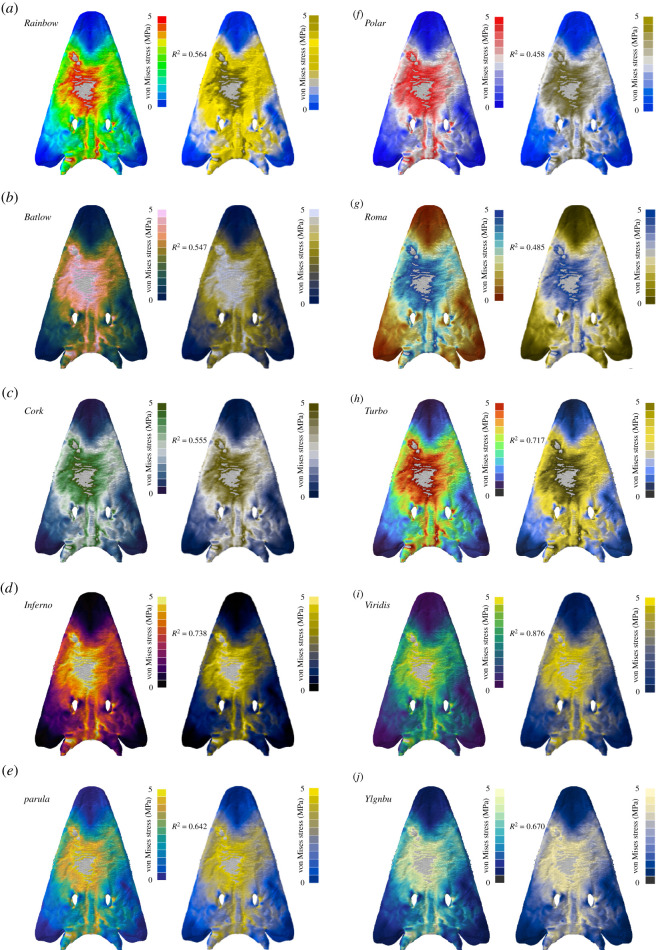
Accessibility is a key aspect for the presentation of research data. In palaeontology, new data is routinely obtained with computational techniques, such as finite-element analysis (FEA). FEA is used to calculate stress and deformation in objects when subjected to external forces. Results are displayed using contour plots in which colour information is used to convey the underlying biomechanical data. The colour map is nearly exclusively used for these contour plots in palaeontological studies. However, numerous studies in other disciplines have shown the map to be problematic due to uneven colour representation and its inaccessibility for those with colour vision deficiencies. Here, different colour maps were tested for their accuracy in representing values of FEA models. Differences in stress magnitudes (ΔS) and colour values (ΔE) of subsequent points from the FEA models were compared and their correlation was used as a measure of accuracy. The results confirm that the colour map is not well suited to represent the underlying stress distribution of FEA models with other colour maps showing a higher discriminative power. As the performance of the colour maps varied with tested scenarios/stress types, it is recommended to use different colour maps for specific purposes.
可访问性是研究数据呈现的一个关键方面。在古生物学中,新数据通常是通过计算技术获得的,比如有限元分析(FEA)。有限元分析用于计算物体在受到外力作用时的应力和变形。结果通过等高线图显示,其中颜色信息用于传达潜在的生物力学数据。在古生物学研究中,颜色映射几乎专门用于这些等高线图。然而,其他学科的大量研究表明,由于颜色表示不均匀以及对于有颜色视觉缺陷的人来说难以访问,这种映射存在问题。在这里,测试了不同的颜色映射在表示有限元分析模型值方面的准确性。比较了有限元分析模型中后续点的应力大小差异(ΔS)和颜色值差异(ΔE),并将它们的相关性用作准确性的度量。结果证实,这种颜色映射不太适合表示有限元分析模型的潜在应力分布,其他颜色映射显示出更高的辨别力。由于颜色映射的性能随测试场景/应力类型而变化,建议针对特定目的使用不同的颜色映射。