Luppi Andrea I, Mediano Pedro A M, Rosas Fernando E, Harrison David J, Carhart-Harris Robin L, Bor Daniel, Stamatakis Emmanuel A
Division of Anaesthesia, School of Clinical Medicine, University of Cambridge, Cambridge CB2 0QQ, UK.
Department of Psychology, University of Cambridge, Cambridge CB2 3EB, UK.
Neurosci Conscious. 2021 Nov 16;2021(2):niab027. doi: 10.1093/nc/niab027. eCollection 2021.
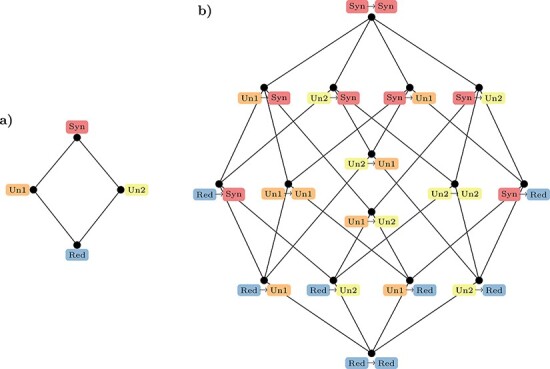
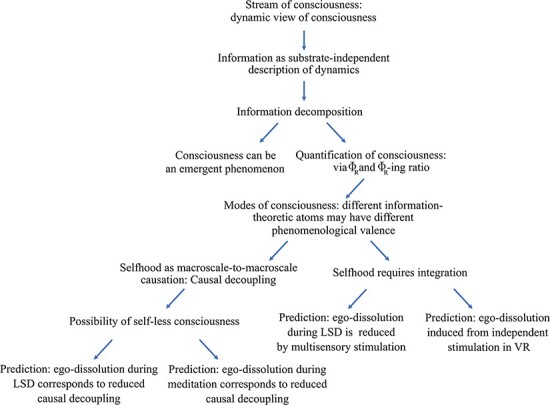
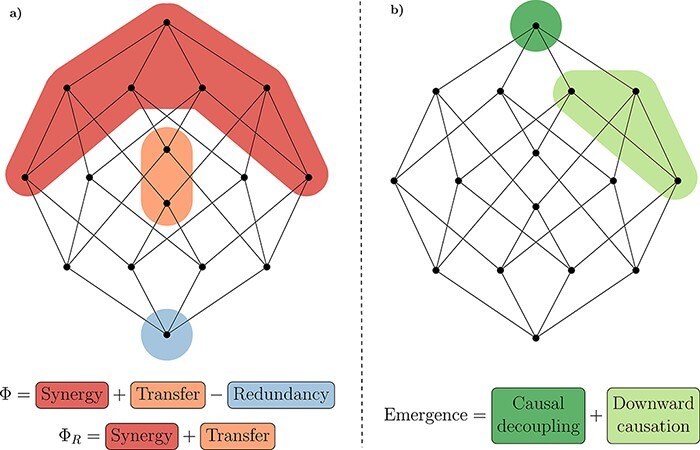
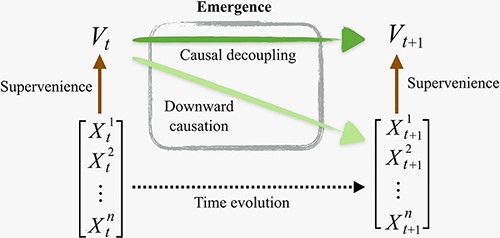
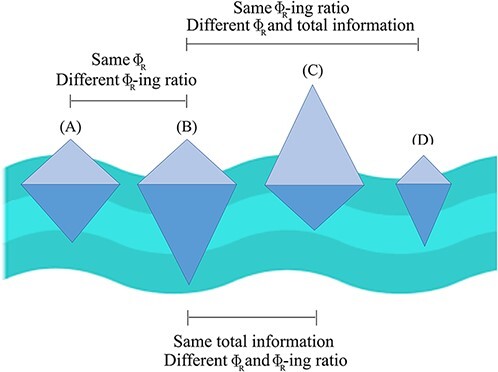
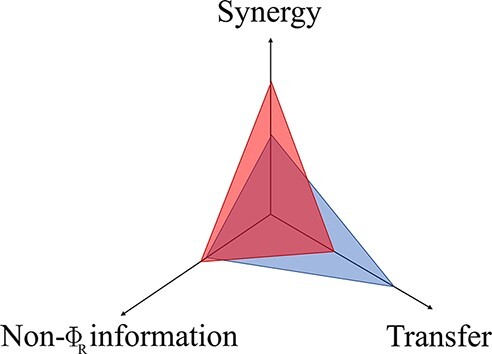
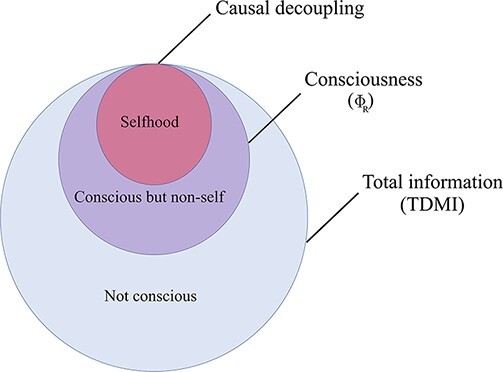
A central question in neuroscience concerns the relationship between consciousness and its physical substrate. Here, we argue that a richer characterization of consciousness can be obtained by viewing it as constituted of distinct information-theoretic elements. In other words, we propose a shift from quantification of consciousness-viewed as integrated information-to its decomposition. Through this approach, termed Integrated Information Decomposition (ΦID), we lay out a formal argument that whether the consciousness of a given system is an emergent phenomenon depends on its information-theoretic composition-providing a principled answer to the long-standing dispute on the relationship between consciousness and emergence. Furthermore, we show that two organisms may attain the same amount of integrated information, yet differ in their information-theoretic composition. Building on ΦID's revised understanding of integrated information, termed Φ, we also introduce the notion of Φ-ing ratio to quantify how efficiently an entity uses information for conscious processing. A combination of Φ and Φ-ing ratio may provide an important way to compare the neural basis of different aspects of consciousness. Decomposition of consciousness enables us to identify qualitatively different 'modes of consciousness', establishing a common space for mapping the phenomenology of different conscious states. We outline both theoretical and empirical avenues to carry out such mapping between phenomenology and information-theoretic modes, starting from a central feature of everyday consciousness: selfhood. Overall, ΦID yields rich new ways to explore the relationship between information, consciousness, and its emergence from neural dynamics.
神经科学中的一个核心问题涉及意识与其物理基础之间的关系。在此,我们认为,通过将意识视为由不同的信息理论元素构成,可以获得对意识更丰富的表征。换句话说,我们提议从将意识量化为整合信息转变为对其进行分解。通过这种被称为整合信息分解(ΦID)的方法,我们提出了一个形式论证,即给定系统的意识是否为一种涌现现象取决于其信息理论构成,从而为关于意识与涌现之间关系的长期争论提供了一个有原则的答案。此外,我们表明,两种生物体可能获得相同数量的整合信息,但它们的信息理论构成却有所不同。基于ΦID对整合信息(称为Φ)的修正理解,我们还引入了Φ比率的概念,以量化一个实体将信息用于意识处理的效率有多高。Φ与Φ比率的结合可能提供一种重要方式来比较意识不同方面的神经基础。意识的分解使我们能够识别出质上不同的“意识模式”,从而建立一个用于映射不同意识状态现象学的公共空间。我们概述了从日常意识的一个核心特征:自我性出发来进行现象学与信息理论模式之间这种映射的理论和实证途径。总体而言,ΦID产生了丰富的新方法来探索信息、意识及其从神经动力学中涌现之间的关系。