Mehravar Samira, Amir Ali Akbari Sedigheh, Nasiri Malihe, Mojab Faraz, Abbasi Hajar
Department of Midwifery & Reproductive Health, School of Nursing and Midwifery, Shahid Beheshti University of Medical Sciences, Tehran, Iran.
Midwifery and Reproductive Health Research Center, Department of Midwifery and Reproductive Health, School of Nursing and Midwifery, Shahid Beheshti University of Medical Sciences, Tehran, Iran.
Avicenna J Phytomed. 2021 Nov-Dec;11(6):576-588. doi: 10.22038/AJP.2021.18179.
Postpartum pain (PP pain) is a common problem after vaginal delivery. Some herbs are used to reduce PP pain. Due to the anti-inflammatory properties of (wheat) germ, this study was conducted to investigate the effect of wheat germ on PP pain.
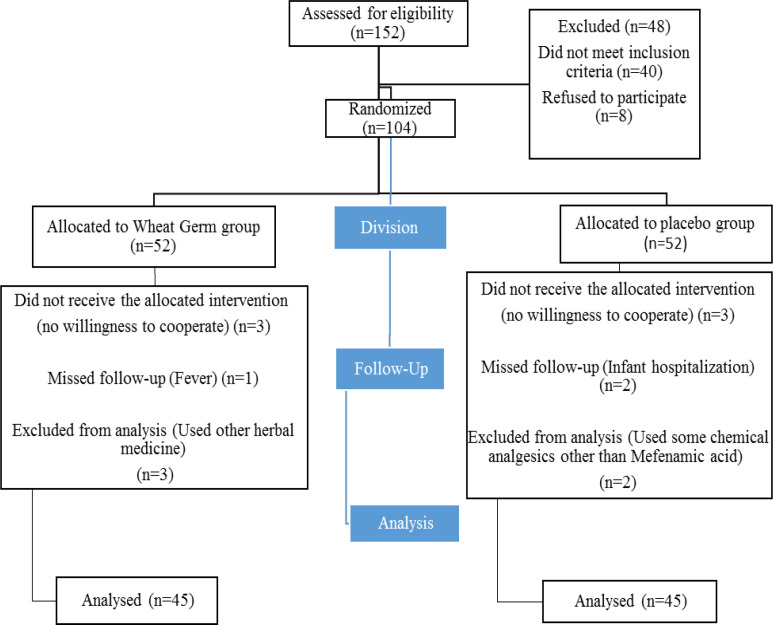
This is a randomized, double-blind, placebo-controlled clinical trial performed on 90 women who had a vaginal delivery and complained of moderate to severe PP pain. The participants were randomly divided into two groups. In the intervention group, a capsule containing 500 mg of wheat germ was taken every 6 hr for 2 days and in the control group, a placebo capsule was taken in the same order. The severity of PP pain was measured before and one hour after receiving the capsule by using the Visual Analogue Scale.
The two groups were not different in terms of pain severity before the intervention. The PP pain in women with moderate pain was significantly reduced in both groups, the reduction was greater in the wheat germ group (GEE=0.04) but this reduction was not significant. The PP pain in women with severe pain was significantly reduced in both groups, however, the reduction was significantly greater in the wheat germ group (GEE=0.63, p=0.007). Moreover, the results showed that the use of mefenamic acid in the wheat germ group was significantly lower than the control group (p=0.04). Moreover, no side effect was reported after consuming the wheat germ.
It seems that wheat germ reduces severe PP pain. Further research on this plant is recommended.
产后疼痛是阴道分娩后常见的问题。一些草药被用于减轻产后疼痛。由于(小麦)胚芽具有抗炎特性,本研究旨在探讨小麦胚芽对产后疼痛的影响。
这是一项随机、双盲、安慰剂对照的临床试验,对90名阴道分娩后抱怨有中度至重度产后疼痛的女性进行。参与者被随机分为两组。干预组每6小时服用一粒含500毫克小麦胚芽的胶囊,共服用2天,对照组按相同顺序服用安慰剂胶囊。使用视觉模拟量表在服用胶囊前和服用后1小时测量产后疼痛的严重程度。
干预前两组在疼痛严重程度方面无差异。中度疼痛女性的产后疼痛在两组中均显著减轻,小麦胚芽组的减轻程度更大(广义估计方程=0.04),但这种减轻不显著。重度疼痛女性的产后疼痛在两组中均显著减轻,然而,小麦胚芽组的减轻程度显著更大(广义估计方程=0.63,p=0.007)。此外,结果表明小麦胚芽组中甲芬那酸的使用量显著低于对照组(p=0.04)。而且,食用小麦胚芽后未报告有副作用。
小麦胚芽似乎能减轻严重的产后疼痛。建议对这种植物进行进一步研究。