Cui Xiaoying, Lin Lili, Sun Xiaoling, Wang Lin, Shen Rong
Department of Anesthesiology, The Cancer Hospital of the University of Chinese Academy of Sciences (Zhejiang Cancer Hospital), Institute of Basic Medicine and Cancer (IBMC), Chinese Academy of Sciences, Hangzhou 310022, China.
Department of Anesthesiology, Qingdao Eighth People's Hospital, Qingdao 266100, China.
Evid Based Complement Alternat Med. 2021 Nov 13;2021:8490772. doi: 10.1155/2021/8490772. eCollection 2021.
The aim of this study was to explore the pharmacological effects of curcumin on oxidative stress and inflammatory response of renal dysfunction induced by renal ischemia/reperfusion (RIRI).
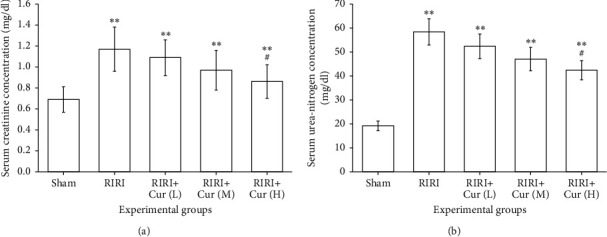
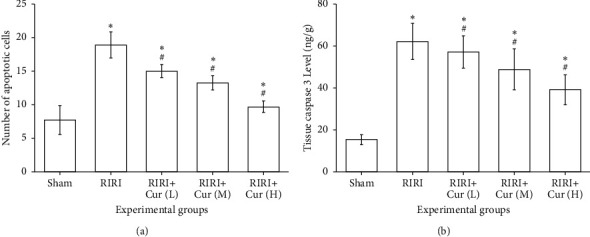
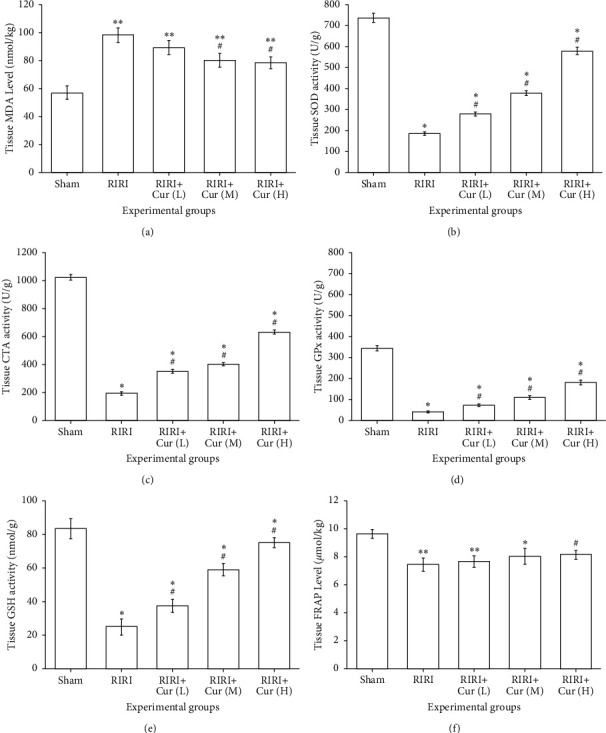
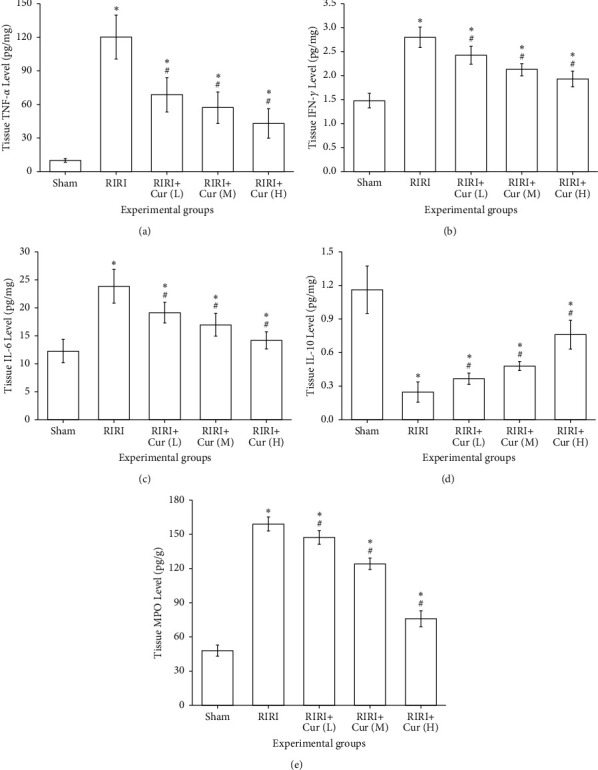
Fifty male SD rats (Sprague Dawley) were randomly divided into the sham group, RIRI group, and curcumin group (low, medium, and high). The RIRI model was established by clipping the left renal artery for 45 min and then reperfusion for 24 h and resection of the contralateral kidney. In the curcumin group, curcumin was intraperitoneally injected once a day for 3 consecutive days using different dosage regimens. The RIRI group was intraperitoneally administered with normal saline. Renal injury was evaluated by measuring the concentration of creatinine (Cr) and urea nitrogen (BUN) in serum. Oxidative stress was assessed by assessing the level of malondialdehyde (MDA), superoxide dismutase (SOD), catalase (CAT), glutathione peroxidase (GPx), glutathione (GSH), and iron reduction/antioxidant capacity (FRAP) in tissues. In addition, the protective effect of RIRI was investigated by measuring Paller scores, the level of serum inflammatory factors and caspase-3, and the number of apoptotic cells.
Ischemia/reperfusion resulted in increased levels of Cr and BUN in serum and MDA in tissues and decreased levels of SOD, CAT, GPx, GSH, and FRAP. Curcumin pretreatment strikingly increased the level of SOD, CAT, GPx, GSH, IL-10, IFN-, and FRAP and significantly decreased MDA, Cr, BUN, IL-8, TNF-, IL-6, and myeloperoxidase (MPO) expressions in tissues.
Curcumin can relieve the degree of renal injury and improve renal function in ischemia-reperfusion, which may be related to the fact that curcumin can increase SOD content in serum and reduce MDA and FRAP levels in the rat model.
本研究旨在探讨姜黄素对肾缺血/再灌注(RIRI)诱导的肾功能障碍的氧化应激和炎症反应的药理作用。
将50只雄性SD大鼠(Sprague Dawley)随机分为假手术组、RIRI组和姜黄素组(低、中、高剂量)。通过夹闭左肾动脉45分钟,然后再灌注24小时并切除对侧肾脏建立RIRI模型。在姜黄素组中,连续3天每天腹腔注射一次姜黄素,采用不同剂量方案。RIRI组腹腔注射生理盐水。通过测量血清中肌酐(Cr)和尿素氮(BUN)的浓度评估肾损伤。通过评估组织中丙二醛(MDA)、超氧化物歧化酶(SOD)、过氧化氢酶(CAT)、谷胱甘肽过氧化物酶(GPx)、谷胱甘肽(GSH)和铁还原/抗氧化能力(FRAP)的水平评估氧化应激。此外,通过测量Paller评分、血清炎症因子和半胱天冬酶-3的水平以及凋亡细胞数量来研究对RIRI的保护作用。
缺血/再灌注导致血清中Cr和BUN水平以及组织中MDA水平升高,SOD、CAT、GPx、GSH和FRAP水平降低。姜黄素预处理显著提高了SOD、CAT、GPx、GSH、IL-10、IFN-和FRAP的水平,并显著降低了组织中MDA、Cr、BUN、IL-8、TNF-、IL-6和髓过氧化物酶(MPO)的表达。
姜黄素可减轻缺血再灌注时的肾损伤程度并改善肾功能,这可能与姜黄素可增加大鼠模型血清中SOD含量并降低MDA和FRAP水平有关。