• 文献检索
  • 文档翻译
  • 深度研究
  • 学术资讯
  • Suppr Zotero 插件Zotero 插件
  • 邀请有礼
  • 套餐&价格
  • 历史记录
应用&插件
Suppr Zotero 插件Zotero 插件浏览器插件Mac 客户端Windows 客户端微信小程序
定价
高级版会员购买积分包购买API积分包
服务
文献检索文档翻译深度研究API 文档MCP 服务
关于我们
关于 Suppr公司介绍联系我们用户协议隐私条款
关注我们

Suppr 超能文献

核心技术专利:CN118964589B侵权必究
粤ICP备2023148730 号-1Suppr @ 2026

文献检索

告别复杂PubMed语法,用中文像聊天一样搜索,搜遍4000万医学文献。AI智能推荐,让科研检索更轻松。

立即免费搜索

文件翻译

保留排版,准确专业,支持PDF/Word/PPT等文件格式,支持 12+语言互译。

免费翻译文档

深度研究

AI帮你快速写综述,25分钟生成高质量综述,智能提取关键信息,辅助科研写作。

立即免费体验

使用智能传染病算法对COVID-19感染传播进行监测路由

Surveillance Routing of COVID-19 Infection Spread Using an Intelligent Infectious Diseases Algorithm.

作者信息

Guevara Cesar, Penas Matilde Santos

机构信息

Centre of Mechatronics and Interactive Systems (MIST)Universidad Tecnológica Indoamérica Quito 170301 Ecuador.

Institute of Knowledge Technology, Complutense University of Madrid 28040 Madrid Spain.

出版信息

IEEE Access. 2020 Nov 5;8:201925-201936. doi: 10.1109/ACCESS.2020.3036347. eCollection 2020.

DOI:10.1109/ACCESS.2020.3036347
PMID:34812367
原文链接:https://pmc.ncbi.nlm.nih.gov/articles/PMC8545257/
Abstract

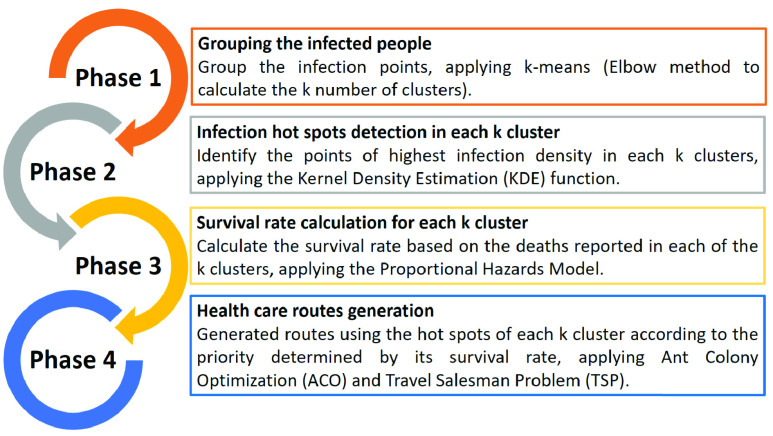
In this study, the Intelligent Infectious Diseases Algorithm (IIDA) has been developed to locate the sources of infection and survival rate of coronavirus disease 2019 (COVID-19), in order to propose health care routes for population affected by COVID-19. The main goal of this computational algorithm is to reduce the spread of the virus and decrease the number of infected people. To do so, health care routes are generated according to the priority of certain population groups. The algorithm was applied to New York state data. Based on infection rates and reported deaths, hot spots were determined by applying the kernel density estimation (KDE) to the groups that have been previously obtained using a clustering algorithm together with the elbow method. For each cluster, the survival rate -the key information to prioritize medical care- was determined using the proportional hazards model. Finally, ant colony optimization (ACO) and the traveling salesman problem (TSP) optimization algorithms were applied to identify the optimal route to the closest hospital. The results obtained efficiently covered the points with the highest concentration of COVID-19 cases. In this way, its spread can be prevented and health resources optimized.

摘要

在本研究中,开发了智能传染病算法(IIDA)来确定2019冠状病毒病(COVID-19)的感染源和存活率,以便为受COVID-19影响的人群提出医疗保健路线。这种计算算法的主要目标是减少病毒传播并减少感染人数。为此,根据特定人群组的优先级生成医疗保健路线。该算法应用于纽约州的数据。基于感染率和报告的死亡人数,通过对先前使用聚类算法和肘部方法获得的组应用核密度估计(KDE)来确定热点地区。对于每个聚类,使用比例风险模型确定存活率——这是确定医疗护理优先级的关键信息。最后,应用蚁群优化(ACO)和旅行商问题(TSP)优化算法来确定前往最近医院的最佳路线。获得的结果有效地覆盖了COVID-19病例浓度最高的点。通过这种方式,可以防止其传播并优化卫生资源。

https://cdn.ncbi.nlm.nih.gov/pmc/blobs/929d/8545257/06bc11103743/santo9-3036347.jpg
https://cdn.ncbi.nlm.nih.gov/pmc/blobs/929d/8545257/0f265fa36e9e/santo1-3036347.jpg
https://cdn.ncbi.nlm.nih.gov/pmc/blobs/929d/8545257/f26038ff57a1/santo2-3036347.jpg
https://cdn.ncbi.nlm.nih.gov/pmc/blobs/929d/8545257/bc949998fd96/santo3-3036347.jpg
https://cdn.ncbi.nlm.nih.gov/pmc/blobs/929d/8545257/92faac48d1fd/santo4-3036347.jpg
https://cdn.ncbi.nlm.nih.gov/pmc/blobs/929d/8545257/18723201c727/santo5-3036347.jpg
https://cdn.ncbi.nlm.nih.gov/pmc/blobs/929d/8545257/f6b1d8282eec/santo6-3036347.jpg
https://cdn.ncbi.nlm.nih.gov/pmc/blobs/929d/8545257/92e3780bfd08/santo7-3036347.jpg
https://cdn.ncbi.nlm.nih.gov/pmc/blobs/929d/8545257/834f0ad766a0/santo8-3036347.jpg
https://cdn.ncbi.nlm.nih.gov/pmc/blobs/929d/8545257/06bc11103743/santo9-3036347.jpg
https://cdn.ncbi.nlm.nih.gov/pmc/blobs/929d/8545257/0f265fa36e9e/santo1-3036347.jpg
https://cdn.ncbi.nlm.nih.gov/pmc/blobs/929d/8545257/f26038ff57a1/santo2-3036347.jpg
https://cdn.ncbi.nlm.nih.gov/pmc/blobs/929d/8545257/bc949998fd96/santo3-3036347.jpg
https://cdn.ncbi.nlm.nih.gov/pmc/blobs/929d/8545257/92faac48d1fd/santo4-3036347.jpg
https://cdn.ncbi.nlm.nih.gov/pmc/blobs/929d/8545257/18723201c727/santo5-3036347.jpg
https://cdn.ncbi.nlm.nih.gov/pmc/blobs/929d/8545257/f6b1d8282eec/santo6-3036347.jpg
https://cdn.ncbi.nlm.nih.gov/pmc/blobs/929d/8545257/92e3780bfd08/santo7-3036347.jpg
https://cdn.ncbi.nlm.nih.gov/pmc/blobs/929d/8545257/834f0ad766a0/santo8-3036347.jpg
https://cdn.ncbi.nlm.nih.gov/pmc/blobs/929d/8545257/06bc11103743/santo9-3036347.jpg

相似文献

1
Surveillance Routing of COVID-19 Infection Spread Using an Intelligent Infectious Diseases Algorithm.使用智能传染病算法对COVID-19感染传播进行监测路由
IEEE Access. 2020 Nov 5;8:201925-201936. doi: 10.1109/ACCESS.2020.3036347. eCollection 2020.
2
Hybrid Algorithm Based on Ant Colony Optimization and Simulated Annealing Applied to the Dynamic Traveling Salesman Problem.基于蚁群优化和模拟退火的混合算法应用于动态旅行商问题
Entropy (Basel). 2020 Aug 12;22(8):884. doi: 10.3390/e22080884.
3
Dynamic Flying Ant Colony Optimization (DFACO) for Solving the Traveling Salesman Problem.用于解决旅行商问题的动态飞蚁群优化算法
Sensors (Basel). 2019 Apr 17;19(8):1837. doi: 10.3390/s19081837.
4
Study on a hybrid algorithm combining enhanced ant colony optimization and double improved simulated annealing via clustering in the Traveling Salesman Problem (TSP).基于聚类的增强蚁群优化与双重改进模拟退火相结合的混合算法在旅行商问题(TSP)中的研究。
PeerJ Comput Sci. 2023 Oct 2;9:e1609. doi: 10.7717/peerj-cs.1609. eCollection 2023.
5
A solution quality assessment method for swarm intelligence optimization algorithms.一种用于群体智能优化算法的解质量评估方法。
ScientificWorldJournal. 2014;2014:183809. doi: 10.1155/2014/183809. Epub 2014 Jun 11.
6
Annealing Ant Colony Optimization with Mutation Operator for Solving TSP.退火蚁群优化算法与变异算子求解旅行商问题。
Comput Intell Neurosci. 2016;2016:8932896. doi: 10.1155/2016/8932896. Epub 2016 Nov 24.
7
Path Optimization of Medical Waste Transport Routes in the Emergent Public Health Event of COVID-19: A Hybrid Optimization Algorithm Based on the Immune-Ant Colony Algorithm.基于免疫蚁群算法的 COVID-19 突发公共卫生事件医疗废物运输路径优化
Int J Environ Res Public Health. 2020 Aug 12;17(16):5831. doi: 10.3390/ijerph17165831.
8
An Effective Hybrid Routing Algorithm in WSN: Ant Colony Optimization in combination with Hop Count Minimization.一种无线传感器网络中的高效混合路由算法:结合跳数最小化的蚁群优化算法。
Sensors (Basel). 2018 Mar 29;18(4):1020. doi: 10.3390/s18041020.
9
Assessment of Ship-Overtaking Situation Based on Swarm Intelligence Improved KDE.基于群智能改进 KDE 的船舶会遇态势评估
Comput Intell Neurosci. 2022 Jun 1;2022:7219661. doi: 10.1155/2022/7219661. eCollection 2022.
10
Information theory inspired optimization algorithm for efficient service orchestration in distributed systems.基于信息论的优化算法在分布式系统中高效的服务编排。
PLoS One. 2021 Jan 4;16(1):e0242285. doi: 10.1371/journal.pone.0242285. eCollection 2021.

引用本文的文献

1
Route Optimization for UVC Disinfection Robot Using Bio-Inspired Metaheuristic Techniques.基于生物启发式元启发式技术的UVC消毒机器人路径优化
Biomimetics (Basel). 2024 Dec 5;9(12):744. doi: 10.3390/biomimetics9120744.
2
COVID-19 spread algorithm in the international airport network-DetArpds.国际机场网络中新冠病毒传播算法——DetArpds
PeerJ Comput Sci. 2023 Feb 16;9:e1228. doi: 10.7717/peerj-cs.1228. eCollection 2023.
3
Optimization in the Context of COVID-19 Prediction and Control: A Literature Review.新冠疫情预测与防控背景下的优化:文献综述

本文引用的文献

1
Partial derivative Nonlinear Global Pandemic Machine Learning prediction of COVID 19.新冠疫情的偏导数非线性全局大流行机器学习预测
Chaos Solitons Fractals. 2020 Oct;139:110056. doi: 10.1016/j.chaos.2020.110056. Epub 2020 Jun 25.
2
Distance sampling for epidemiology: an interactive tool for estimating under-reporting of cases from clinic data.距离抽样法在流行病学中的应用:一种用于从临床数据中估计病例漏报的交互式工具。
Int J Health Geogr. 2020 Apr 20;19(1):16. doi: 10.1186/s12942-020-00209-1.
3
Spatial epidemic dynamics of the COVID-19 outbreak in China.
IEEE Access. 2021 Sep 17;9:130072-130093. doi: 10.1109/ACCESS.2021.3113812. eCollection 2021.
中国 COVID-19 疫情的空间流行动态。
Int J Infect Dis. 2020 May;94:96-102. doi: 10.1016/j.ijid.2020.03.076. Epub 2020 Apr 3.
4
Migration, hotspots, and dispersal of HIV infection in Rakai, Uganda.HIV 感染在乌干达拉凯的迁移、热点和扩散。
Nat Commun. 2020 Feb 20;11(1):976. doi: 10.1038/s41467-020-14636-y.
5
Middle East Respiratory Syndrome (MERS): Comparing the knowledge, attitude and practices of different health care workers.中东呼吸综合征(MERS):比较不同医护人员的知识、态度和实践。
J Infect Public Health. 2021 Jan;14(1):89-96. doi: 10.1016/j.jiph.2019.06.029. Epub 2019 Aug 17.
6
Spatiotemporal Variation and Hotspot Detection of the Avian Influenza A(H7N9) Virus in China, 2013⁻2017.2013-2017 年中国 H7N9 禽流感病毒的时空变异及热点检测
Int J Environ Res Public Health. 2019 Feb 22;16(4):648. doi: 10.3390/ijerph16040648.
7
Quantifying the spatial spread of dengue in a non-endemic Brazilian metropolis via transmission chain reconstruction.通过传播链重建量化非流行地区巴西大都市中的登革热空间传播。
Nat Commun. 2018 Jul 19;9(1):2837. doi: 10.1038/s41467-018-05230-4.
8
Prediction of infectious disease epidemics via weighted density ensembles.通过加权密度集合预测传染病疫情。
PLoS Comput Biol. 2018 Feb 20;14(2):e1005910. doi: 10.1371/journal.pcbi.1005910. eCollection 2018 Feb.
9
Multinational patterns of seasonal asymmetry in human movement influence infectious disease dynamics.跨国的人类活动季节性非对称性模式影响传染病动力学。
Nat Commun. 2017 Dec 12;8(1):2069. doi: 10.1038/s41467-017-02064-4.
10
When Viruses Don't Go Viral: The Importance of Host Phylogeographic Structure in the Spatial Spread of Arenaviruses.当病毒无法传播时:宿主系统发育地理结构在沙粒病毒空间传播中的重要性
PLoS Pathog. 2017 Jan 11;13(1):e1006073. doi: 10.1371/journal.ppat.1006073. eCollection 2017 Jan.