School of Biosciences and Veterinary Medicine, University of Camerino.
School of Pharmacy, University of Camerino.
Eur J Histochem. 2021 Nov 23;65(s1):3305. doi: 10.4081/ejh.2021.3305.
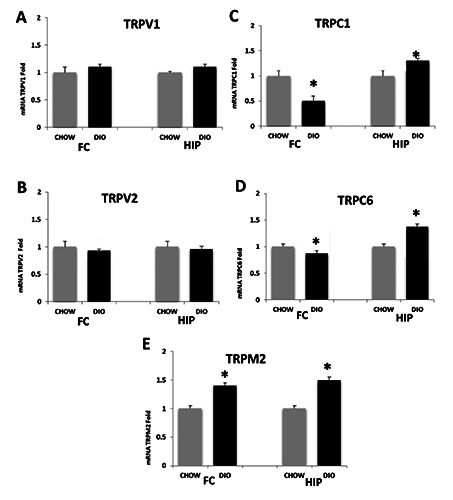
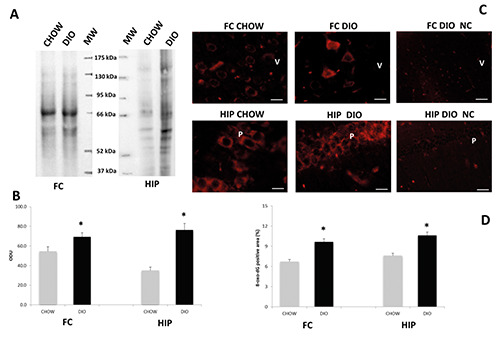
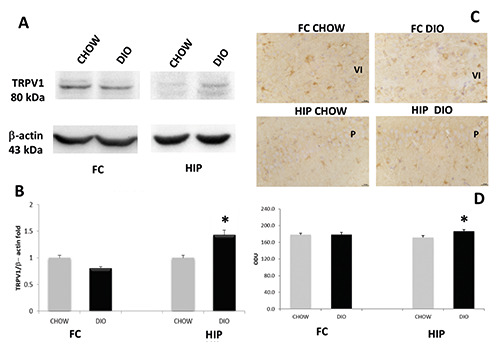
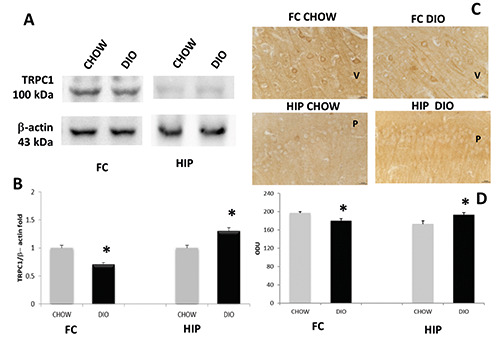
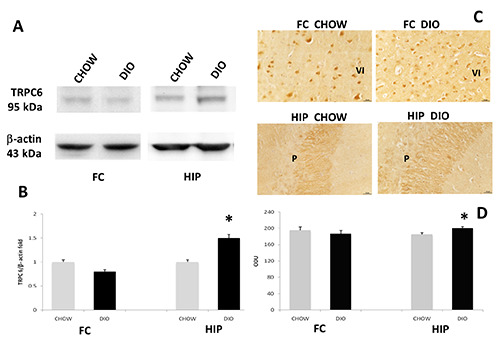
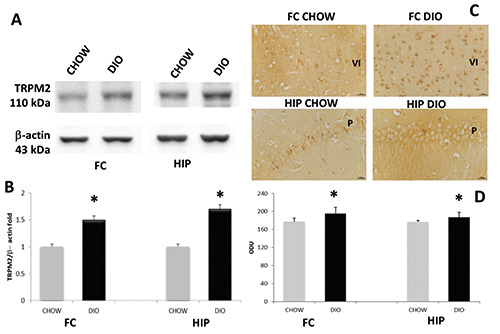
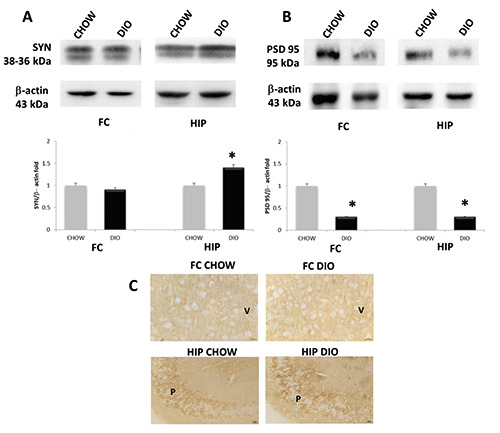
Evidence suggests that transient receptor potential (TRP) ion channels dysfunction significantly contributes to the physiopathology of metabolic and neurological disorders. Dysregulation in functions and expression in genes encoding the TRP channels cause several inherited diseases in humans (the so-called 'TRP channelopathies'), which affect the cardiovascular, renal, skeletal, and nervous systems. This study aimed to evaluate the expression of ion channels in the forebrain of rats with diet-induced obesity (DIO). DIO rats were studied after 17 weeks under a hypercaloric diet (high-fat diet, HFD) and were compared to the control rats with a standard diet (CHOW). To determine the systemic effects of HFD exposure, we examined food intake, fat mass content, fasting glycemia, insulin levels, cholesterol, and triglycerides. qRT-PCR, Western blot, and immunochemistry analysis were performed in the frontal cortex (FC) and hippocampus (HIP). After 17 weeks of HFD, DIO rats increased their body weight significantly compared to the CHOW rats. In DIO rats, TRPC1 and TRPC6 were upregulated in the HIP, while they were downregulated in the FC. In the case of TRPM2 expression, instead was increased both in the HIP and in the FC. These could be related to the increase of proteins and nucleic acid oxidation. TRPV1 and TRPV2 gene expression showed no differences both in the FC and HIP. In general, qRT-PCR analyses were confirmed by Western blot analysis. Immunohistochemical procedures highlighted the expression of the channels in the cell body of neurons and axons, particularly for the TRPC1 and TRPC6. The alterations of TRP channel expression could be related to the activation of glial cells or the neurodegenerative process presented in the brain of the DIO rat highlighted with post synaptic protein (PSD 95) alterations. The availability of suitable animal models may be useful for studying possible pharmacological treatments to counter obesity-induced brain injury. The identified changes in DIO rats may represent the first insight to characterize the neuronal alterations occurring in obesity. Further investigations are necessary to characterize the role of TRP channels in the regulation of synaptic plasticity and obesity-related cognitive decline.
有证据表明,瞬时受体电位 (TRP) 离子通道功能障碍对代谢和神经紊乱的病理生理学有重要贡献。编码 TRP 通道的基因功能和表达的失调导致人类几种遗传性疾病(所谓的“TRP 通道病”),这些疾病影响心血管、肾脏、骨骼和神经系统。本研究旨在评估饮食诱导肥胖 (DIO) 大鼠前脑的离子通道表达。DIO 大鼠在高热量饮食(高脂肪饮食,HFD)下研究 17 周后,并与标准饮食(CHOW)的对照大鼠进行比较。为了确定 HFD 暴露的全身影响,我们检查了食物摄入量、脂肪质量含量、空腹血糖、胰岛素水平、胆固醇和甘油三酯。在额皮质 (FC) 和海马 (HIP) 中进行了 qRT-PCR、Western blot 和免疫化学分析。在 HFD 17 周后,与 CHOW 大鼠相比,DIO 大鼠的体重显著增加。在 DIO 大鼠中,TRPC1 和 TRPC6 在 HIP 中上调,而在 FC 中下调。相反,TRPM2 的表达在 HIP 和 FC 中均增加。这可能与蛋白质和核酸氧化的增加有关。TRPV1 和 TRPV2 基因表达在 FC 和 HIP 中均无差异。一般来说,qRT-PCR 分析得到 Western blot 分析的证实。免疫组织化学程序突出了通道在神经元细胞体和轴突中的表达,特别是 TRPC1 和 TRPC6。TRP 通道表达的改变可能与胶质细胞的激活或 DIO 大鼠大脑中突出后蛋白 (PSD95) 改变所呈现的神经退行性过程有关。适当的动物模型的可用性可能有助于研究可能的药物治疗来对抗肥胖引起的脑损伤。DIO 大鼠中发现的变化可能代表了表征肥胖发生时神经元改变的第一见解。需要进一步研究以表征 TRP 通道在调节突触可塑性和肥胖相关认知能力下降中的作用。