Hu Guohong, Zhou Xiansheng
Dermatology Hospital of Jiangxi Province, Nanchang, 330001, Jiangxi, People's Republic of China.
Clin Cosmet Investig Dermatol. 2021 Nov 16;14:1675-1683. doi: 10.2147/CCID.S327825. eCollection 2021.
Gallic acid (GA) has an anti-inflammatory effect by regulating inflammatory molecules. This study aimed to investigate the effect of GA on atopic dermatitis (AD)-like skin inflammation.
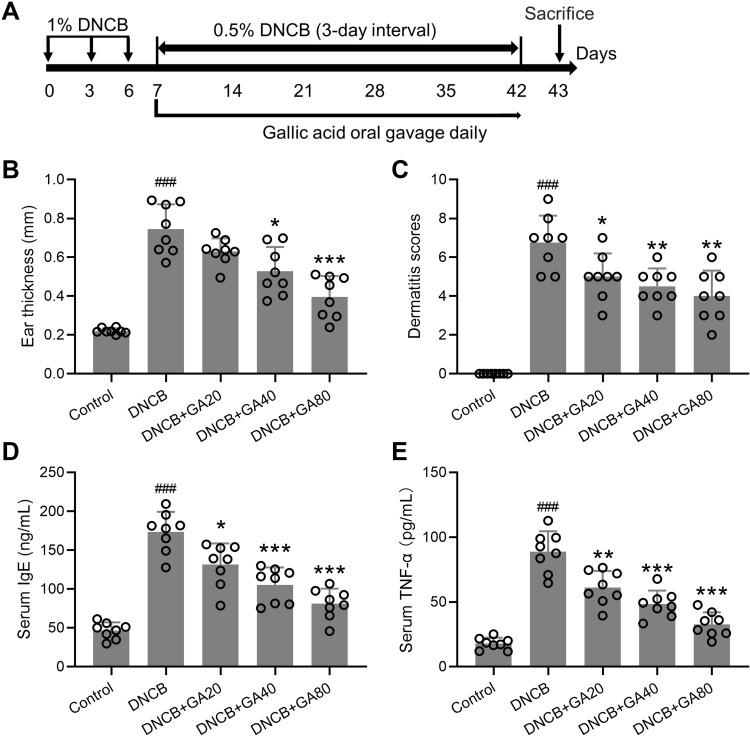
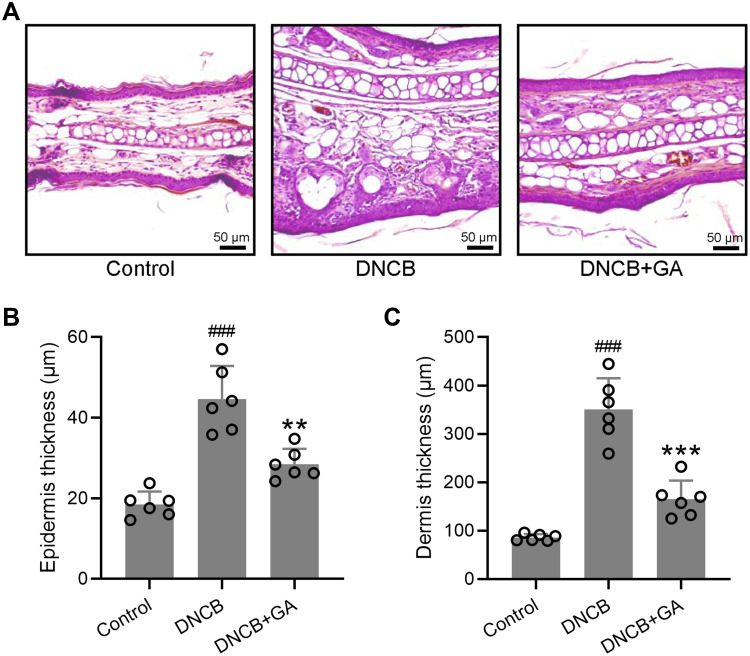
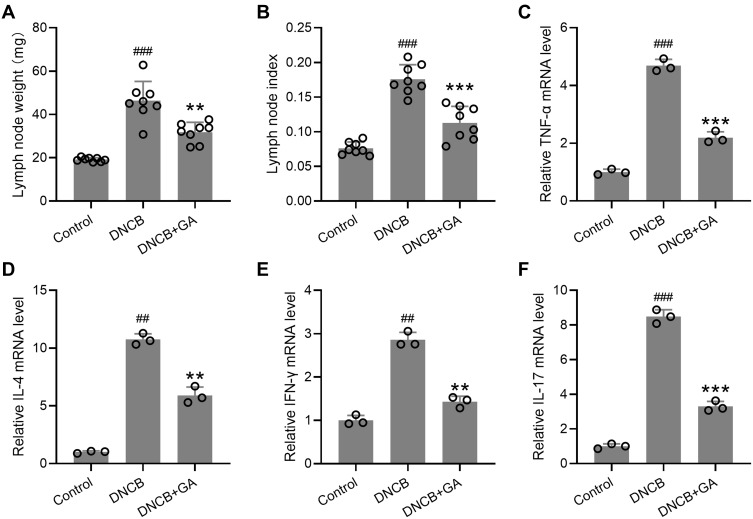
4-dinitrochlorobenzene (DNCB) was used to induce an AD-like skin inflammation model. The effect of GA on DNCB-induced inflammation was assessed by measuring the thickness and histopathological examination of the ear. Serum IgE and TNF-α levels were detected. The effect of GA on lymph nodes was determined by measuring the weights and mRNA/protein expression levels of TNF-α, IL-4, IFN-γ and IL-17. Ratio of Treg cells and Th17 cells was also analyzed.
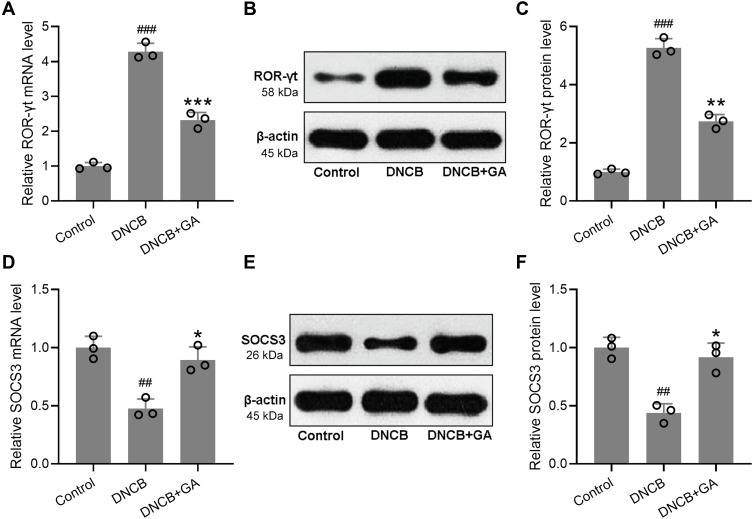
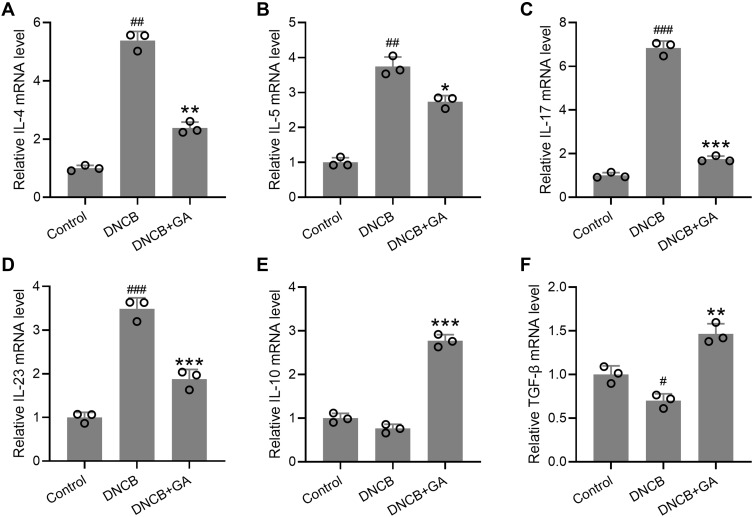
It was found that the thickness and pathology of the ear were significantly improved by GA in the DNCB-induced mice. Serum IgE and TNF-α levels were significantly reduced in GA-treated model mice compared to the model group. GA treatment lowered the weight of lymph node and the expression of mRNAs of TNF-α, IL-4, IFN-γ, and IL-17 of lymph node. In the ear, inflammatory factors (IL-4, IL-5, IL-17, or IL-23) showed a significant decrease in GA-treated model mice versus model mice, while the expression levels of IL-10 and TGF-β showed a great increase in GA-treated model mice. ROR-γt showed a decrease in GA-treated model group, along with an increase expression of SOCS3.
GA could ameliorate AD-like skin inflammation possibly through Th17 mediated immune regulation in a DNCB-induced mouse model.
没食子酸(GA)通过调节炎症分子发挥抗炎作用。本研究旨在探讨GA对特应性皮炎(AD)样皮肤炎症的影响。
采用4-二硝基氯苯(DNCB)诱导建立AD样皮肤炎症模型。通过测量耳部厚度和组织病理学检查评估GA对DNCB诱导炎症的影响。检测血清IgE和TNF-α水平。通过测量淋巴结重量以及TNF-α、IL-4、IFN-γ和IL-17的mRNA/蛋白表达水平来确定GA对淋巴结的影响。还分析了调节性T细胞(Treg细胞)和辅助性T细胞17(Th17细胞)的比例。
发现GA可显著改善DNCB诱导小鼠的耳部厚度和病理情况。与模型组相比,GA处理的模型小鼠血清IgE和TNF-α水平显著降低。GA处理降低了淋巴结重量以及淋巴结中TNF-α、IL-4、IFN-γ和IL-17的mRNA表达。在耳部,与模型小鼠相比,GA处理的模型小鼠炎症因子(IL-4、IL-5、IL-17或IL-23)显著减少,而IL-10和TGF-β的表达水平显著增加。GA处理的模型组维甲酸相关孤儿受体γt(ROR-γt)减少,同时细胞因子信号转导抑制因子3(SOCS3)表达增加。
在DNCB诱导的小鼠模型中,GA可能通过Th17介导的免疫调节改善AD样皮肤炎症。